
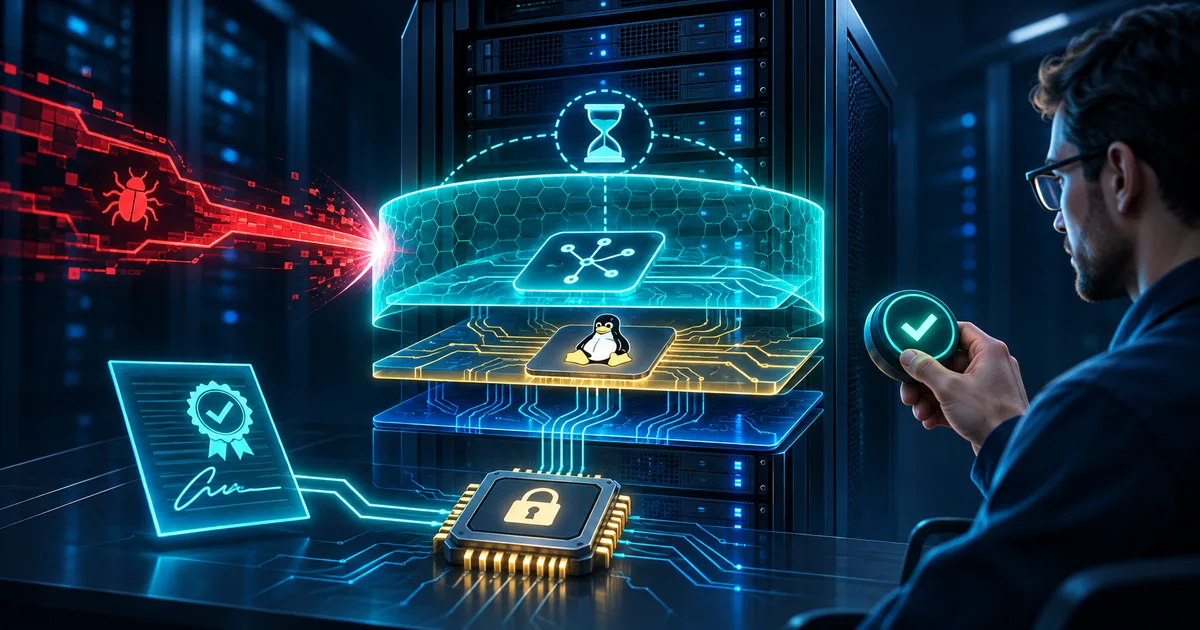
A guarded pilot for Cisco and OpenAI's new open-source Shirudo runtime shields, with signed artifacts, disposable Linux targets and verified rollback.
What changed on November 23
Cisco and OpenAI launched Shirudo as an open-source project on November 23. Cisco describes AI agents that find a vulnerability, build and test a temporary runtime shield, then make the shield available for human-controlled deployment. The project uses eBPF-based controls and cryptographically signed artifacts rather than changing the application itself.
The public repository labels Shirudo pre-release. Its README says production targets need Shirudo kernel patches, a signed-loader ABI and TPM 2.0. Development packages may appear as workflow artifacts and tagged releases publish packages on GitHub. That makes a disposable lab the appropriate starting point—not an emergency production rollout.

Understand the trust and operating boundary
Isovalent says the design uses a one-shot CLI rather than a permanent operator daemon. An operator builds shield packages, signs them and publishes them through an OCI registry. The target verifies the package and key path before loading the runtime control; the repository describes TPM-backed evidence for state changes.
Cisco reports tests against Java4Shell and a PHP flaw. Those are vendor-reported demonstrations, not DeepSecurity.io testing or proof that a shield will protect another workload. A shield buys investigation or maintenance time only when its target, signature, behavior and removal path are independently verified.
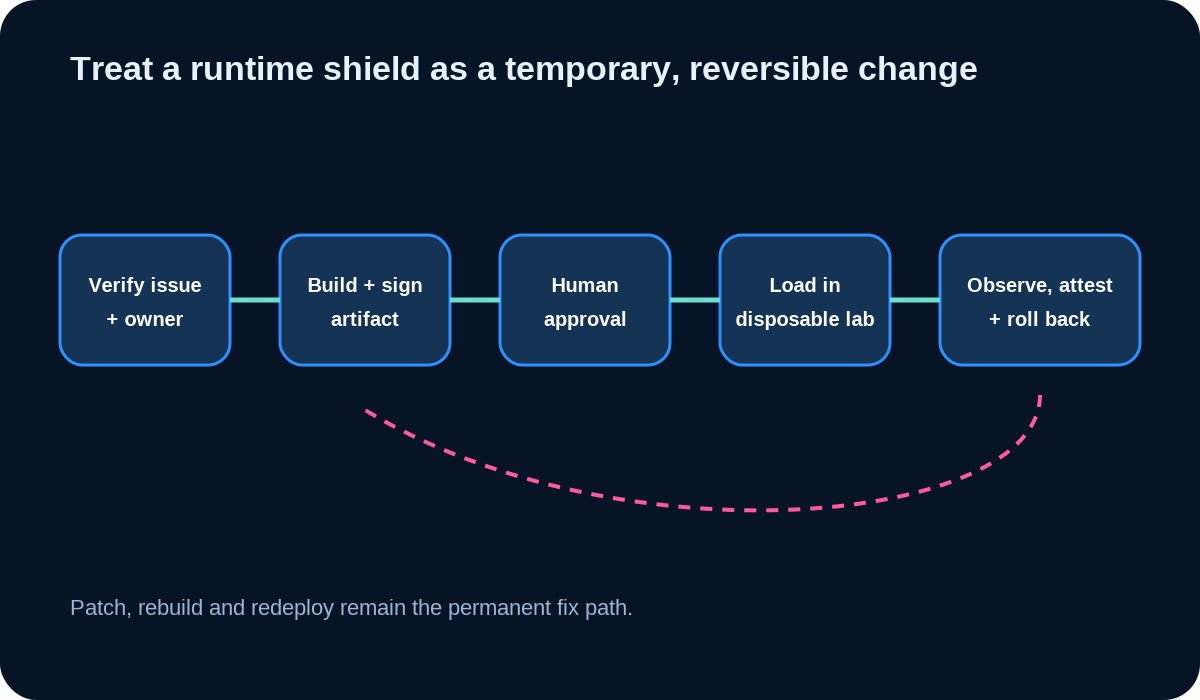
- Operator boundary: source review, build, signing key and registry publication.
- Target boundary: compatible kernel, trusted key enrollment, TPM and load evidence.
- Application boundary: one documented path to block and normal paths that must keep working.
- Change boundary: named approver, expiration, rollback and linked permanent patch.
Step 1: qualify one disposable target
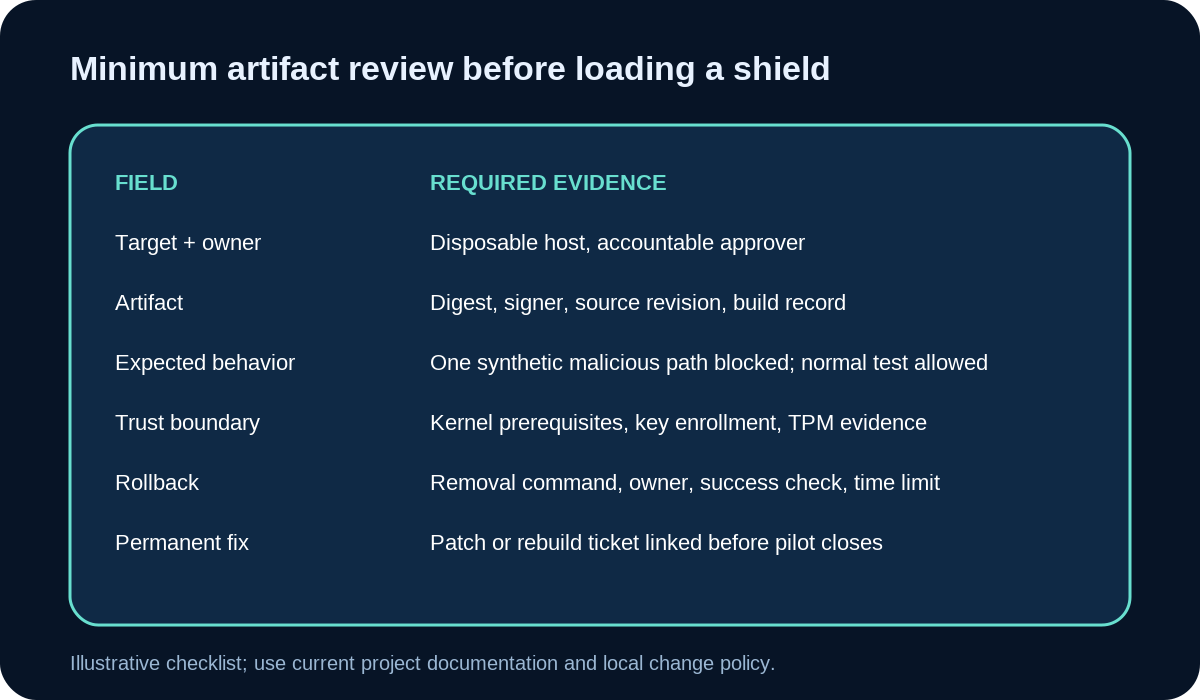
Choose a nonproduction Linux workload with an accountable owner, a synthetic test for the documented vulnerable path and a separate normal-traffic test. Confirm the current repository prerequisites directly: architecture, Shirudo kernel patches, signed-loader ABI, TPM 2.0, key enrollment, build tooling and registry access. Do not assume a standard production kernel qualifies.
Record the source revision, toolchain, package digest, signer, key custody, target image, expected block, expected allowed behavior, observation window and expiration. If any prerequisite or rollback step is unclear, stop before loading.
Step 2: run one controlled shield experiment
Build and sign the package in an isolated operator environment, inspect the artifact and have a second person approve it. Load it only on the disposable target. Run the safe synthetic negative test and a representative normal-traffic suite, then preserve loader output, signature verification, application health and TPM evidence.
Do not publish exploit payloads or turn the pilot into vulnerability research. The expected output is a change packet showing whether the documented test path was blocked, whether legitimate behavior survived and whether the evidence can be reopened.
Step 3: prove removal and close with the permanent fix
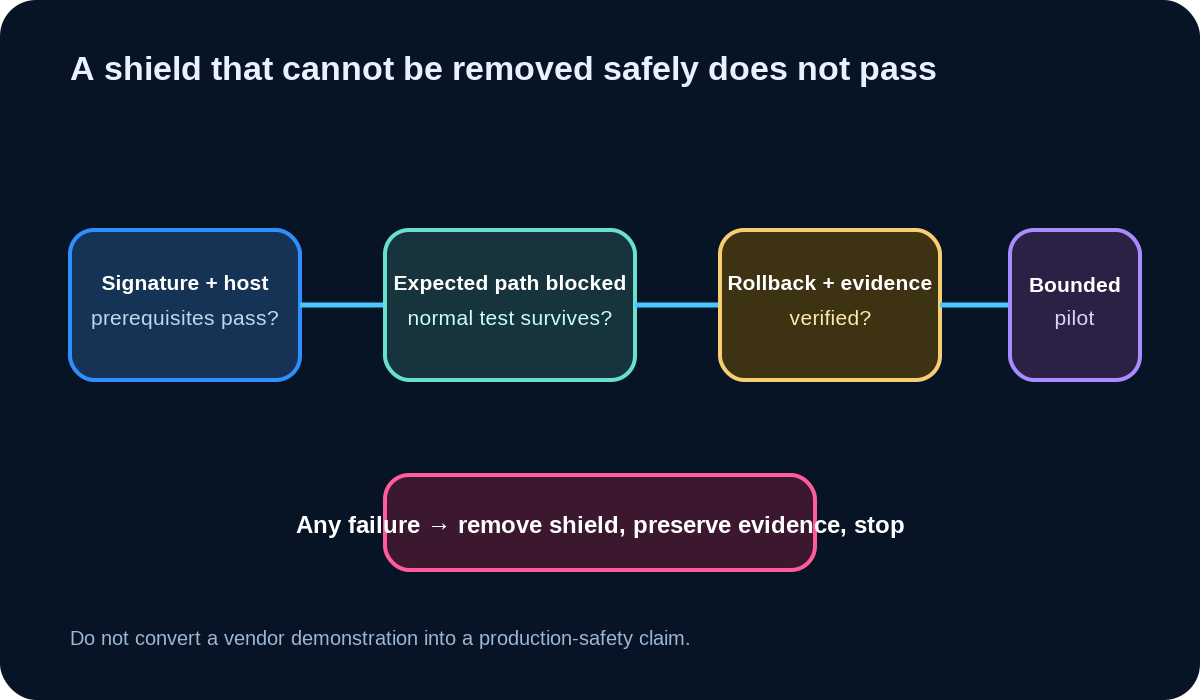
Remove the shield on schedule, confirm the runtime state, rerun the normal test and preserve the removal evidence. Rebuild or patch the application through the established maintenance process, then repeat the safe validation without the temporary shield.
Useful pilot measures are time to produce a reviewable artifact, signature and attestation success, normal-test regressions, rollback time, reviewer corrections and whether the permanent fix closed on schedule. A successful lab test supports only that defined workload and configuration.

Availability, limitations and topic-selection signal
Shirudo is available as a BSD-2-Clause open-source repository; BPF programs carry BSD/GPL terms and vendored files retain their own notices. The software itself has no listed license price, but compatible hosts, engineering time, build infrastructure, registry, signing and operations have real cost. The pre-release label, kernel requirements, TPM dependency and evolving architecture are material constraints.
Focused Firecrawl research on November 26 returned Cisco's November 23 announcement first, November 24 independent coverage prominently and Isovalent's technical launch article alongside the public repository. That establishes current attention and availability; it does not prove production readiness, adoption, benchmark performance, search volume or DeepSecurity.io rankings.
Put the insight into practice.
Deep Security helps organizations assess risk, validate controls, and build a practical plan to strengthen their defenses.
Talk with Deep Security