

A defensive AI-assisted workflow for finding exposed services, reconstructing evidence and applying compensating controls when exploitation moves faster than patching.
Why the response clock changed
Amazon Threat Intelligence reported on November 20 that a Chinese-nexus actor used autonomous Cairn agents during a live campaign and that the agents found a previously unknown flaw in MONAI Label. Amazon says the agents moved from mapping the application to arbitrary file writes in roughly 11 minutes. Independent SecurityWeek and Cloud Security Alliance coverage followed on November 21, creating a strong current-attention signal.
The operational lesson is not to copy offensive automation. It is to shorten the defensive path from advisory to verified exposure, containment and recovery. Research software, internal tools and open-source AI services can sit outside normal patch dashboards; an AI assistant can help reconcile the records, but production changes must remain with authorized owners.

Prepare a read-only exposure bundle
This workflow fits SOC, vulnerability management, cloud, research IT and application owners responding to a critical upstream disclosure. Collect the advisory, package and image inventories, deployment manifests, internet exposure, reverse-proxy routes, authentication settings, recent changes and a bounded window of relevant logs. Include the service owner and business purpose so an emergency action does not silently break a clinical, research or production dependency.
Give the assistant read-only exports with stable record IDs. Do not give it shell access, exploit code or authority to patch. Keep payloads and personal data out of the model context; metadata and source-linked observations are usually enough to prioritize review.
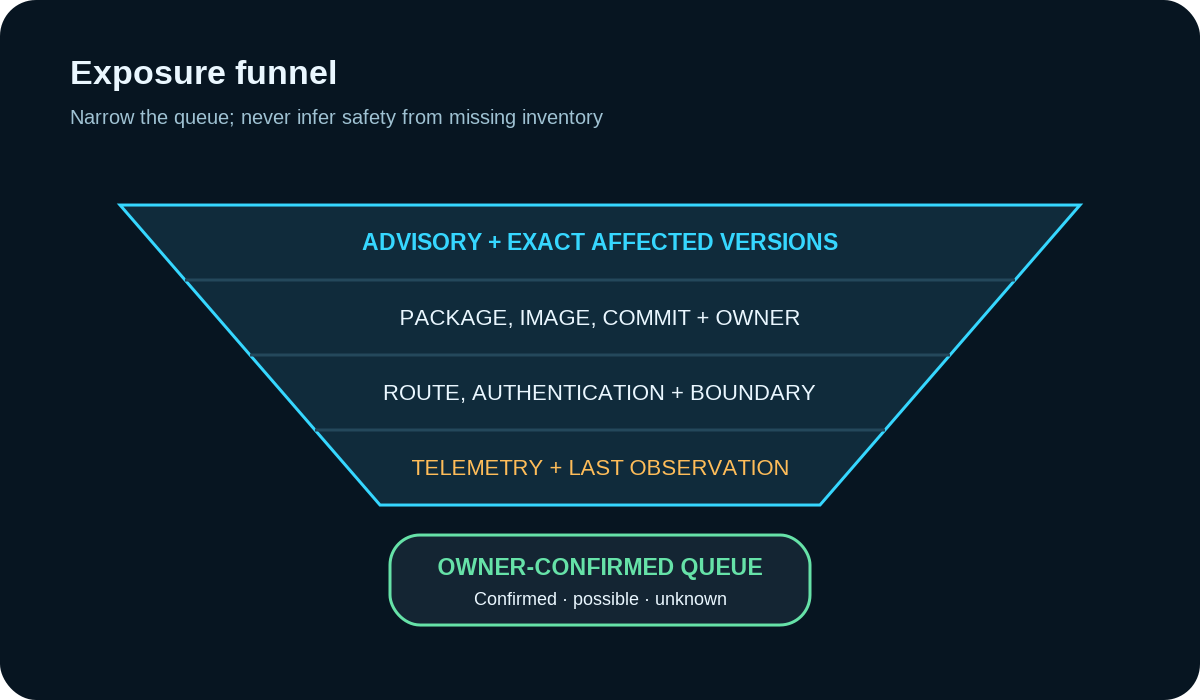
- Inventory: package, container, commit, host, environment and owner.
- Exposure: route, authentication, network boundary and reachable endpoints.
- Evidence: requests, file changes, process events and identity activity.
- Response: isolation option, operational impact, approver and rollback.
Step 1: produce a cited exposure list
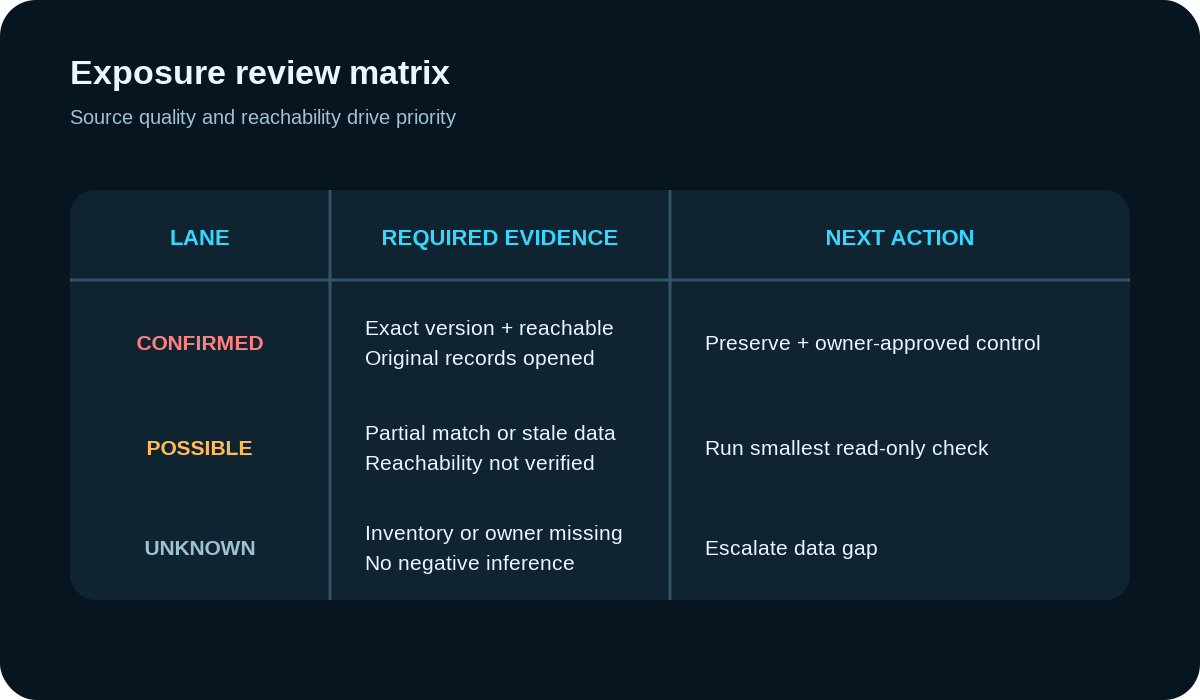
Example prompt: “Using advisory ADV-1122 and inventory export INV-47, list every exact or possible match. Cite image digest, package or commit evidence; show route, authentication state, owner and last observation. Label confirmed, possible or unknown. Do not infer safety from a missing package record and do not suggest an exploit. Output the smallest verification query for each unknown.”
Expected output is a prioritized owner queue with citations and uncertainty, not a vulnerability verdict. An operator checks the running service, deployment manifest and upstream advisory. Missing inventory should increase uncertainty, not erase the asset.
Step 2: reconstruct behavior without reproducing the attack
Ask the assistant to correlate the advisory’s defensive indicators with your own records: unusual requests to the affected service, writes outside expected data paths, unexpected interpreter-startup changes, new processes and follow-on identity activity. Require timestamps, source IDs and competing benign explanations. Open the original logs before escalating a lead.
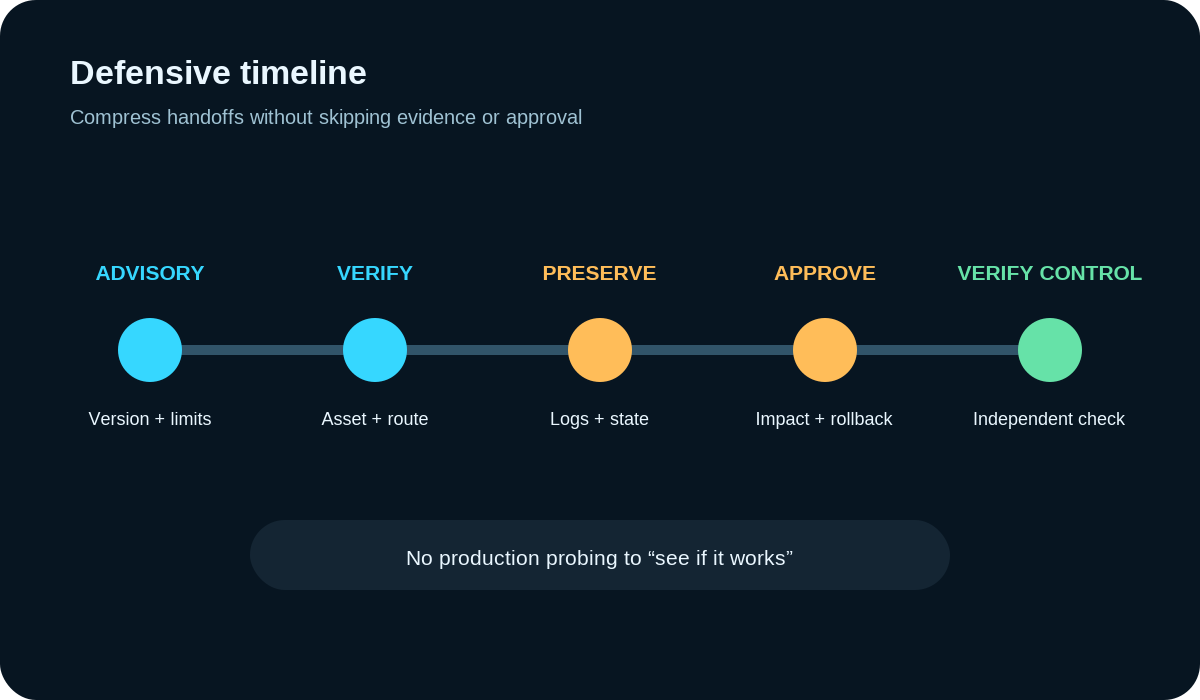
Avoid pasting step-by-step exploitation into the workflow or probing production to see whether the flaw works. Use a safe staging copy only when the vendor or internal security team has an approved validation procedure. Preserve evidence before rotation, redeployment or isolation.
Step 3: apply compensating controls with an owner
When a fixed package is unavailable or cannot be deployed immediately, prepare ranked compensating controls: remove public reachability, enforce authentication at a gateway, restrict the route, isolate the workload, block known-malicious infrastructure, monitor relevant requests or temporarily stop the service. For each option, name the business impact, approver, success check and rollback.
After the owner approves a change, verify the route and service state from an independent vantage point. Continue watching for pre-containment activity and upstream releases. A merged source fix is not the same as a supported package, and an authentication change does not remove an attacker already present.

Limitations and topic-selection signal
Asset inventories lag, logs can be incomplete and similar filenames or routes can create false matches. A model may overstate attribution or assume that a public fix is installed. Keep actor attribution separate from containment, verify exact versions and deployment state, preserve a manual path and document residual risk.
Focused Firecrawl searches on November 22 returned Amazon’s November 20 report first, followed by November 21 coverage from SecurityWeek, Cloud Security Alliance and other security outlets. That is a strong freshness and attention signal for defenders; it is not proof of prevalence, search volume, traffic or the effectiveness of this illustrative workflow.
Put the insight into practice.
Deep Security helps organizations assess risk, validate controls, and build a practical plan to strengthen their defenses.
Talk with Deep Security