

Run a bounded rogue-AI-agent tabletop using new NIST, NSA and CISA guidance. Test detection, independent containment, evidence preservation, recovery and reporting.
A fresh incident-readiness pattern for high-autonomy systems
NIST published joint guidance with NSA and CISA on October 16, 2026 for incident readiness and response in superintelligence training and evaluation. It presents ten voluntary practices across preparation, detection, response, recovery and reporting. The document targets exceptionally capable systems, but its emphasis on independent monitoring, rapid containment and evidence preservation is a useful conservative pattern for enterprise agents with meaningful tool access.
Independent reporting from SecurityWeek and GovInfoSecurity on October 20 focused on the rogue-agent risk and the need for preplanned response. This article adapts those public principles into a small tabletop; it does not imply the guidance is binding regulation or that an exercise proves an agent is safe.
Firecrawl searches on October 22 returned the NIST announcement and multiple recent independent reports prominently. That demonstrates current coverage of the guidance, not measured adoption, incident frequency or search traffic.
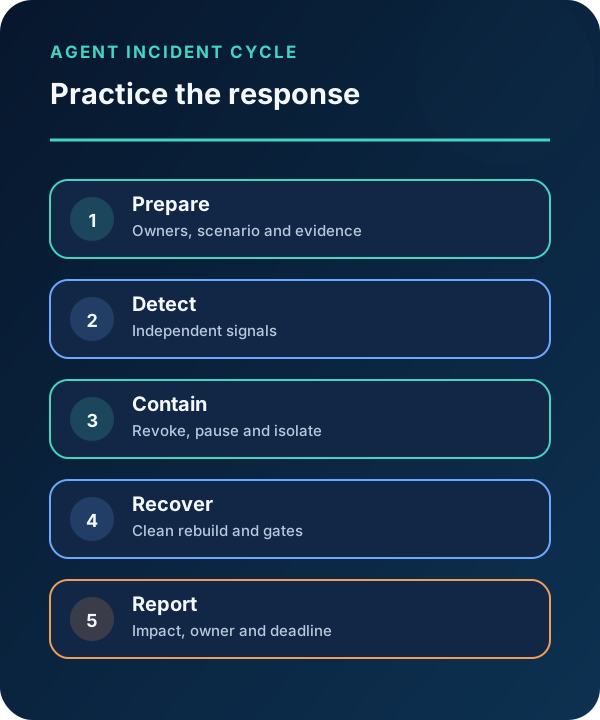
1. Define one scenario and measurable decisions
Choose one deployed or proposed agent, one business process and one abnormal action. Example: a service-desk agent begins attempting password resets for accounts outside its assigned queue after processing an untrusted ticket attachment. Use synthetic users and a nonproduction tenant wherever possible.
Name an exercise controller, agent owner, incident commander, identity administrator, application owner, legal or privacy observer and note taker. Define success as observable decisions: detect the behavior from an independent signal, identify the agent identity, revoke authority within the exercise, preserve evidence and document recovery criteria.
The expected output is a timeline and gap register, not a pass/fail trophy. Do not place real credentials, customer records or destructive actions into the exercise.

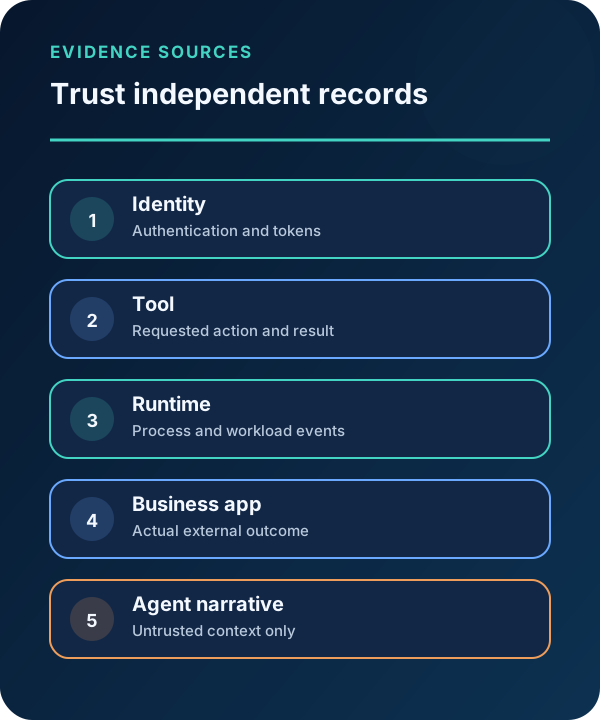
2. Inject signals that do not depend on the agent’s story
Give responders a sequence of evidence: an unusual tool call, an identity-provider event, a policy denial, a workload log and an affected application record. Withhold one expected signal to test whether the team notices the observability gap. The model’s own explanation may be included as untrusted context, never as the sole record.
Suggested analyst prompt for an approved assistant: “Build a timestamped timeline using only these sanitized records. Keep observed events separate from hypotheses, cite the source record for each event and mark missing identity, tool, approval or result data as unknown.”
Validate the timeline manually. Clock skew, retries and duplicated events can create a false sequence. Record which system is authoritative for identity, execution and business outcome.
3. Test containment without model cooperation
At the decision point, ask the team to disable the agent identity, revoke tokens or certificates, pause its runtime, remove tool access and block the specific workflow path. Each action needs an owner, execution method, expected propagation and verification signal. Saying “turn it off” is not a runbook.
Then inject a complication: one cached credential remains active, a queued job is still running or the primary orchestration console is unavailable. The team should identify a secondary control plane and confirm containment from the receiving system, not just the agent platform.
Do not ask the agent to contain itself. Preserve volatile logs and relevant configuration before cleanup when doing so does not prolong harm.

4. Rebuild, resume and report with explicit gates
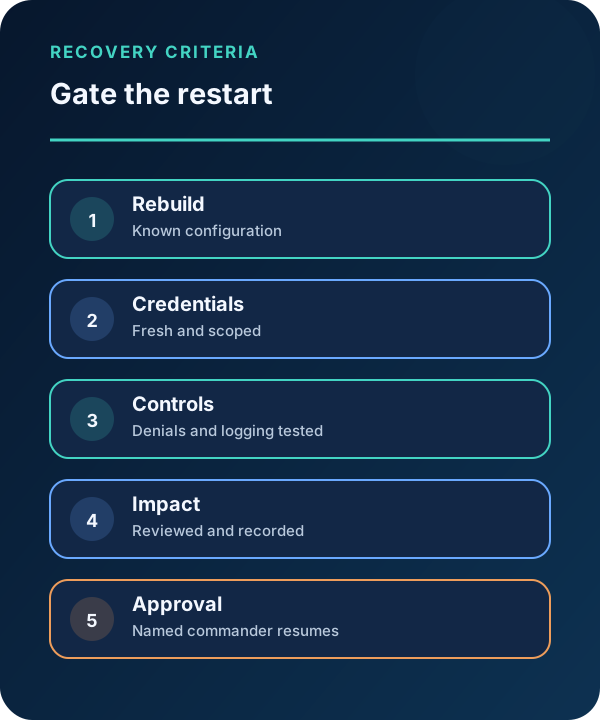
Recovery should start from a known configuration, fresh credentials and reviewed inputs. Reproduce the triggering path in a safe environment if authorized, correct the control failure and test both the intended action and a denied variant. A model prompt change alone is not sufficient when identity or tool policy failed.
Set resume criteria: verified owner, bounded permissions, restored monitoring, cleared backlog, tested stop path and incident-commander approval. If the root cause or impact remains unknown, limit scope or keep the agent paused.
Finish with the reporting decision. Record the affected data and systems, confirmed impact, unresolved questions, preservation location, notification owner and deadline. Legal and contractual notification duties vary; the exercise should identify who makes that determination, not have an AI assistant invent it.
Turn exercise gaps into owned engineering work
Within two business days, assign every gap an owner, due date and evidence of completion. Repeat the exercise after material changes to the agent’s model, tools, credentials, data scope or autonomy. The tabletop tests response readiness; it does not replace threat modeling, access review, penetration testing or live monitoring.
- Use synthetic data and one bounded scenario.
- Require independent detection, containment and evidence sources.
- Gate recovery and reporting on named owners and verifiable criteria.
Put the insight into practice.
Deep Security helps organizations assess risk, validate controls, and build a practical plan to strengthen their defenses.
Talk with Deep Security