

Run an evidence-based AI agent access review before production. Map identity, owner, tools, data, write authority, approval gates, logging and shutdown controls.
Why an AI agent needs an insider-style review
A useful agent may read contracts, open tickets, modify cloud resources or send messages. Those permissions make the workflow productive, but they also create a nonhuman actor that can make a mistake, be manipulated by untrusted input or continue operating after the original context changes.
On October 19, 2026, Microsoft described an expansion of Project Perception and Microsoft 365 E7 around agent risk. Its central design principle is that access and containment controls should sit outside the model. Independent coverage from GeekWire reported that the announced capabilities were in private preview, with broader availability planned for Microsoft Ignite. This article therefore does not tell readers to rely on an unavailable control; it turns the public security principles into a vendor-neutral review that can be performed now.
Focused Firecrawl searches on October 21 returned the Microsoft announcement first and several same-day independent reports. That is a current-attention signal, not proof of search volume, product effectiveness or DeepSecurity.io ranking.
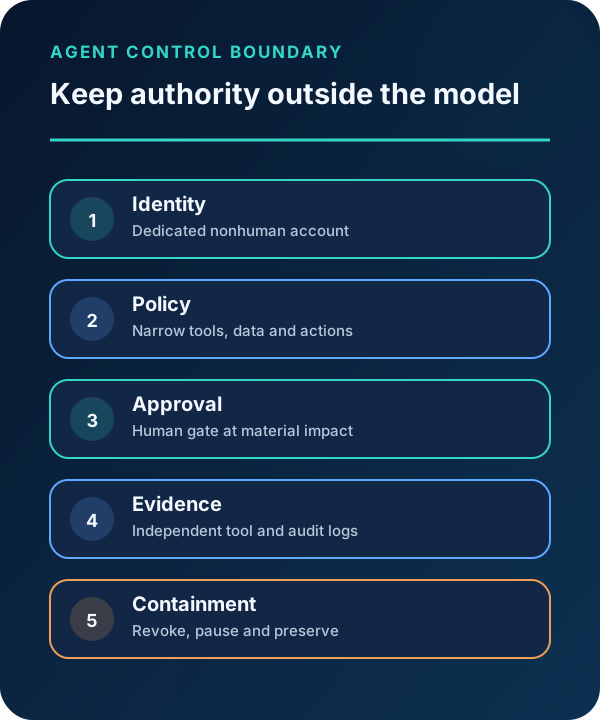
1. Build one accountable agent record
Start with one production candidate, not every assistant in the company. Record the agent name, business purpose, environment, human owner, technical owner, model or service, runtime, credentials, connected tools and data stores. Include who approves new capabilities and who receives an alert when the agent behaves unexpectedly.
Use a separate nonhuman identity wherever the platform supports it. A shared employee token hides which actor performed an operation and can keep working after the employee changes roles. If a dedicated identity is not possible, record the limitation and reduce the agent to read-only access while an alternative is designed.
The expected output is a short register entry another administrator can verify from identity, application and cloud consoles. Do not ask an AI assistant to invent missing owners, permissions or connection details.

2. Convert broad access into an authority map
For every tool, list the exact operation, target and maximum impact. Separate read, propose, create, modify, delete and external-communication authority. A ticket-summary agent may need to read approved queues and draft a response, but it may not need to close a case or email a customer.
Suggested review prompt for an approved assistant: ‘Using only this exported permission list and tool catalog, build a table of identity, operation, target, business reason, approval requirement, logging source and revocation method. Mark missing evidence as unknown. Do not infer effective access or recommend adding permissions.’
Validate the output against the actual system. Group membership, inherited roles and tool-side credentials can create access that does not appear in a project description. The assistant organizes supplied evidence; the identity platform and application configuration establish effective authority.
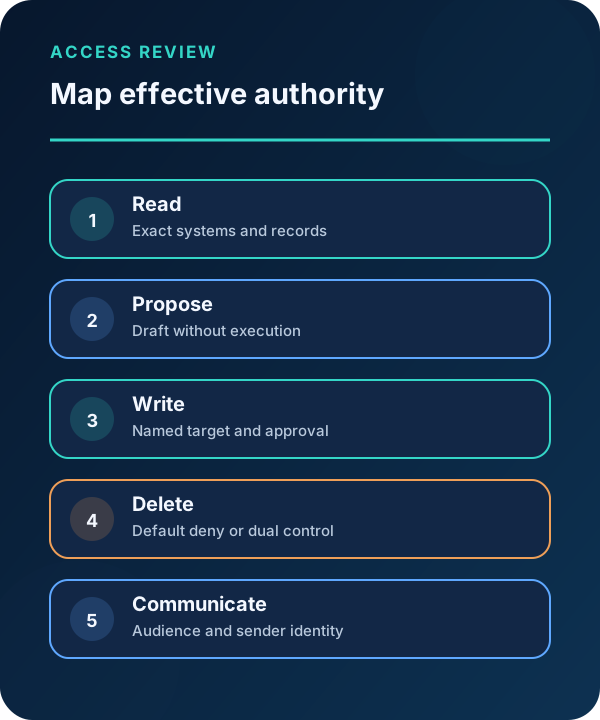
3. Place human approval at the impact boundary
Define actions the agent can complete alone and actions that require a named reviewer. High-impact examples include changing access, deleting data, deploying code, moving money, contacting a customer or containing a production host. The approval request should show the proposed action, target, reason, source evidence and expected effect.
Keep approval separate from the conversation that generated the action. A model should not approve its own proposal or reinterpret silence as permission. Expire stale approvals and require the requester to re-evaluate if inputs, scope or time have changed.
For a pilot, give the agent a safe read path and a simulated or nonproduction write target. Measure unsupported actions, missing context and reviewer corrections rather than claiming time savings before a real comparison exists.

4. Make behavior observable and stoppable
Retain the agent identity, human requester, tool call, target, decision, approval, result and correlation identifier in the systems that actually execute the work. Preserve rejected and failed attempts as well as successful ones. A fluent summary is not a substitute for the underlying audit records.
Define a stop path that responders can perform without asking the agent to cooperate: disable its identity, revoke credentials, remove tool access, pause the runtime and preserve evidence. Test that path in a nonproduction environment and record what remains active after each step.
Alert on material drift such as a new tool, broader data scope, unusual volume, repeated denied requests or a change from reading to writing. A risk score can help prioritize review, but it should not erase the events and policy conditions behind the score.
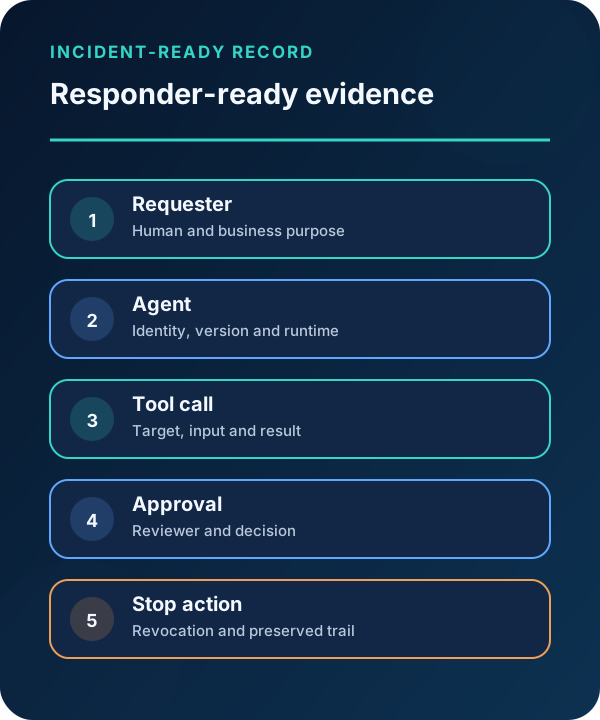
Use the review as a release gate
Approve production use only when the identity, owner, authority map, human gates, logging and stop procedure are verified. Re-run the review when the model, tool set, data source, permissions or business purpose changes. Microsoft’s private-preview controls may later automate parts of this work, but preview status and licensing should be confirmed before any rollout decision.
- Give the agent a distinct identity and named accountable owners.
- Map effective authority from real configuration, not a design document.
- Keep high-impact approval and shutdown controls outside the model.
Put the insight into practice.
Deep Security helps organizations assess risk, validate controls, and build a practical plan to strengthen their defenses.
Talk with Deep Security