

A practical rollout for OpenShift 5 Lightspeed troubleshooting and update-risk checks using a nonproduction cluster, cited evidence and human change approval.
What changed in OpenShift 5
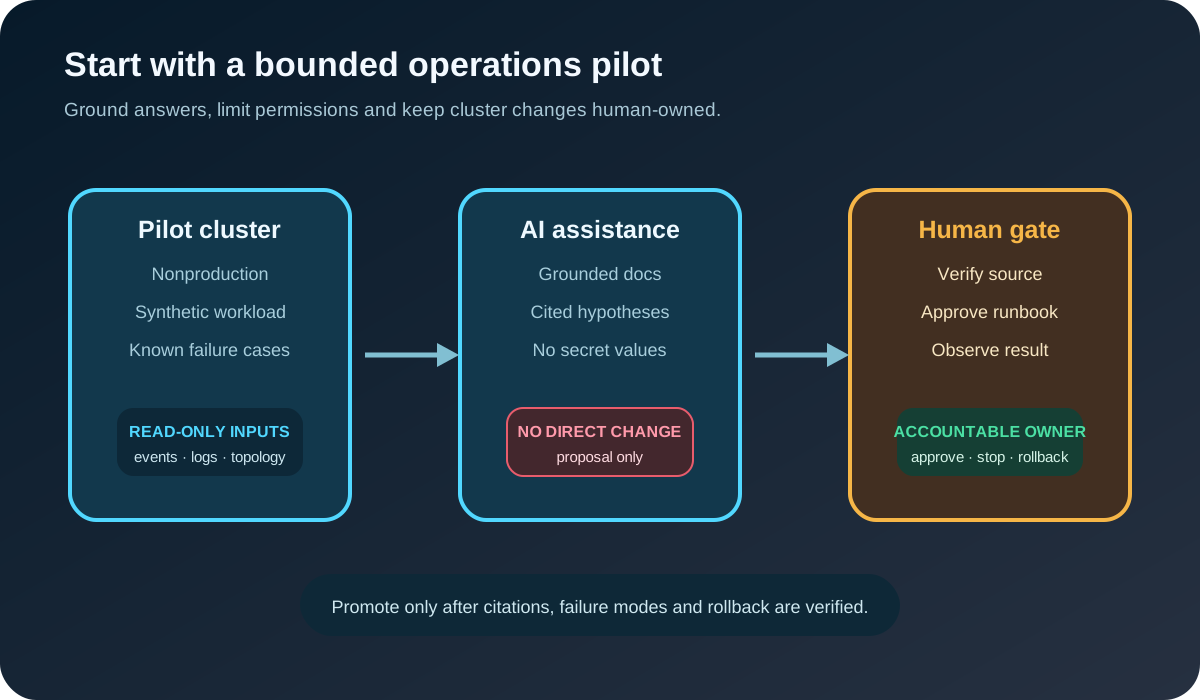
Red Hat announced general availability of OpenShift 5 on November 9 for customers with existing subscriptions. Red Hat says OpenShift Lightspeed now moves from a conversational assistant toward agentic troubleshooting: it can help isolate anomalies, analyze log streams and guide supervised remediation in the console. The release also adds AI-assisted update-risk assessment and preflight readiness analysis for APIs and optional operators.
The boundaries matter. Red Hat’s product blog says the update agent that goes further in helping plan and run update paths is in technology preview. The MCP server and gateway support described in the same announcement are generally available, while individual features and managed-service availability can differ. OpenShift 5 is available on Red Hat OpenShift Service on AWS with hosted control planes, where Red Hat says Lightspeed answers are grounded in official OpenShift and AWS documentation.
Who can use it, and what it costs
The November 9 press release says OpenShift 5 is available now to customers with existing subscriptions through the Red Hat Customer Portal. Red Hat’s pricing page describes self-managed pricing as dependent on sizing and subscription choices; managed services such as Red Hat OpenShift Service on AWS and Azure Red Hat OpenShift use pay-as-you-go options, and the page shows some reserved-instance pricing starting at $0.076 per hour under a specific 4-vCPU, three-year configuration with minimum worker-node requirements.
That published starting price is not a price for Lightspeed or a complete cluster. The reviewed public pages did not provide a separate per-feature price for the new troubleshooting or update-risk functions. Confirm edition, managed-service support, Lightspeed entitlement, model access, regional availability, data handling and support terms in the Customer Portal or with Red Hat before planning a rollout.
- General availability: OpenShift 5 platform for existing subscribers.
- Generally available supporting feature: OpenShift MCP server and gateway, per Red Hat’s announcement.
- Technology preview boundary: the update agent that helps plan and run update paths.
- Commercial boundary: edition, infrastructure and managed-service charges vary.
Practical workload: prepare a low-risk cluster update
Use a representative nonproduction cluster on the supported path, with synthetic workloads and the same optional operators as a production cohort. Red Hat describes an in-place path from OpenShift 4.22 to 5.0 and says no migration plan is required for that path, but teams should still validate the supported update graph, operator compatibility, workload disruption tolerance, backup and recovery before scheduling a real change.
The pilot goal is not to prove that an assistant can produce a confident answer. It is to test whether it cites the right events and documentation, identifies incompatible or end-of-life operators, exposes unknown dependencies and helps an engineer build a safer go/no-go packet.

Step 1: create known troubleshooting cases
Seed reversible failures in nonproduction: a degraded optional operator, a pod scheduling failure, an expired test certificate, a quota constraint and an API deprecation warning. Preserve expected evidence and the approved runbook for each. Give Lightspeed only the permissions and data access required for the test; do not expose application secrets or unrelated namespaces.
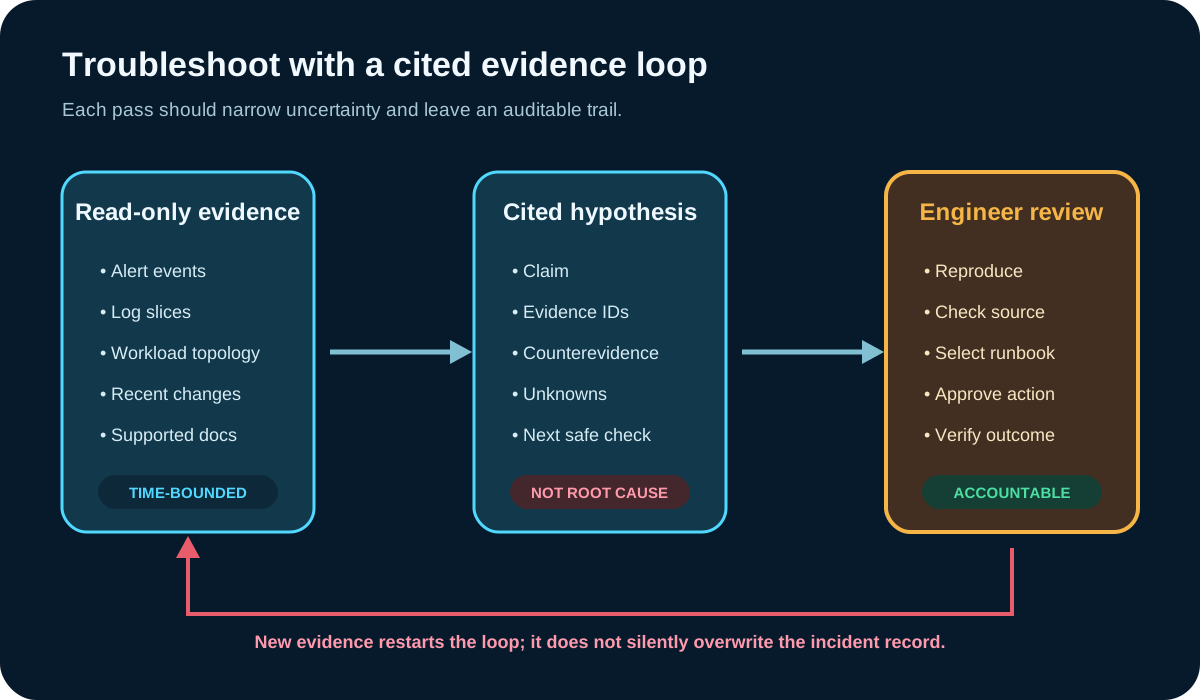
Ask the assistant to produce a hypothesis table with event IDs, log references, topology objects, documentation links, counterevidence, unknowns and the next read-only check. Require the engineer to reproduce the evidence in the console or command line.

Step 2: prompt for a bounded update-risk packet
Collect cluster version, supported update path, API usage, optional-operator channels and lifecycle state, degraded conditions, capacity, recent changes, backup status, recovery evidence and the proposed maintenance window. Keep credentials and secret values out of the prompt.
Example prompt: “Using only the attached nonproduction cluster evidence and linked official documentation, prepare an update-risk packet. List API compatibility findings, operator lifecycle and channel conflicts, degraded conditions, capacity risks, backup and rollback evidence, unknown dependencies and required human checks. Cite the source object or documentation link for every claim. Do not run commands, change subscriptions, approve the update or treat missing evidence as healthy.”
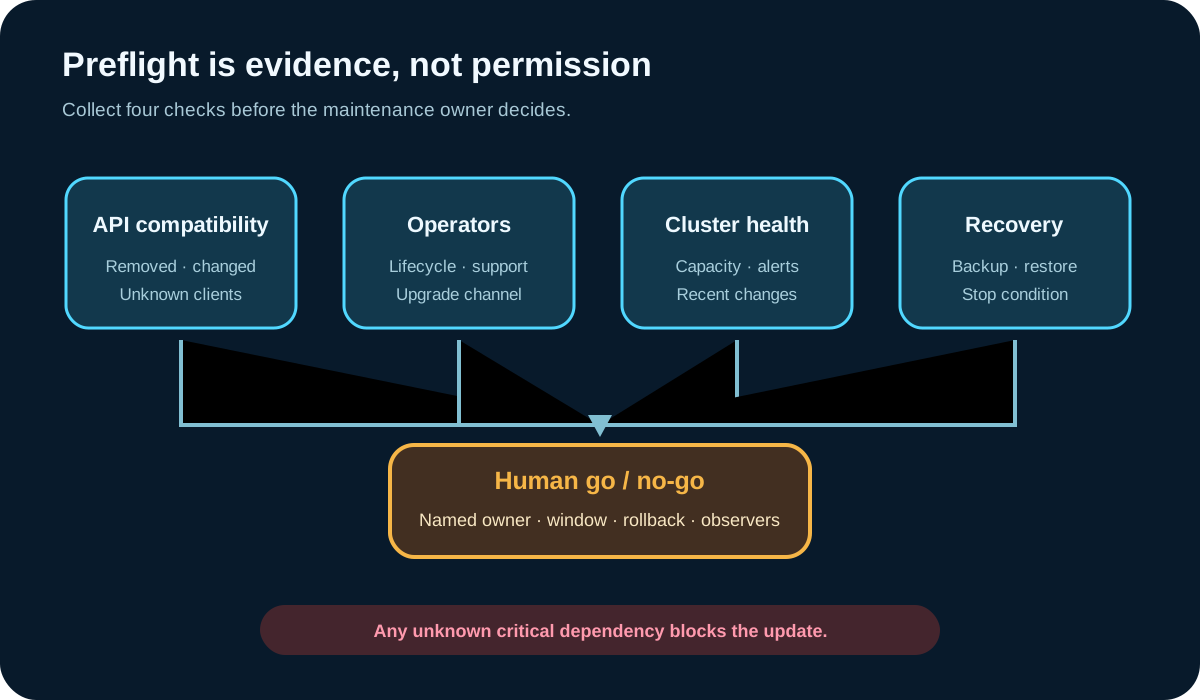
- Expected output: a cited readiness packet with blocking unknowns.
- Verify every operator recommendation against the catalog and support policy.
- Treat a technology-preview agent as evaluation-only unless Red Hat documents a supported production use.
- Record the exact model, feature, cluster and documentation versions used.
Step 3: require human execution and rollback
A named platform owner reviews the packet, resolves blockers and approves the maintenance plan through normal change control. Use supported update tooling and official documentation. Have an observer watch cluster operators, workloads and external dependencies, and define stop conditions before the window opens. If the assistant suggests a remediation, translate it into a reviewed runbook step instead of executing free-form output.
After the change, independently verify operator health, workload availability, authentication, networking, storage, policy enforcement and monitoring. Compare the observed result with the assistant’s forecast and record unsupported claims, missed dependencies and human overrides. That feedback belongs in the evaluation record, not as silent model memory.
Realistic limitations
Grounded answers can still cite the wrong version, overlook a custom operator, misread a transient condition or recommend a valid command that is unsafe in the local topology. Logs may omit the cause, and an update-risk check cannot guarantee zero downtime. The reviewed launch materials are vendor claims; this article did not test OpenShift 5, Lightspeed, ROSA or the update agent.
Keep production write access out of the initial pilot. Measure citation accuracy, unsupported claims, missed blockers, time to independently verify, remediation success and rollback readiness. A faster answer is useful only when the team can prove what it relied on and stop safely.
Why this topic was selected
A focused Firecrawl search on November 10 for “Red Hat OpenShift 5 general availability November 9 2026 Lightspeed update risk assessment pricing” returned Red Hat’s November 9 product announcement first, followed by same-day BigDATAwire and ITOps Times coverage. The result set verifies a materially updated, generally available platform and current independent attention; it does not prove Google ranking, search volume or adoption. The reader gap was a safe, reproducible nonproduction pilot that separates GA capabilities, preview features, commercial uncertainty and human change control.
Put the insight into practice.
Deep Security helps organizations assess risk, validate controls, and build a practical plan to strengthen their defenses.
Talk with Deep Security