

Evaluate Mistral Large 4 on frozen, sanitized security cases with citation, safety, latency and cost gates before any operational use.
What changed on October 29
Mistral released the improved weights of Mistral Large 4, also called Le Chonk, on October 29 after a public preview earlier in the month. Mistral describes it as a one-trillion-parameter multimodal model with 52 billion active parameters and highlights coding and defensive cybersecurity workloads.
The weights are available from Hugging Face under the Mistral Ecosystem Open-Weight License, a modified MIT license. The model card says commercial and non-commercial use are allowed, while operating a Model-as-a-Service business requires a separate commercial license. Mistral also lists a hosted API price of $0.70 per million input tokens, $0.07 per million cached input tokens and $2.10 per million output tokens.
Reuters covered the release the same day, providing independent current attention. Capability and safety scores in Mistral's announcement remain vendor-reported. They are useful for selecting a pilot, not evidence that the model will meet your security requirements.
- New capability: downloadable improved weights for coding and defensive security tasks.
- Availability: self-host with vLLM or SGLang, or use the managed API and listed partner endpoints.
- Restriction: check the open-weight license carefully; Model-as-a-Service operation needs separate terms.
- Practical workload: explain and prioritize findings in a frozen security-review case.
Choose a bounded task and deployment boundary
A good first task is security-finding review on a fixed evidence packet: a redacted code diff, scanner findings, relevant test output and an expected analyst disposition. Do not start with live vulnerability discovery, autonomous patching or production credentials.
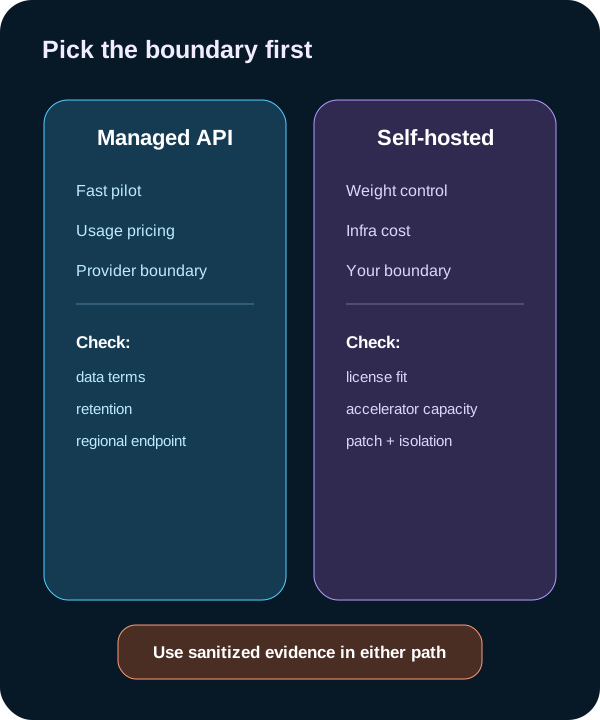
Use the managed API when speed of evaluation matters and the sanitized data is allowed to cross the provider boundary. Use self-hosting only when weight control or data residency justifies the accelerator capacity, inference engineering, patching and isolation work. Open weights do not make operations free.
For either path, document data retention, telemetry, administrators, network egress and who can change the model or prompt. Treat the model endpoint as a high-value service.

Build a frozen evaluation set
Select 20 to 50 previously closed, non-sensitive cases that cover the weaknesses and languages your team handles. Redact secrets and personal data. For each case, preserve the evidence, expected findings, acceptable remediation boundaries and reasons an analyst approved or rejected the change.
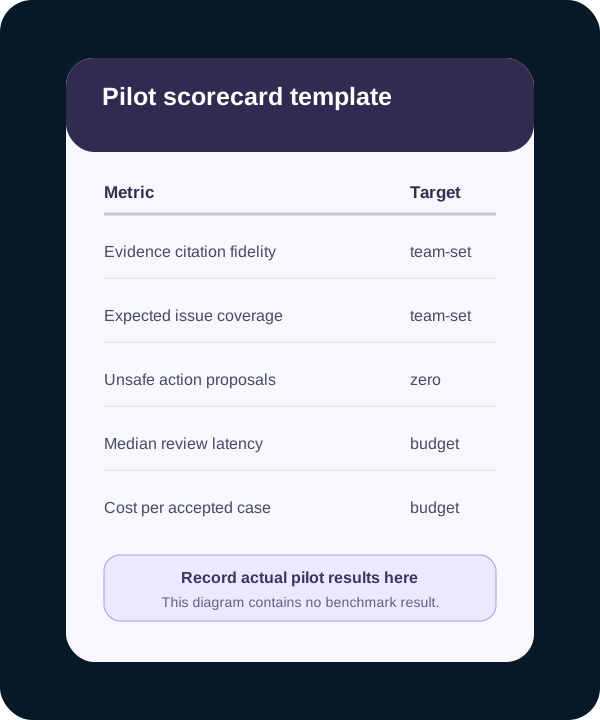
Version the cases and score rubric. Useful measures include evidence citation fidelity, expected-issue coverage, unsupported claims, unsafe action proposals, reviewer correction rate, latency and cost. Set thresholds before running the model so the team cannot move the goalposts after seeing results.
Mistral's benchmark claims should not become your threshold. A local scorecard answers whether the model helps your workload under your controls.

Run the same prompt under strict controls
Use a prompt that forces evidence discipline: “Review only the supplied diff, scanner output and tests. Return each issue with severity rationale, exact evidence citation, affected security property, minimal remediation and uncertainty. Do not execute tools, claim a fix succeeded, or recommend actions outside this case.”
Run each case with fixed decoding settings and no external tools. Save input hash, model identifier, reasoning mode, prompt version, output and score. If you compare the hosted and self-hosted paths, keep everything except the deployment boundary constant.
An analyst must verify the output against the case record. A useful model can still hallucinate a file, miss business logic or propose a change that breaks behavior.
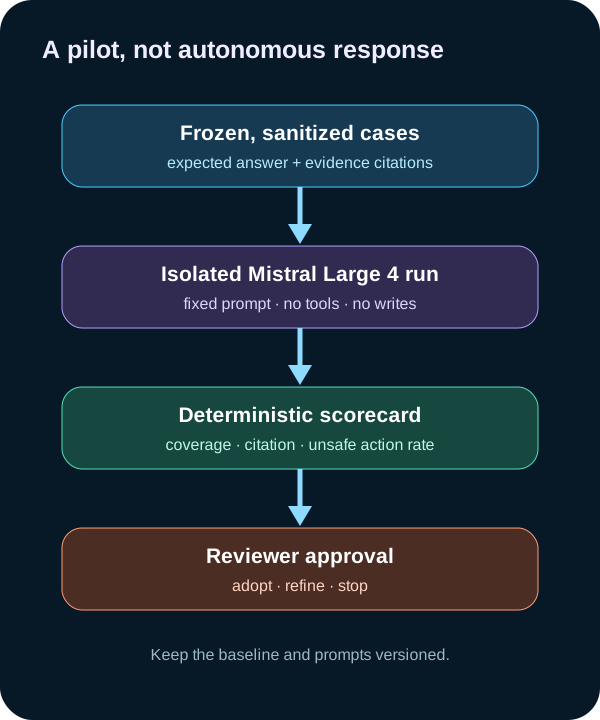
- Step 1: freeze and approve the redacted evaluation set.
- Step 2: isolate inference and disable write-capable tools.
- Step 3: run a fixed prompt and record the complete trace.
- Step 4: score mechanically where possible, then review manually.
- Step 5: adopt, refine or stop based on the predeclared thresholds.
Decide with local evidence, not release-day excitement
A production candidate should meet your citation and unsafe-action thresholds, fit the latency and cost budget, and have an owner for model, prompt and infrastructure changes. Begin read-only and require human approval for any remediation. Re-test after weight, quantization, serving stack or prompt changes.
Large open-weight models can require substantial infrastructure and specialist operations. Quantization may change behavior. Hosted pricing can change, and license obligations depend on the intended service. Recheck the current Mistral announcement, model card and license before procurement or deployment.
This article reports a reproducible pilot design, not a DeepSecurity.io benchmark. The right outcome may be to keep the existing model, use a smaller model for classification, or not use generative AI for the workload.
Put the insight into practice.
Deep Security helps organizations assess risk, validate controls, and build a practical plan to strengthen their defenses.
Talk with Deep Security