

Design an AI-assisted SOC workflow for air-gapped environments with local evidence, explicit data boundaries, retrieval tests, human approval and export controls.
Why this workload is receiving attention
Google announced new Google Distributed Cloud air-gapped capabilities on October 20, including enterprise search with Gemini, support for frontier and open-weight models, infrastructure updates and partner software. Elastic separately described an AI-assisted security operations integration for fully air-gapped environments.
This uses nine-day-old context, outside the preferred seven-day window but inside the requested 30-day expansion. Focused Firecrawl research on October 29 returned the Google and Elastic announcements first, plus recent independent coverage from OpenTools and Tech Insider. That is a freshness and attention signal—not proof of deployment volume, effectiveness, search traffic or ranking.
The practical opportunity is to summarize and correlate protected telemetry without sending it to a public cloud. The risk is assuming that an air-gapped product name proves every data, update and administrator path stays within the approved boundary.
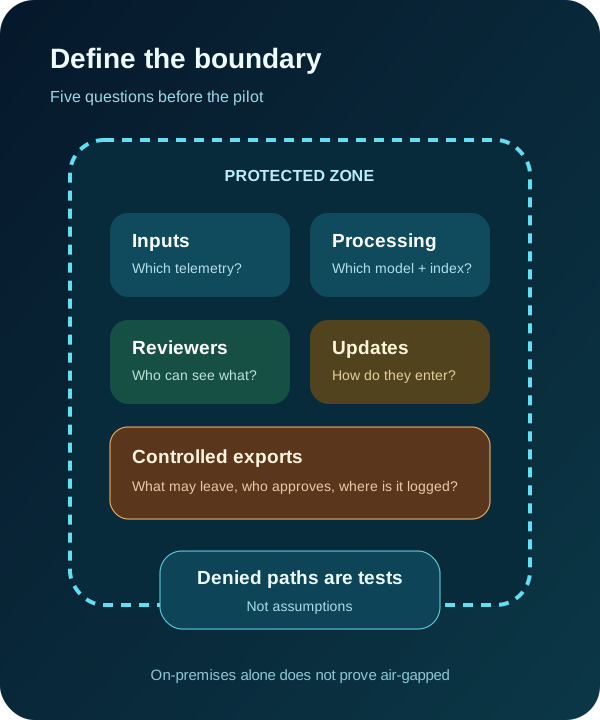
1. Define the boundary as testable data paths
List every telemetry source, collector, index, retrieval service, model endpoint, identity provider, update channel, administrative interface, backup path and export mechanism. For each one, name the owner, protocol, destination, authentication method, logging and failure mode.
Do not equate on-premises with air-gapped. A license check, telemetry service, model update, remote support tunnel or administrator workstation can create a crossing. Document which crossings are prohibited, which use an approved transfer station and which require a two-person review.
Confirm the actual product edition, regional support, hardware capacity, model availability, licensing and commercial terms with the vendors. The announcements describe capabilities and partnerships; they do not replace a site-specific architecture review or availability quote.

- Map every ingestion, inference, update, administration and export path.
- Test denied paths as well as allowed ones.
- Record the approved model and index versions used for each case.
2. Build a local evidence-and-retrieval workflow
Ingest only the sources required for the pilot and preserve the raw records separately from normalized or summarized data. Keep stable source IDs, timestamps, parser versions and collection queries. Index approved runbooks, asset ownership and change windows with source attribution and an explicit review date.
Example prompt: 'Using only the local case index and approved runbooks, summarize case SOC-317. Cite every supporting event and document. Separate observations, retrieved policy, inference and unknowns. Return conflicting evidence and missing sensors. Do not initiate containment, export data or query any service outside the protected zone.'
Retrieval can produce a confident answer from stale or overbroad context. Test authorization at document level, source freshness, revocation, conflicting procedures and empty results. If the system cannot cite the exact local record, the answer should remain unverified.
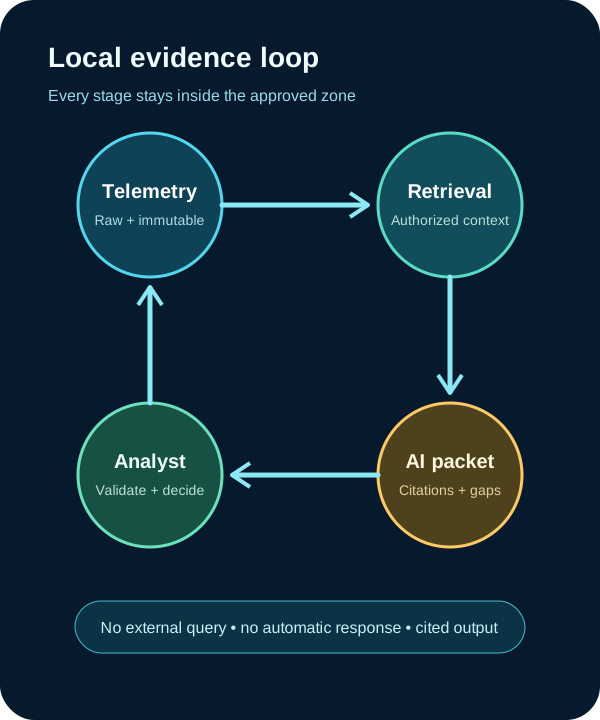
3. Review the packet against original evidence
Require an analyst to open the cited events, confirm identity and asset ownership, compare the timeline with known maintenance, and test at least one alternative explanation. The summary is a navigation aid; it is not the authoritative incident record.
Keep containment, account revocation, endpoint isolation and firewall changes in separate systems under existing approval. If a response recommendation is exported, record exactly what left the zone, who approved it and how the destination stores it.
DeepSecurity.io did not deploy Google Distributed Cloud AI SecOps or benchmark the Elastic integration. Claims about closing a security velocity gap are vendor claims. This workflow describes a defensible evaluation pattern, not a measured performance result.

4. Prove the boundary and close the pilot
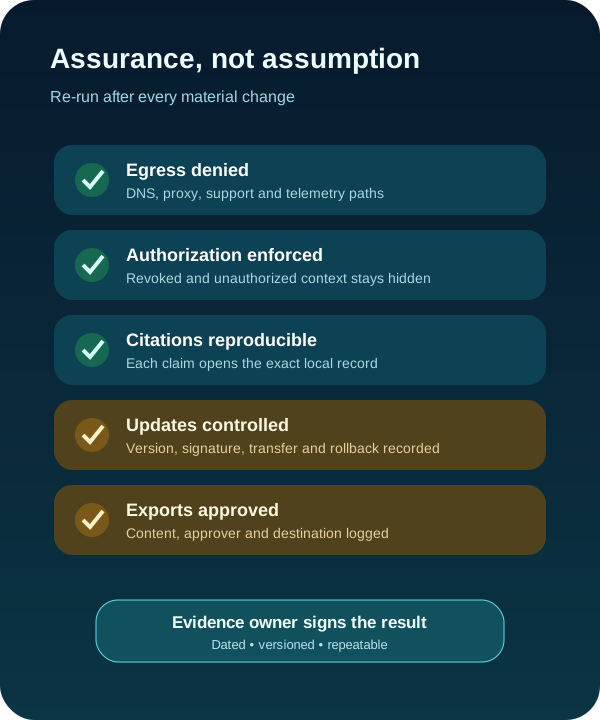
Use synthetic cases with known facts and canary records that must never appear for an unauthorized user. Test blocked outbound resolution, denied retrieval, expired access, stale documents, incomplete telemetry and a failed update import. Review both application logs and infrastructure egress records.
Measure citation accuracy, unauthorized retrieval, missed gaps, reviewer corrections, evidence-to-summary traceability and export exceptions. Do not treat model fluency or a successful demonstration as proof of boundary assurance.
The closeout packet should contain the architecture, data-flow inventory, approved crossings, test fixtures, results, unresolved risks, rollback plan, update procedure and accountable approver. Re-run boundary tests after every model, connector, index or infrastructure change.
Put the insight into practice.
Deep Security helps organizations assess risk, validate controls, and build a practical plan to strengthen their defenses.
Talk with Deep Security