

What Google changed in Gemini 4 Hydrogen and how to test its long-context coding workflow on a dependency upgrade without granting merge authority.
What Google released on November 12
Google introduced Gemini 4 Hydrogen on November 12 as a fast model for everyday coding and agentic workflows. The model identifier is gemini-4-hydrogen. Google’s AI Studio documentation says it is available on free and paid tiers through Google AI Studio and the Gemini API, including GenerateContent and the Interactions API. Google also announced availability across its business, consumer and Antigravity surfaces, with plan-dependent access.
The API price is $1.50 per million input tokens and $7.50 per million output tokens, including thinking tokens. The unified context window is 1,048,576 tokens. Synchronous output is capped at 65,536 tokens; longer output requires background execution or client continuation. Independent November 13 coverage focused on migration, billing and safety caveats. Google’s speed, benchmark, honesty and prompt-injection figures are vendor or benchmark claims; Deep Security did not reproduce them.
Who can use it and what materially changed
Developers can select Hydrogen in AI Studio or call it through the Gemini API, subject to account availability and rate limits. Google documents four thinking levels: low, medium, high by default and xhigh. The model can process code and multimodal documents and supports declared tools and structured outputs. Free-tier use is rate-limited; paid API use follows published token pricing. Confirm enterprise product entitlements separately because consumer, Antigravity and business availability differ.
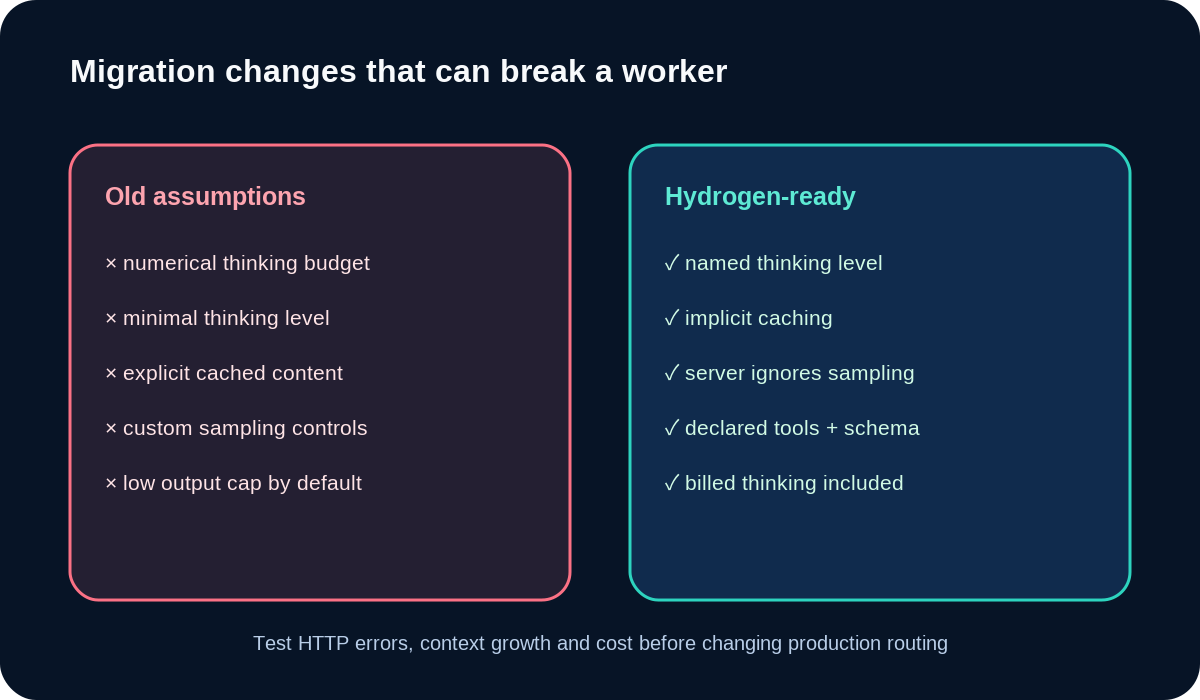
A migration is not just a model-name change. Numerical thinking budgets and the minimal level are not accepted. Explicit cached-content APIs are unsupported, while implicit caching applies to sufficiently long prompts. Custom temperature, top-p and top-k are ignored. Billing includes thinking and function declarations. Existing agent runtimes also need to preserve conversation state and thought signatures correctly.
- System of record: repository, dependency lockfile, CI results, software inventory and change ticket.
- Model role: map dependency impact, draft a branch plan, explain diffs and propose tests.
- Human role: choose scope, inspect changes, disposition findings and own merge or rollback.
- Stop condition: secret access, undeclared tool, unbounded context, failed security check or requested branch-protection bypass.
Step 1: choose a bounded dependency-upgrade workload
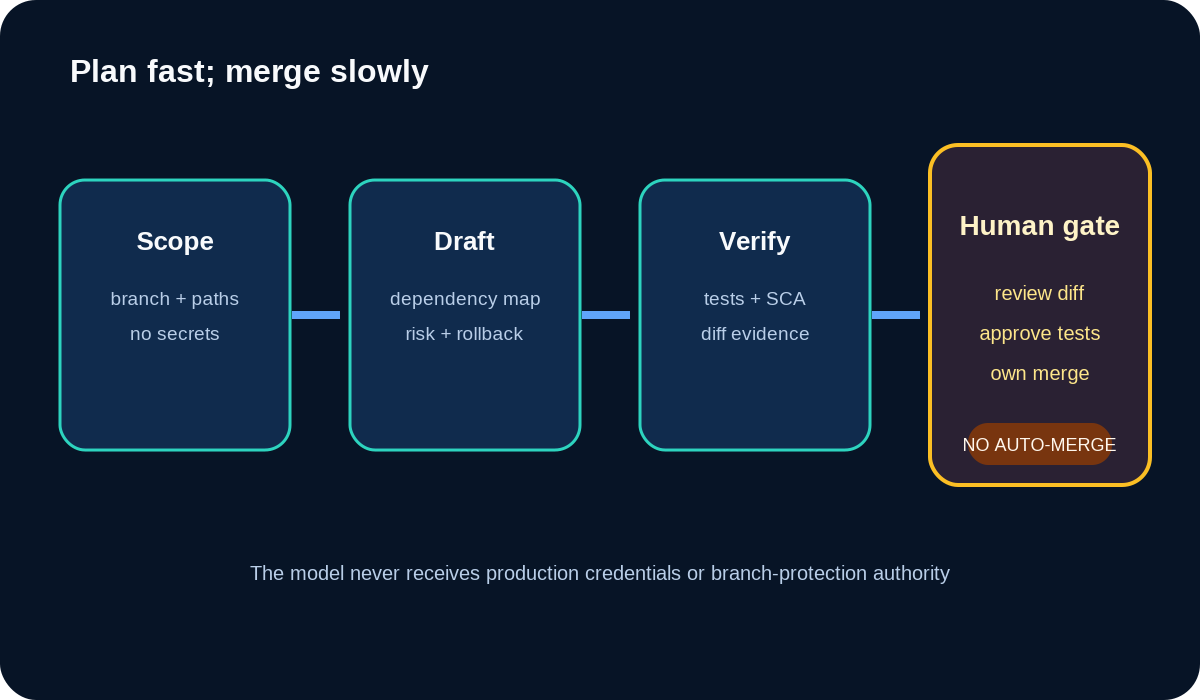
Select one repository, one dependency family and a disposable branch. Provide only the relevant source paths, manifests, lockfiles, tests, architecture notes and current vulnerability advisory. Exclude secrets, customer data, production logs and unrelated repositories. Expose read-only search plus narrowly defined test commands through a tool wrapper; do not give the model cloud credentials or merge permission.
Capture the baseline build, tests, dependency tree, software composition analysis and bundle or image size before the model runs. Set maximum tool calls, context tokens, output tokens, wall time and cost. A million-token window is capacity, not a reason to send the entire estate.

Step 2: ask for a plan before a patch
Require an inventory of affected packages, files, APIs and tests before code changes. Separate mechanical edits from architecture decisions and unknowns. Make the model cite file paths and symbols, and verify those citations against the repository outside the model.
Example prompt: “On branch upgrade/widget-8, inspect only the approved paths and read-only tools. Produce an upgrade plan for widget 7 to 8 with affected files and symbols, breaking changes, security implications, test additions, rollback steps and unresolved questions. Cite repository paths for every claim. Do not read secrets, edit CI permissions, modify branch protection, contact external services, merge, publish or describe a check as passing unless its tool result is present.”
- Expected output: an impact map, ordered patch plan, test plan and rollback note.
- Reject invented files, APIs or test outcomes.
- Require human approval before generating the patch.
- Keep an immutable record of prompts, tool calls, model version and cost.
Step 3: generate on a branch and verify deterministically
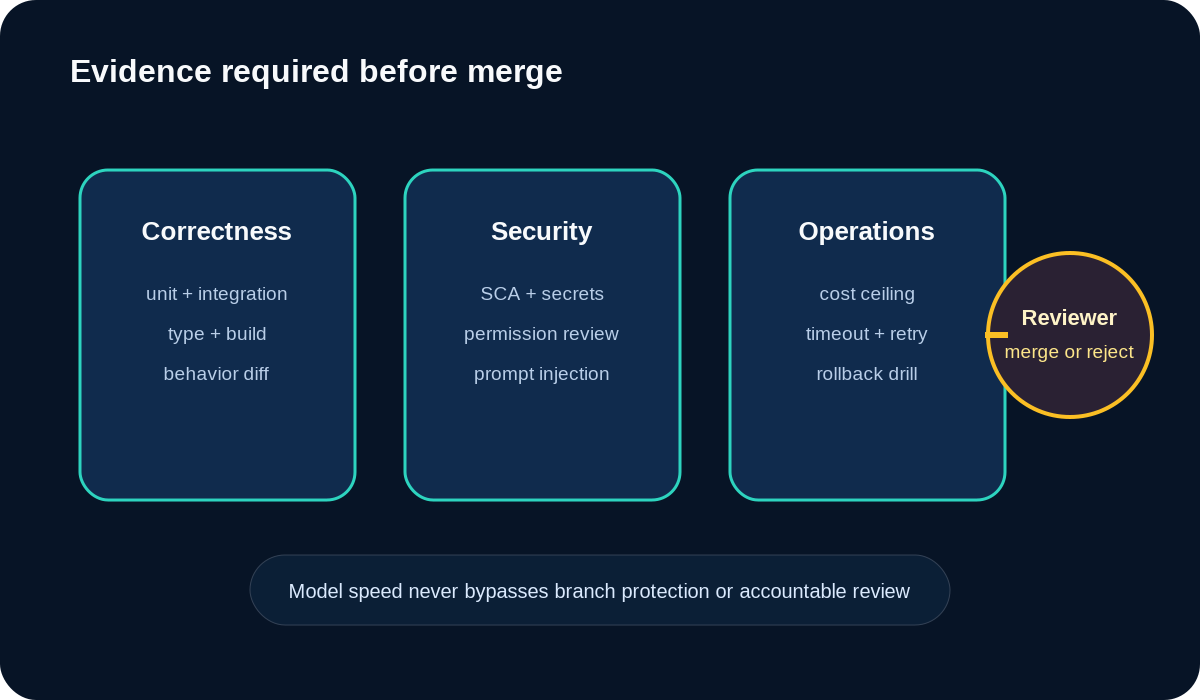
After plan approval, let the assistant edit only allow-listed paths. Run formatting, type, unit, integration, build, software-composition and secret checks in CI. Compare public behavior, dependency graph and produced artifacts with the baseline. Do not accept a prose explanation as proof of a passing check.
Test adversarial repository content too: prompt-like comments, malicious package metadata, stale migration guides and instructions embedded in issue text. Treat all repository text as untrusted data. The tool wrapper, not the model, must enforce paths, command arguments, network access and timeouts.
Step 4: evaluate the new model before changing routing
Replay a labeled set of repository tasks through the old and new configuration. Measure correct file identification, unsupported claims, unsafe tool attempts, patch review time, test outcomes, latency and total billed tokens. Higher thinking levels can consume more output tokens, so compare quality and cost together rather than assuming a faster model is cheaper for every task.
Run shadow traffic first and keep the previous route available. Document HTTP errors caused by old thinking settings, context growth, timeouts and long-output behavior. Do not promote Hydrogen solely on Google’s or a partner’s benchmark.
Human review and realistic limitations
The reviewer should receive the dependency rationale, complete diff, changed interfaces, generated tests, CI evidence, security findings, residual risk, cost, rollback and model configuration. Review high-risk files independently and require the normal code-owner approvals. The model should have no token capable of bypassing those controls.
Long context can still contain stale or conflicting information, and a model can invent an API, miss a transitive effect or follow malicious repository text. Higher thinking can add latency and cost. Independent coverage also notes timeouts, unjustified refusals and security-report gaps. The reviewed sources do not establish that Hydrogen is better for your repository, so validate it locally and retain a fallback.

Why this topic was selected
A focused Firecrawl search on November 13 for “Gemini 4 Hydrogen agent workflows November 2026” surfaced Google’s November 12 launch and AI Studio documentation alongside new independent DevOps coverage. The sources addressed actual API migration, price and workload questions rather than only benchmark headlines. That prominent current placement is a topic-interest signal, not proof of Google rank, search volume or DeepSecurity.io traffic.
Put the insight into practice.
Deep Security helps organizations assess risk, validate controls, and build a practical plan to strengthen their defenses.
Talk with Deep Security