
Claude Code Review is generally available. Learn how to pilot AI pull request reviews, verify findings, and keep people in control of production releases.
A new feature with a concrete job to do
An AI coding assistant can produce a patch quickly. The harder question is whether someone has checked what that patch actually does. For teams managing customer portals, cloud tools, or business websites, a useful AI workload is reviewing a proposed change before it reaches production.
Anthropic announced general availability for Claude Code Review on October 15, 2026, for Team and Enterprise organizations. The release adds repository-level Quick, Standard, and Deep review choices. Anthropic also reports faster reviews than its preview; that is a vendor claim, not a Deep Security benchmark.
The practical opportunity is straightforward: ask AI to identify code-level concerns while your team retains responsibility for validation and release. This guide proposes a small pilot you can adapt to your own development process. We researched the feature on October 18; we have not run a hands-on evaluation of the managed service.

Choose the right review route
The managed Code Review service is enabled by an organization owner through the Claude GitHub App. Its findings appear on pull requests. Current documentation says it reads code without building or running it, and does not approve or block the merge.
That is different from running a local review command or placing an AI tool inside your own CI runner. The environment, permissions, credentials, and responsibility for execution differ. Decide which route you mean before copying an installation example.
Check current eligibility and data-handling requirements with your administrator. The managed service has restrictions for configurations such as Zero Data Retention, HIPAA, and customer-managed encryption keys. Review the app’s requested permissions and billing controls before enabling a repository.
Start with one repository and one useful change
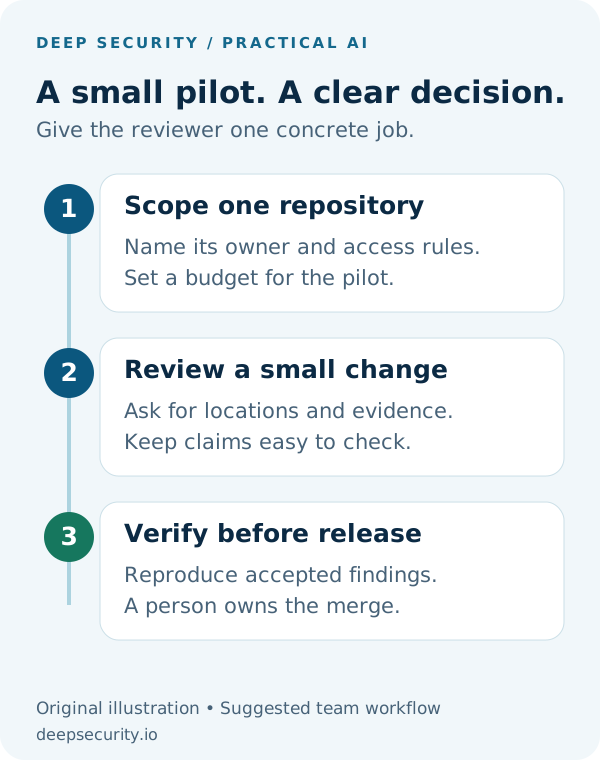
Select a repository whose owner can explain its access rules and test coverage. A small pilot is easier to assess than enabling a reviewer across every customer application at once. Name an engineer who will triage the findings and a person who owns the release decision.
Choose an ordinary change with meaningful behavior: a new invoice endpoint, a file download permission check, or a session timeout update. Write down the expected behavior first. For example, a user should be able to view their own organization’s invoice and should be denied an invoice from another organization.
Set a budget and review cadence appropriate to your team. Standard is the documented default review level; treat any move to a deeper review as a choice to evaluate, not proof that the result will be complete. Keep the pilot separate from production deployment credentials.

- Define the change: what should work, who is authorized, and which behavior must remain unchanged.
- Define the review output: a finding with a location, a trigger, supporting code, and a proposed fix.
- Define the owner: someone must decide whether the finding is valid and whether a new test is needed.
A practical example: check the ownership boundary
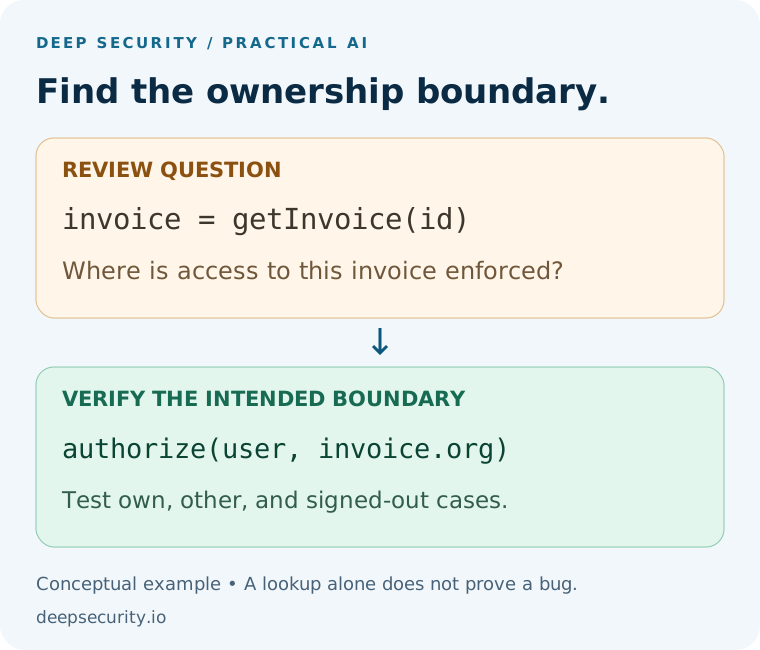
Consider a fictional billing portal. A patch adds a lookup for an invoice using an identifier from the request. The review question is whether the authenticated user’s organization is enforced in the relevant authorization path, not simply whether an identifier was validated.
Ask the reviewer to trace the endpoint through its authorization helper and data query. A lookup by identifier is a clue to investigate; by itself, it does not prove a vulnerability. Another layer may already enforce ownership. Conversely, a reassuring comment is not evidence that enforcement exists.
If a boundary is missing, the developer should implement the application’s actual ownership check and prove the result with tests. The graphic below is conceptual pseudocode, not a drop-in fix for a specific framework.
Turn a comment into a finding you can reproduce
A useful finding tells another engineer how to check the claim. It should name the affected path, the necessary conditions, the evidence, and the expected result. Ask for the missing context rather than allowing the model to invent a helper’s behavior.
Suggested review guidance: “For each material concern, identify the changed lines and relevant surrounding code. Explain the conditions needed to trigger the issue. Trace existing authorization before reporting a bypass. Separate confirmed code behavior from assumptions. Propose a minimal validation test and say what evidence would disprove the finding.”
Then review the result yourself. For the invoice example, test the same organization, a different organization, an unauthenticated request, and the existing error behavior. Keep the intended permission model explicit so a patch cannot quietly make legitimate access stop working.

Keep the release decision separate
An AI comment is a lead, not a release verdict. The developer makes the correction, existing automated checks run, and the reviewer confirms that the change addresses the actual problem. Keep your normal branch protections and release process.
A review with no findings is not a security certification. It can miss a problem or lack the context needed to recognize one. AI review is most useful alongside tests, dependency checks, and human review of the business rules.
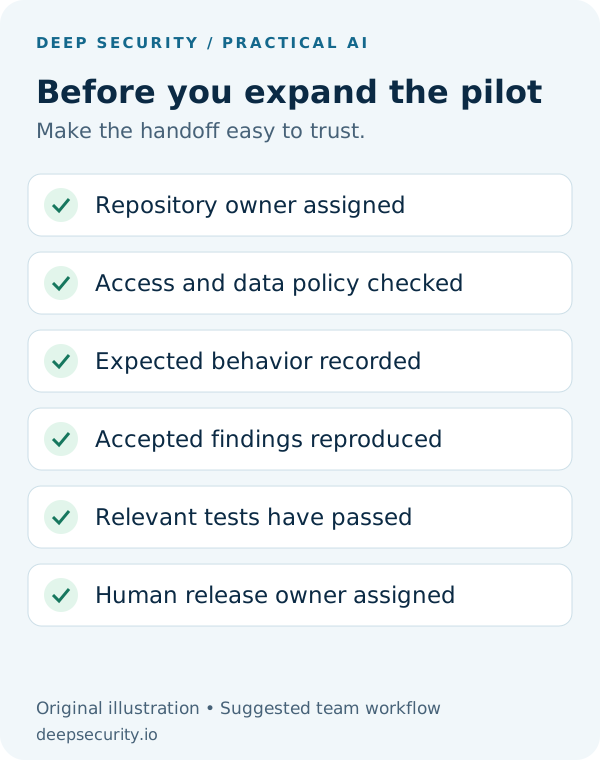
Use the pilot checklist below as a short readiness conversation. It describes suggested team responsibilities, not a claim that the product enforces each control for you.
Measure usefulness before expanding
Keep a simple pilot record: the change reviewed, findings accepted or rejected, validation evidence, developer corrections, and review effort. Compare similar changes rather than treating the number of AI comments as a quality score.
Useful questions are whether the reviewer identified a real issue the team could verify, whether its explanation helped the developer, and whether important context was missed. Report these observations honestly. This article claims no measured time saving or vulnerability detection rate.
Expand when the results justify it. A small, well-understood review workflow can improve how a team handles code changes without turning an AI assistant into the final authority over production.
Put the insight into practice.
Deep Security helps organizations assess risk, validate controls, and build a practical plan to strengthen their defenses.
Talk with Deep Security