

What Eclipse Enclave 1.0 changes, who can use it, and how to pilot an AI coding agent with isolated files, controlled egress, external secrets and human review.
What changed and why the launch has current attention
The Eclipse Foundation publicly announced Eclipse Enclave 1.0 on November 19 as an open-source, vendor-neutral runtime and sandbox for autonomous coding agents. The announcement names Claude Code, Codex and OpenCode; the project repository also documents Copilot and Pi extensions. A Firecrawl search returned launch coverage first, a second independent summary next, and the primary repository and releases immediately after—current attention without implying traffic or rank.
The repository shows an important chronology: version 1.0.0 was tagged on October 30 but not published because Windows archives lacked license files; 1.0.1, published October 31, is the first official release with that issue corrected. The November 19 announcement is therefore a public launch of the 1.0 line, not evidence that new binaries were created that day.

Who can use it and what the boundary covers
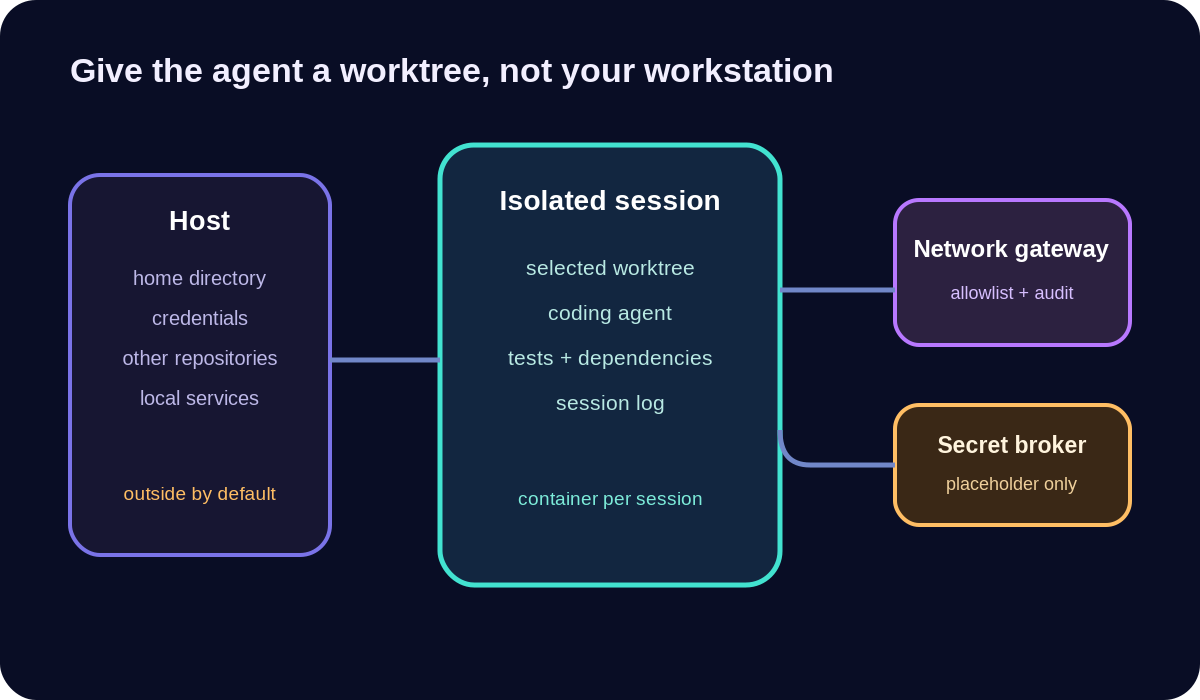
Enclave is available under the MIT license for Linux, macOS and Windows through WSL2. It requires Git 2.26 or newer and either rootful Docker with buildx or Podman; the project says rootless Podman works. Each session gets an isolated container and selected worktree or extra mounts while the rest of the host stays outside the agent’s view.
The documented controls include allowlist-based egress through a gateway, a network audit log, OAuth profiles and layered secrets. The gateway can substitute secrets into requests while the container sees placeholders. Enclave refuses to run as root and refuses home-directory or sensitive-path mounts. These are useful boundaries, not proof that a configured session is safe.
Step 1: verify the release before installation
Use the stable 1.0.1 release page, choose the artifact for the pilot host and verify it against the published checksums. Record source URL, version, hash, download time and reviewer. The project notes that release artifacts are not yet signed, so checksum verification reduces accidental corruption risk but does not provide a signed publisher chain.
Windows runs through WSL2. The deb and rpm packages are x86-64 only and do not self-update; package upgrades are manual. Rolling builds continue on the rolling channel until configuration is changed to stable. Decide which update channel the pilot owns before the first session.
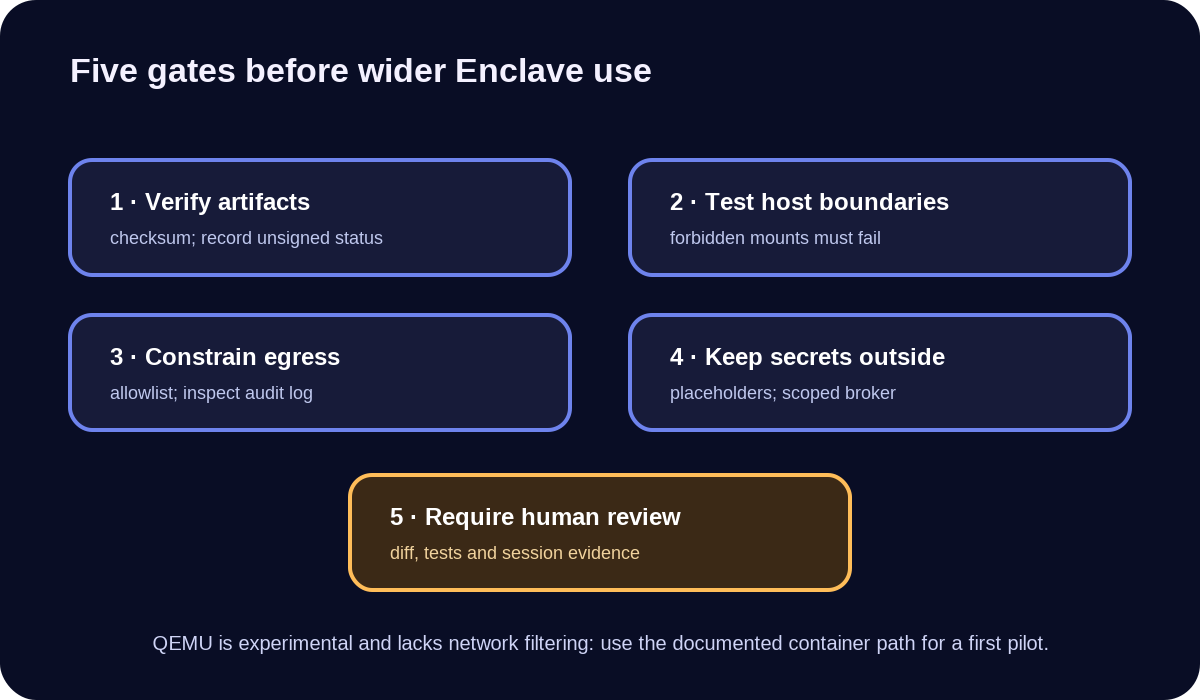
- Treat the unsigned-artifact status as an explicit accepted pilot risk.
- Pin the Enclave version and base image used for each session.
- Keep package and agent credentials out of the repository.
- Document uninstall and session cleanup before enabling more users.
Step 2: choose a low-risk workload and policy
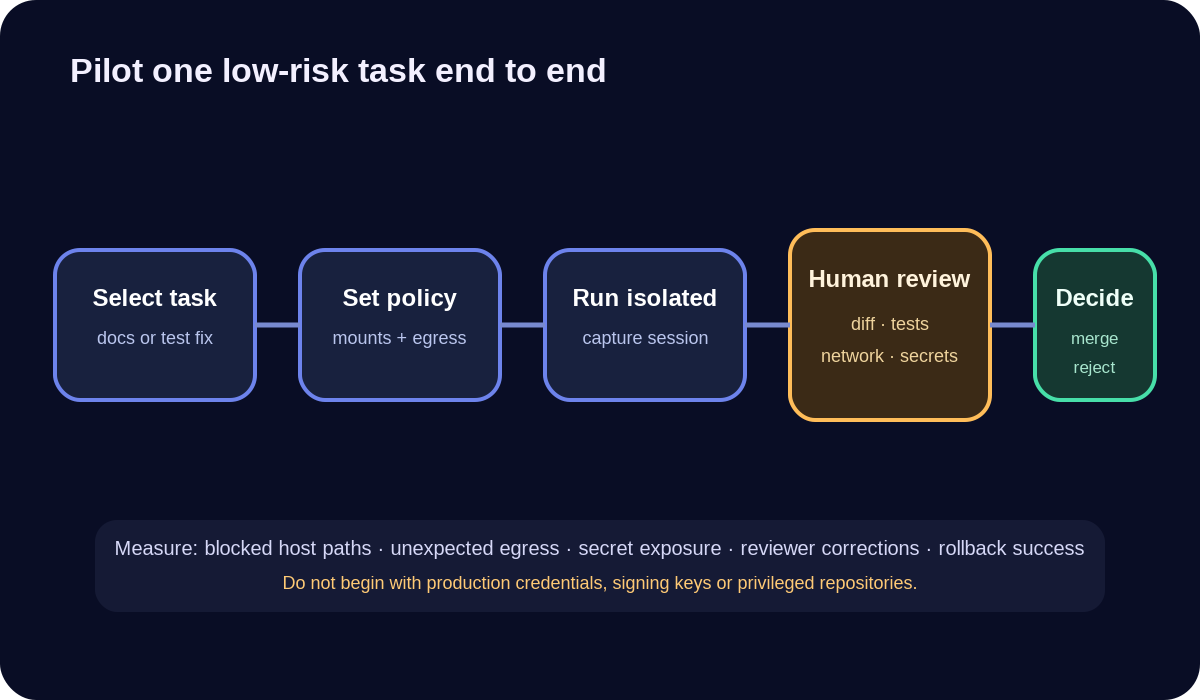
Begin with a disposable fork and a task such as improving documentation, adding a deterministic unit test or fixing a non-sensitive lint error. Mount only that worktree. Allowlist the package and source-control destinations needed for the task, deny other egress and use a scoped test credential if authentication is unavoidable.
Do not start with production infrastructure code, signing keys, customer data or a repository whose tests execute privileged local services. The experimental QEMU backend does not yet provide network filtering, so use the documented container path for a first network-restricted pilot.
Step 3: give the agent a reproducible task
Example task: “In the mounted worktree, update only the approved documentation and test files for issue ENG-219. Run the listed checks. Do not access other paths, add dependencies, contact destinations outside the allowlist, change authentication or push commits. Return changed files, commands, test results, failed requests and unresolved questions.”
Expected output is a bounded diff plus command and test evidence. The Enclave session and gateway logs should show the same file and network boundaries. A successful task with an unexpected egress attempt or secret request is a control failure, not a successful pilot.
Step 4: review the session before accepting the diff
Compare the diff with the issue, reproduce tests outside the agent session in a clean environment, inspect network audit records and confirm no sensitive mount or credential entered the container. Record reviewer corrections and every blocked request. Resume behavior and persistent configuration should also be tested so old state does not silently widen a later task.
Keep merge, signing, release and production access outside Enclave’s pilot credential set. A human reviewer decides whether the diff is acceptable, and the existing CI/CD system supplies the authoritative build and deployment evidence.
Step 5: measure the boundary before expanding
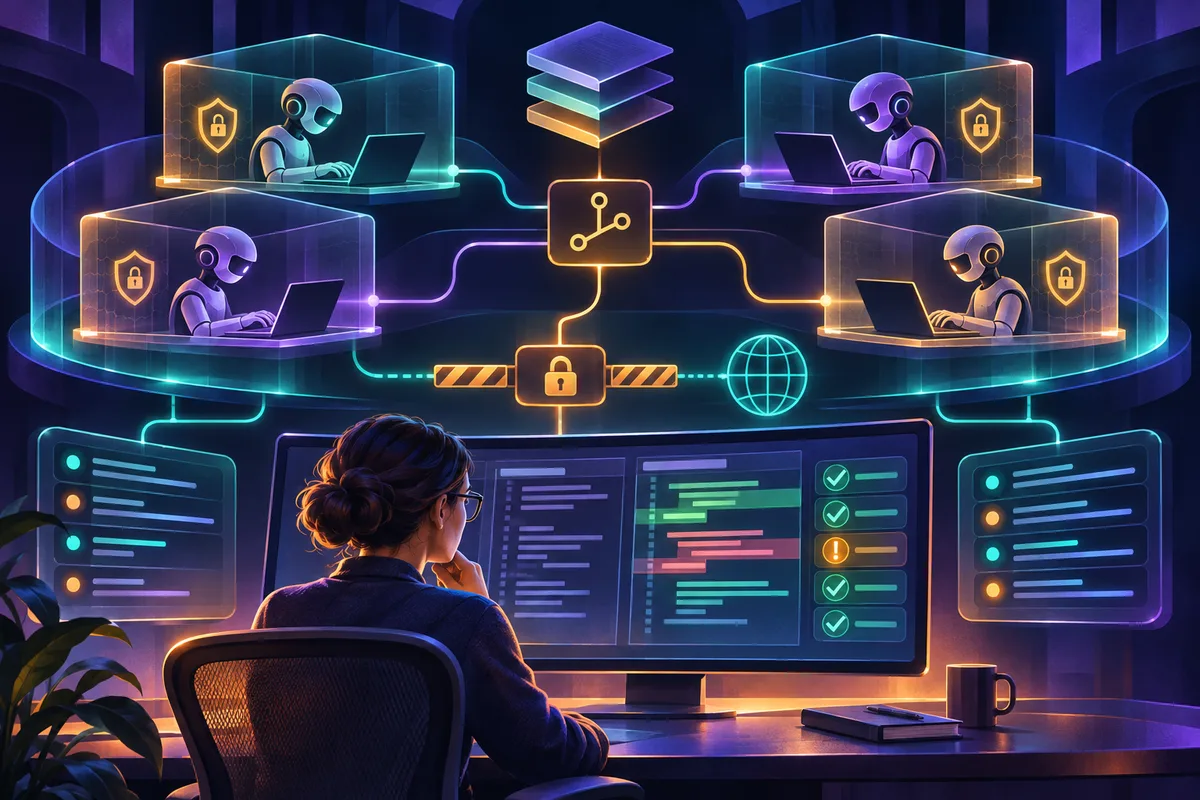
Test prohibited home-directory mounts, denied destinations, placeholder secret handling, container escape assumptions, cleanup, host-port bridging and agent failure modes. Track blocked host access, unexpected egress, secret exposure, test reproducibility, reviewer corrections, stale sessions and time to revoke the pilot credential.
Expand to another repository or agent only after controls behave consistently and the team can reconstruct each session. Keep a non-agent development path and a documented response for a compromised dependency, gateway policy error or unavailable container runtime.
Limitations and topic-selection reason
A container is not a complete security boundary for every threat model. Enclave depends on the host runtime, base images, gateway configuration, agent behavior and the permissions of selected mounts. Unsigned release artifacts, manual package upgrades, Windows-through-WSL2 and the experimental QEMU networking gap are material pilot constraints.
Firecrawl research on November 19 found the public launch at the top of a focused search, followed by multiple fresh summaries and the primary repository and release pages. The feature directly fits Deep Security’s secure-development and cloud-administration readers because it improves an actual workload—parallel autonomous coding—while making host, network and credential boundaries reviewable. The search signal does not establish adoption, traffic or Google ranking.
Put the insight into practice.
Deep Security helps organizations assess risk, validate controls, and build a practical plan to strengthen their defenses.
Talk with Deep Security