

A practical rollout for Detectify Agentic Tooling that verifies selected security findings against a staging app while preserving human scope and approval.
What changed on November 16
Detectify announced Agentic Tooling on November 16, 2026. The feature lets an organization’s own MCP-capable agent call Detectify testing tools for a specific suspected issue, then links the agent’s verdict to an add-only Security Ledger written by Detectify. The product page describes inputs from SARIF 2.1.0, Semgrep JSON, bug bounty reports and internal findings, with outcomes such as confirmed, not confirmed, inconclusive or not testable.
Detectify says the agent and model run in the customer’s environment and that the provider receives investigation data, ledger entries, ticket contents and request metadata rather than the codebase itself. Agentic Tooling was available on request at launch. The public pages offer a demo or trial but do not publish a price or plan entitlement, so teams should confirm commercial terms, data handling and regional requirements directly.

Choose a safe first workload
The practical first workload is a backlog of suspected web findings on a disposable or staging target that mirrors the relevant route. Pick one supported class and a small queue with clear owners. Exclude denial-of-service, destructive state changes, regulated production data and third-party systems. Detectify’s FAQ says unsafe tickets are marked for a person to decide; preserve that boundary in your own policy.
You need an existing MCP-capable agent, its model and usage budget, an Agentic Tooling entitlement, a controlled target, a finding source and a reviewer who can inspect the ledger. The feature does not replace a penetration test, code review or release approval.
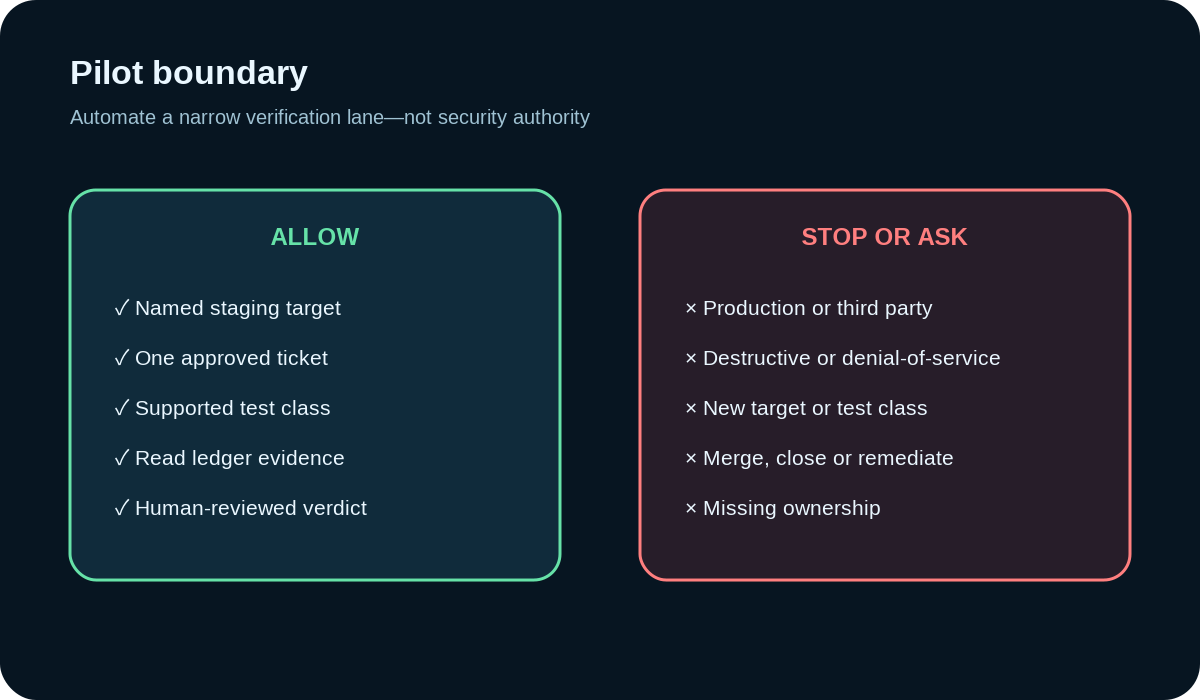
- Allow: claim one approved ticket, request one bounded assessment and read ledger evidence.
- Ask: expand scope, test a new class, touch production or handle ambiguous ownership.
- Deny: denial-of-service, persistence, data extraction, third-party targets or self-approval.
- Record: ticket, target, tool call, evidence, verdict, reviewer and follow-up action.
Step 1: connect the queue and define the agent contract
Configure the MCP connection according to current Detectify documentation, then give the agent the minimum repository and target context required for one ticket. A useful instruction is: “Work only ticket SEC-PILOT-07 against staging target APP-STG-2. Use only allowlisted Detectify tools. Do not broaden the vulnerability class or target, change code, close the ticket or publish a verdict without ledger references. Stop on unsafe, inconclusive or access-denied results.”
Upload or create a finding with its source, relevant location, CWE where known and staging target. Confirm that secrets are not embedded in the ticket and that any source snippet is approved for Detectify’s stated data flow.
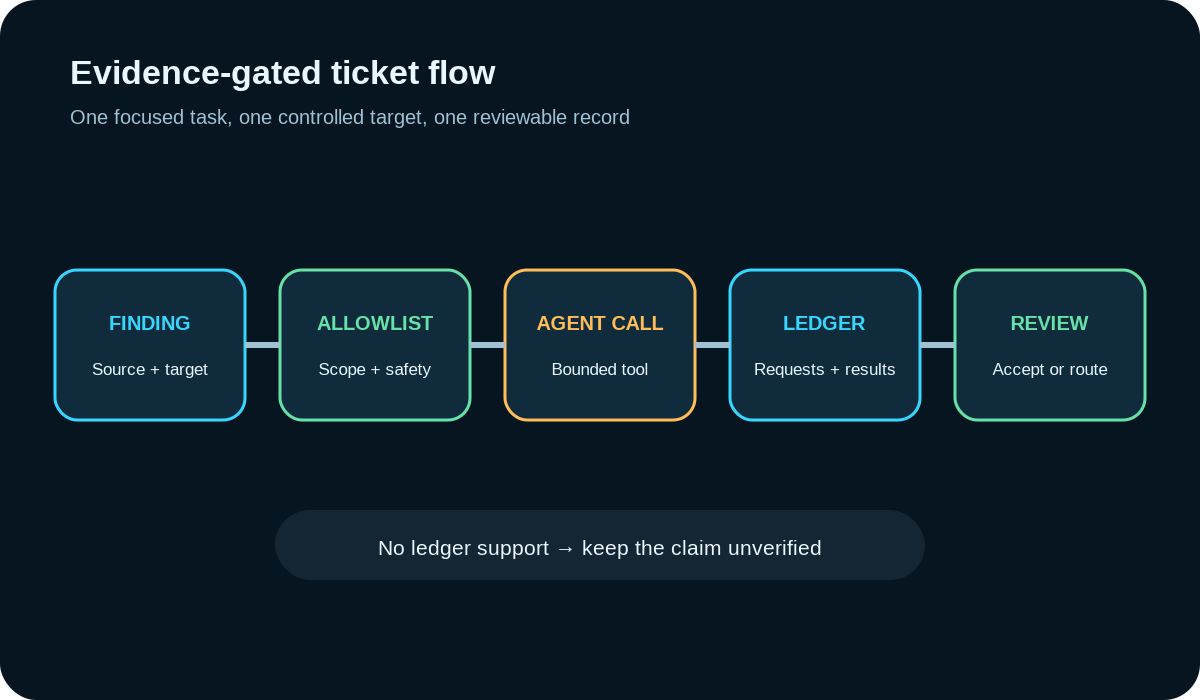
Step 2: inspect the ledger, not just the summary
For each run, compare the claimed verdict with the recorded requests, assessments, browser observations and target. If the agent claims a result without a supporting record, keep it unverified. If the evidence is ambiguous, route it to a security engineer rather than asking the same agent to rationalize its first answer.
A confirmed dynamic result still needs code context, ownership and severity review. A not-confirmed result does not prove the code is safe; the route, environment, authentication state or test coverage may differ from production. Record reviewer disagreement and reopen rates during the pilot.

Step 3: measure a bounded pilot before scaling
Run the pilot for a fixed number of tickets and compare reviewer time, confirmed findings, inconclusive or unsafe stops, ledger gaps, false closures and retest success with the existing manual path. Track agent-model cost separately because Detectify states that customers choose and pay their own model provider.
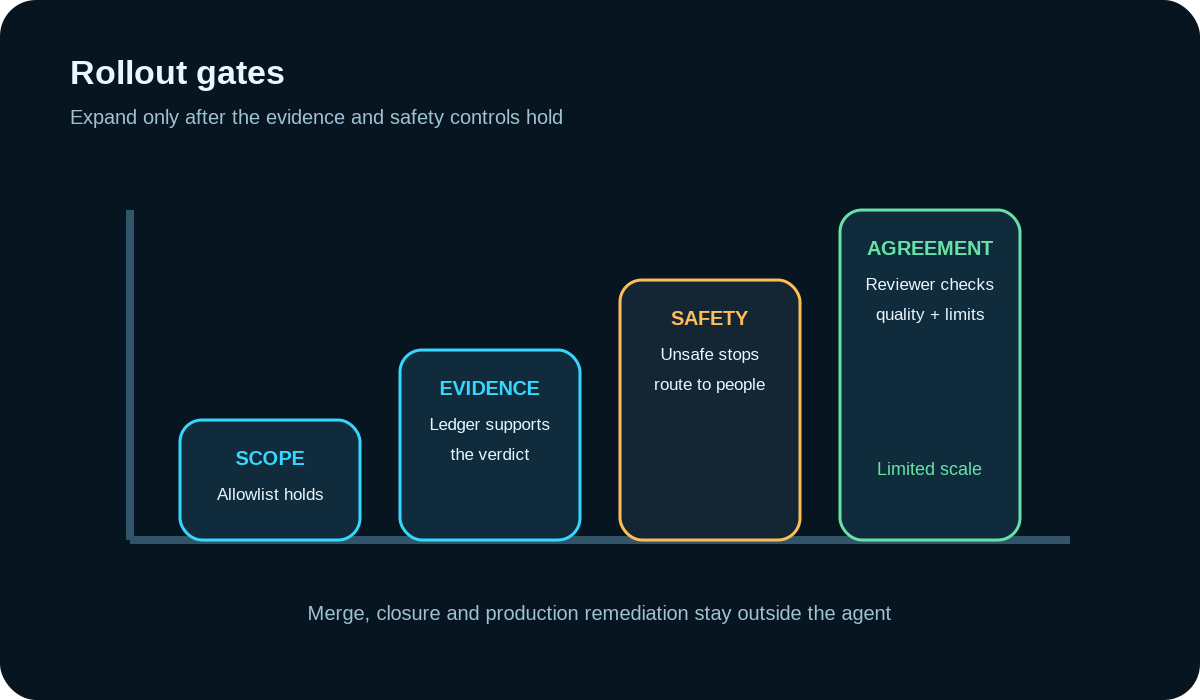
Scale only after the security owner approves supported classes, target boundaries, incident handling, data retention and rollback. Keep pull-request merge, ticket closure and production remediation outside the agent’s authority. Recheck product documentation and commercial terms because availability on request and undocumented pricing can change.
Limitations and topic-selection signal
The ledger can show what the connected tools recorded, but it cannot guarantee complete coverage, safe business impact or correct severity. Staging may differ from production, a supported test may miss a variant and an agent may choose the wrong tool. Retain human review, target allowlists, rate limits, test accounts, monitoring and a kill switch.
Focused Firecrawl research on November 22 returned Detectify’s November 16 launch and product pages first, plus same-day SC Media and other independent coverage. That supports current public attention and a concrete application-security workload; it does not establish independent performance, adoption, search rank, traffic or return on investment.
Put the insight into practice.
Deep Security helps organizations assess risk, validate controls, and build a practical plan to strengthen their defenses.
Talk with Deep Security