

A practical rollout for CodeMender’s November pull-request architecture and v0.21 sandbox updates, with short-lived identity, review gates and evidence checks.
What changed in November
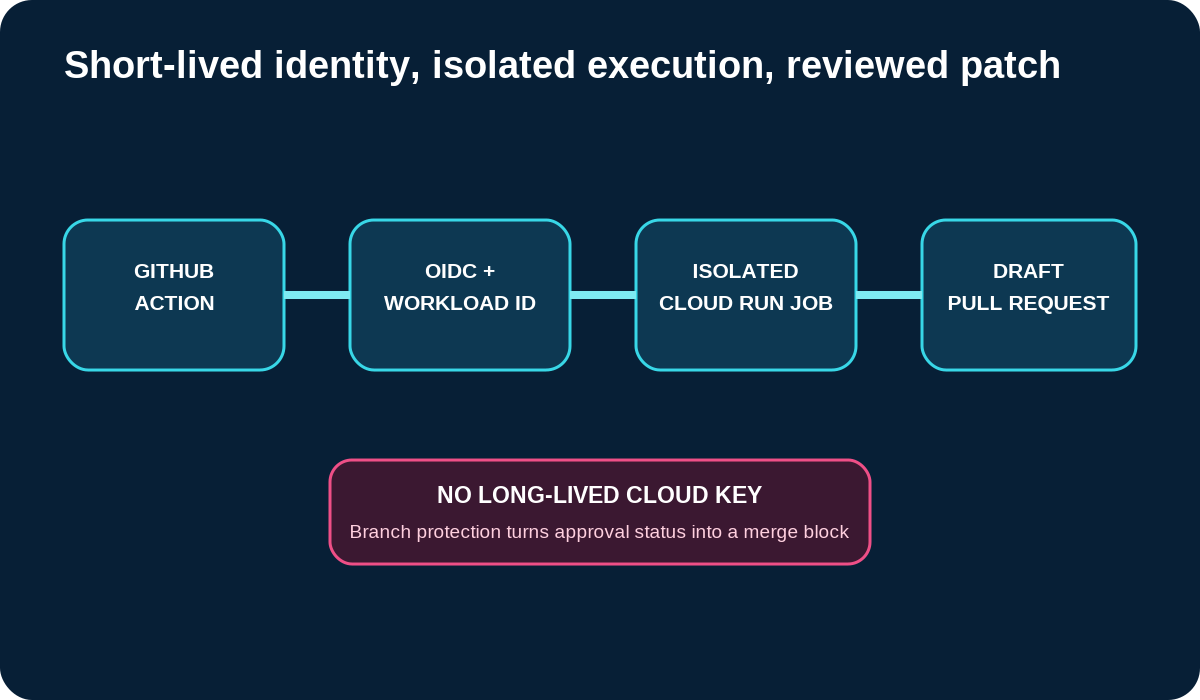
Google Cloud published a reference architecture on November 10 that connects CodeMender to GitHub pull requests through GitHub Actions, Workload Identity Federation, Cloud Run jobs and Cloud Storage. A developer can request a fix, review a proposed diff in a draft pull request and explicitly approve the patch. The architecture avoids a long-lived Google Cloud key and can turn CodeMender’s commit status into a merge block through branch protection.
CodeMender v0.21.0 followed on November 11. Google’s release notes say sandboxed build validation now runs the configured build command inside the sandbox, host toolchain and package-manager directories are mounted read-only, supported caches move to session-scoped temporary directories, Git hooks and host Git configuration are isolated, stalled silent turns time out after 30 minutes, reproducer output is preserved on errors and patch generation retries in a fresh sandbox after certain failures. This is a material workflow and isolation update, not merely a new model.

Who can use it and the important boundaries
Google documents CodeMender as generally available globally. The default language list includes C and C++, C# and .NET, Go, Java, JavaScript and TypeScript, Kotlin, Python, Ruby, Rust and PHP; other model-supported languages can be configured, but Google says it does not publish formal per-language evaluations and quality varies. The CLI requires a Google Cloud project, APIs and IAM roles, Application Default Credentials, a local source workspace and sandbox configuration.
The documentation lists multiple Gemini models and records billed token usage in Cloud Billing, but the November pull-request article does not state a per-run price or quota. CodeMender may send targeted code, vulnerability information, proposed patches, command results, diagnostics and usage telemetry to the service. Google documents a seven-day maximum session-data retention and DeleteInteraction for immediate cleanup. Review current terms, region, billing and data policy before using proprietary code.
- Use a non-production repository or a narrow test branch first.
- Keep secrets, signing keys and production credentials out of the job.
- Treat model-supported language as different from proven patch quality.
- Budget tokens and Cloud Run execution before enabling broad triggers.
Step 1: create an isolated pilot repository
Choose one maintained repository with reproducible tests, a known non-emergency vulnerability and an owner who can evaluate the patch. Fork or branch it into a controlled pilot, remove production secrets and document the expected build, test and reproduction commands.
Deploy the reference implementation only after reviewing its infrastructure and IAM. Bind the workload identity condition to the immutable repository ID, not a mutable name. Use a Cloud Run job in the second-generation environment, restrict direct VPC egress and deny routes that would let untrusted code fetch a second stage or exfiltrate data.

Step 2: separate fix request, preview and approval
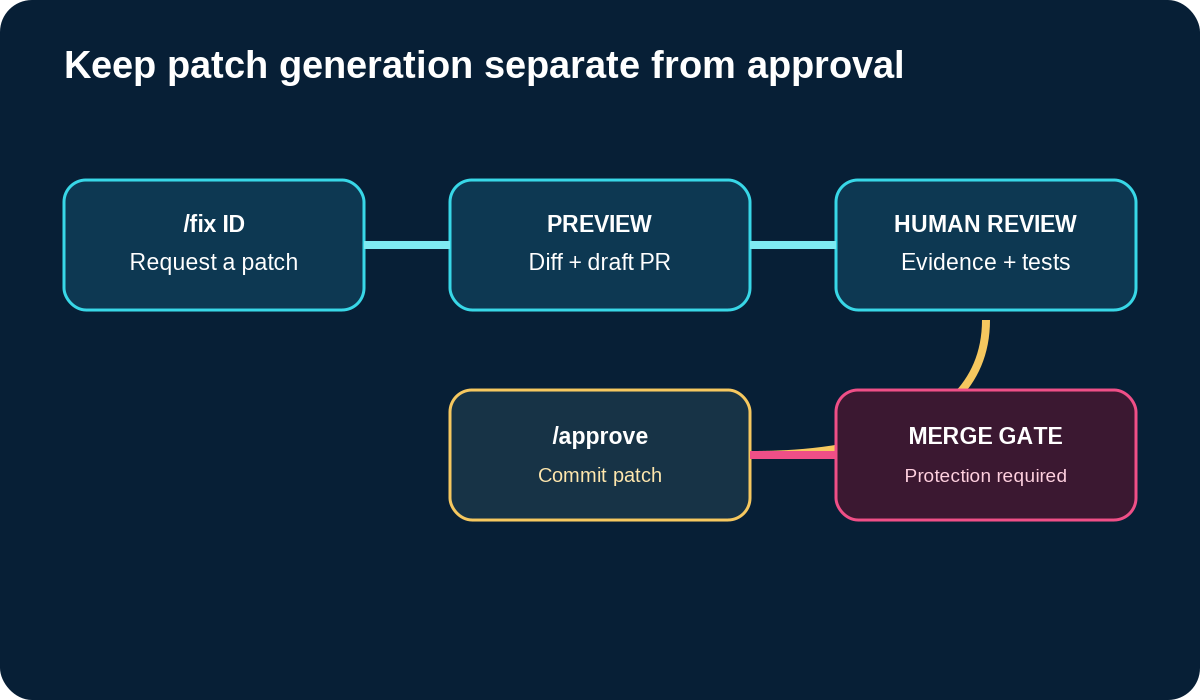
Google’s pattern uses a comment such as “/fix [id]” or “/fix all” to request a patch. CodeMender returns a proposed unified diff behind a preview block with a draft pull request. A separate “/approve” step commits and pushes the patch, then sets the security/codemender-gate status green.
Branch protection is essential: without it, the status is advisory rather than a merge block. Limit who can invoke approval, require another reviewer for security-sensitive code and prevent the agent identity from changing workflow, policy or branch-protection files in the same run.
Step 3: require a security evidence packet
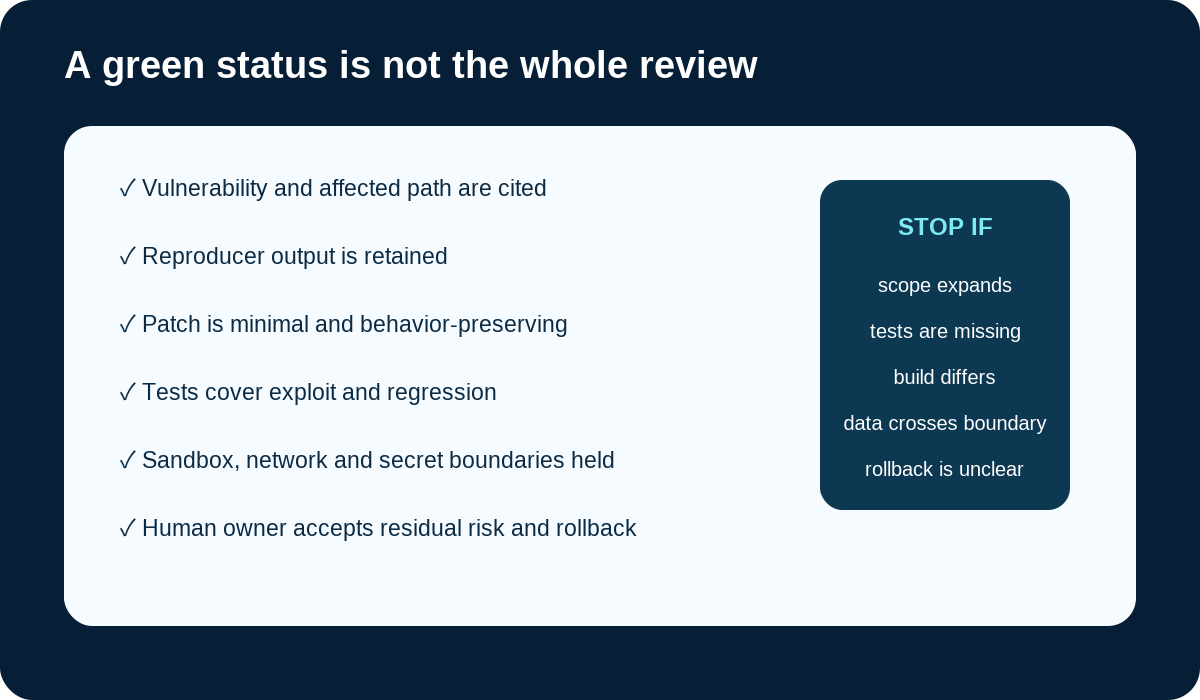
Example review prompt: “For finding CM-17, explain the vulnerable path, cite the reproducer output, summarize the smallest behavior-preserving patch and list every file changed. Return the pre-fix failure, post-fix result, regression tests, build environment, sandbox policy, network attempts and remaining uncertainty. Do not change workflow, dependency policy, authentication, signing or deployment files. Do not approve, merge or claim exploitability is eliminated.”
A human reviewer should reproduce the vulnerability when safe, inspect the diff, run the normal test suite, assess new dependencies and verify that the patch addresses the root cause without widening behavior. Preserve stdout and stderr from failed reproducers; v0.21’s retention of that output is useful precisely because a failed setup is not proof that a vulnerability is absent.
Step 4: measure patch quality before expanding
Run a bounded set of known findings and record valid patch rate, build success, test regressions, reviewer corrections, scope expansion, token cost, job duration and sandbox or egress violations. Separate “patch applied” from “vulnerability fixed” and “safe to merge.”
Expand by language, vulnerability class and repository only after reviewers understand the failure modes. Pause when toolchains change, builds become non-reproducible, the agent touches restricted files or token and execution cost exceeds the pilot budget. Keep emergency remediation and high-impact cryptographic or authorization changes in a manual lane.
Realistic limitations and why this topic was selected
CodeMender can misunderstand exploitability, produce a patch that passes narrow tests, alter performance or compatibility, or fail because the sandbox cannot reproduce the real build. Read-only host tools and isolated caches reduce risk but do not make untrusted repository code harmless. A protected branch, human review, normal secure-development checks and rollback remain required.
Firecrawl searches on November 17 placed Google’s November 10 pull-request guide and November 11 v0.21 release notes prominently, while Google’s November 16 SecOps roundup highlighted the guide among the week’s security developments. Direct independent coverage of the pull-request architecture was limited, so current attention is established from dated primary documentation and a current community roundup—not claimed traffic or popularity. The topic was selected because the new isolation and approval workflow directly serves Deep Security’s secure-development audience.
Put the insight into practice.
Deep Security helps organizations assess risk, validate controls, and build a practical plan to strengthen their defenses.
Talk with Deep Security