

Pilot Commvault IDRecover's new AI-guided identity remediation in a synthetic lab with independent evidence, human approval and a recovery drill.
What Commvault announced — and what remains uncertain
Commvault announced new identity resilience capabilities on October 28. The company says IDRecover will continuously audit and track changes across Active Directory, Microsoft Entra ID and Okta, expose Tier 0 relationships, provide AI-guided remediation recommendations and help recover identity configurations to a trusted state.
Independent analysis from Futurum on October 30 highlighted the shift toward pre-incident identity exposure management, but also noted that several capabilities are early access, with no firm general-availability dates or complete packaging details. The primary release says future capabilities will enter early access in the coming quarters. Pricing was not published in the reviewed sources.
This is therefore a pilot guide, not a procurement endorsement. Verify which objects, tenants, non-human identities, regions and recovery operations your account can actually access, plus licensing, retention and support terms, before scheduling a test.
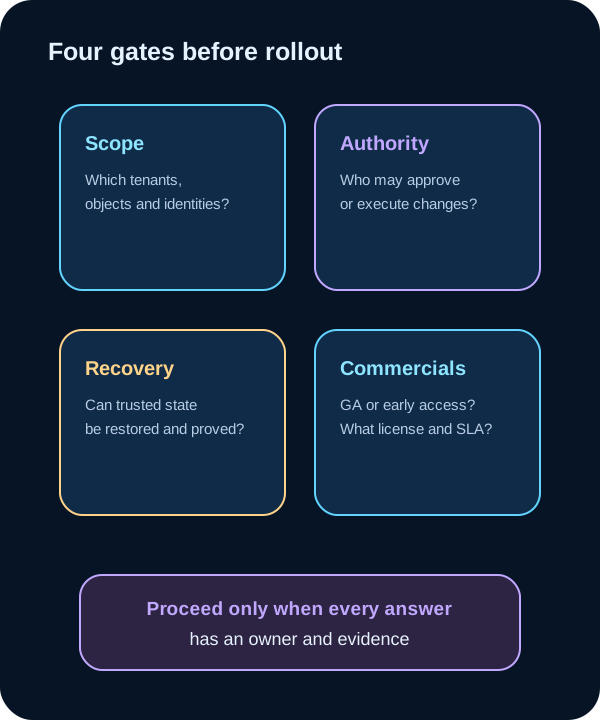
- What changed: broader identity change tracking, Tier 0 exposure context and AI-guided remediation tied to recovery.
- Who can use it: organizations with eligible Commvault access and supported identity systems; exact availability requires vendor confirmation.
- Practical workload: validate a risky privileged path, approve a bounded fix and prove recovery without granting AI autonomous authority.
Create a synthetic identity-resilience lab
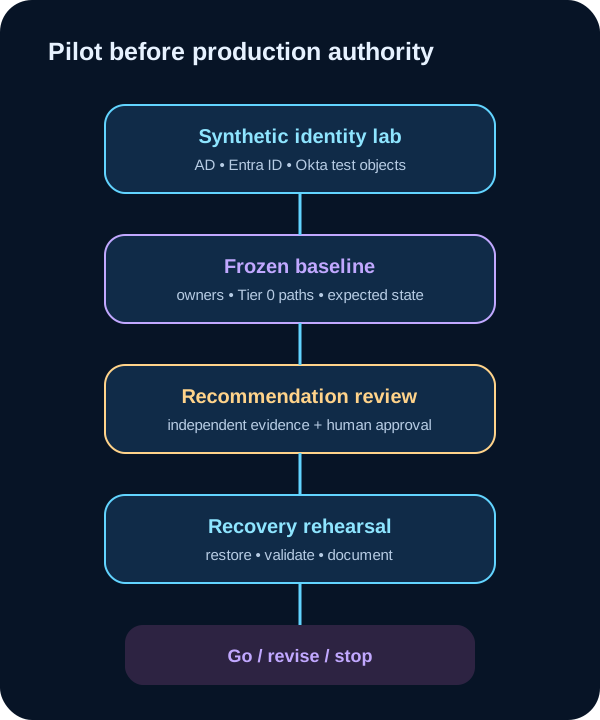
Build a test tenant or isolated directory with synthetic users, groups, service identities and a small privileged tier. Include one documented risky path, such as an ordinary test account controlling a group that can administer a protected test system. Do not import real employee identities, customer data, production secrets or live break-glass accounts.
Export the expected object state, ownership, group lineage and access policy before connecting the pilot. Time-stamp and hash that baseline. Assign separate people to product administration, identity ownership and recovery validation so one operator cannot create, approve and declare success on the same change.
Define stop conditions: unexplained writes, unsupported object types, missing audit events, an unrecoverable change, or a recommendation that exceeds the synthetic scenario.

- Tools required: supported identity test systems, IDRecover access, independent directory queries, change record and recovery evidence store.
- Isolation: no trust path from the test privileged tier to production.
- Success evidence: finding, corroboration, approved change, rollback and post-recovery validation.
Run the pilot in four controlled phases
First, discover the synthetic environment and compare IDRecover's inventory with the frozen baseline. Second, review whether the intended Tier 0 exposure is identified and whether the explanation names the relevant objects and relationship. Third, collect the AI-guided recommendation without authorizing an automatic change. Fourth, execute the approved fix through the normal change path, then rehearse recovery to the trusted baseline.
Record read coverage and unsupported objects as explicit gaps. A product cannot protect what it cannot see, and a visually complete graph may still omit a connector, tenant or identity class.
Use one change per run. Multiple simultaneous fixes make it difficult to prove which action or recovery step produced the observed state.
Verify every recommendation independently
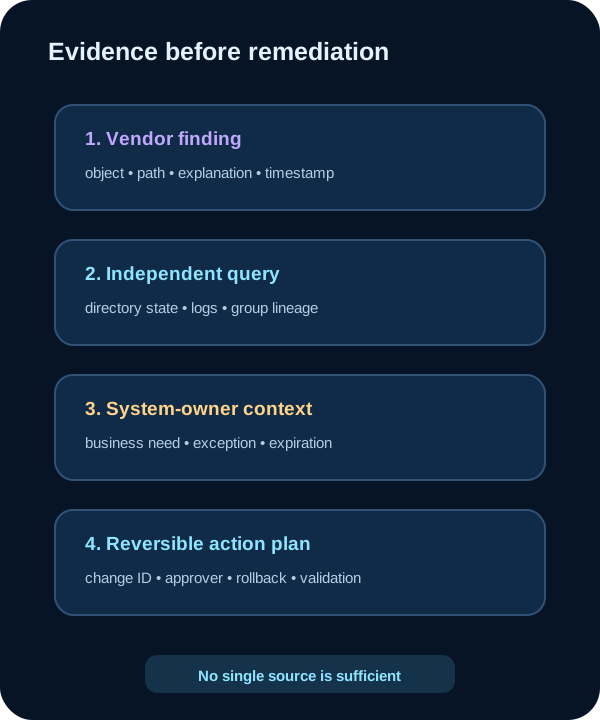
For each reported exposure, capture the named objects, relationship path, timestamps and explanation. Re-run the relationship with independent directory or identity-provider queries, then ask the system owner whether the access is required, temporary or stale. A recommendation is ready for change review only when the vendor finding, independent state and business context agree.
Example review prompt for an approved assistant: Using only the supplied finding, directory query and owner record, build a table of observed objects, privilege path, business justification, expiry and conflicting evidence. Cite every row. Mark missing evidence unknown. Propose no command and do not authorize remediation.
If the product's explanation and independent query disagree, preserve both records and stop. Connector delay, nested-group interpretation, stale cache or a real defect can all cause disagreement.
Prove recovery, not just remediation
After the approved test change, validate the intended privilege reduction with an independent query and a synthetic access attempt. Then invoke the documented recovery path to restore the trusted state. Re-query object values, membership, ownership and relevant policy, and confirm that the audit trail links the change and recovery to named approvers.
A successful interface message is not recovery proof. Compare the restored object state with the frozen baseline and document any field that is intentionally different. Test downstream effects such as cached tokens separately; directory recovery may not revoke an already issued session.
Keep break-glass access outside the product being tested, and rehearse the stop procedure before the first change.

Decide with a readiness record
The final record should list supported and unsupported identity sources, object coverage, evidence latency, false or ambiguous findings, recommendation quality, required approval roles, recovery completeness, remaining session risk, commercial status and owners for every gap. Use your own observations; this article provides no pass rate or performance benchmark.
A limited rollout can proceed only for the tested scope, with human approval and rollback retained. Early-access features should have an explicit exit plan if the interface, schema, support terms or availability changes.
Limitations and procurement questions
The announcement does not establish complete support for every directory object, non-human identity, tenant topology or recovery dependency. AI-guided explanations can be incomplete or wrong, and identity restoration does not automatically invalidate tokens or reverse downstream application state.
Ask Commvault which features are generally available versus early access, which plans include them, what data leaves your environment, how recommendations are logged, which objects can be restored, what regional and retention controls apply, and how support handles a failed recovery. Confirm pricing and contract language directly; neither was fully specified in the reviewed public material.
Put the insight into practice.
Deep Security helps organizations assess risk, validate controls, and build a practical plan to strengthen their defenses.
Talk with Deep Security