
Trace an incorrect AI support answer in CloudWatch Omni. Separate retrieval, tool and infrastructure problems, then compare a correction against a fixed test set.
Start with the bad answer, not the green dashboard
Imagine an internal IT assistant that gives a clear but outdated password-reset instruction. The service returns successfully, latency looks normal and the user still receives the wrong procedure. That fictional scenario matters to teams running internal business applications, managed IT workflows and customer support tools: system availability alone does not establish answer quality.
AWS launched CloudWatch Omni on September 22, 2026, with agent traces, evaluations and application telemetry in a shared experience. This is September context within the expanded 30-day research window, not a new October launch. Primary documentation and pricing were reviewed October 19.
The following is a proposed investigation workflow. It reports no hands-on benchmark or customer outcome. Its deliverable is a verified explanation and a small regression test set, not an automatic production fix.

1. Prepare one instrumented, approved workflow
You need a supported instrumented agent, approved sample inputs, access to its traces and a reviewer who knows the correct procedure. Omni uses OpenTelemetry and OTLP. Existing CloudWatch telemetry can appear in Omni; other workloads require appropriate instrumentation. Confirm that model and tool spans carry the context you need before expecting the interface to explain a failure.
For local development, AWS offers a free Omni IDE extension without an AWS account. A hosted domain and space require AWS setup and permissions. A space maps to an account and Region; cross-account or cross-Region telemetry requires deliberate centralization rather than assuming Omni collects everything. Set access boundaries for the actual data sources.
Prompts and tool responses can contain sensitive information. Start with synthetic questions and approved documents, remove unnecessary secrets and personal data before collection, and review retention. The local extension’s availability does not mean production ingestion, storage, analysis, model evaluation or investigation services are universally free; check the current pricing and your selected services.
2. Trace a single incorrect answer
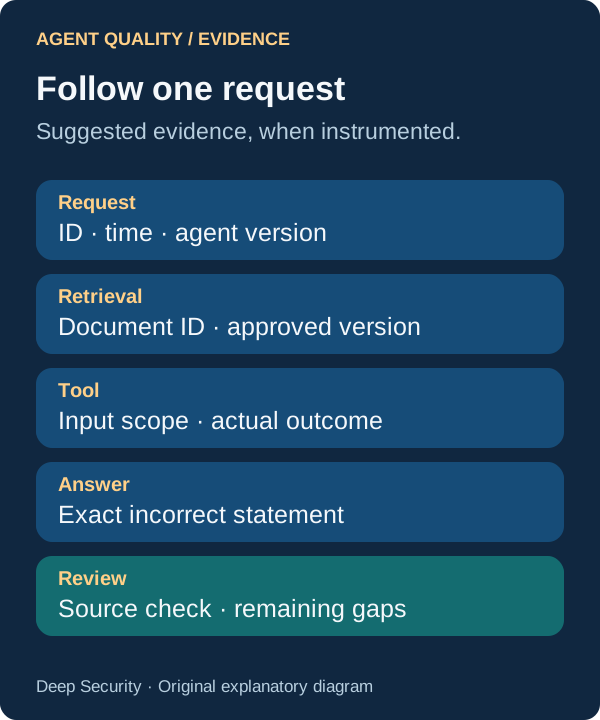
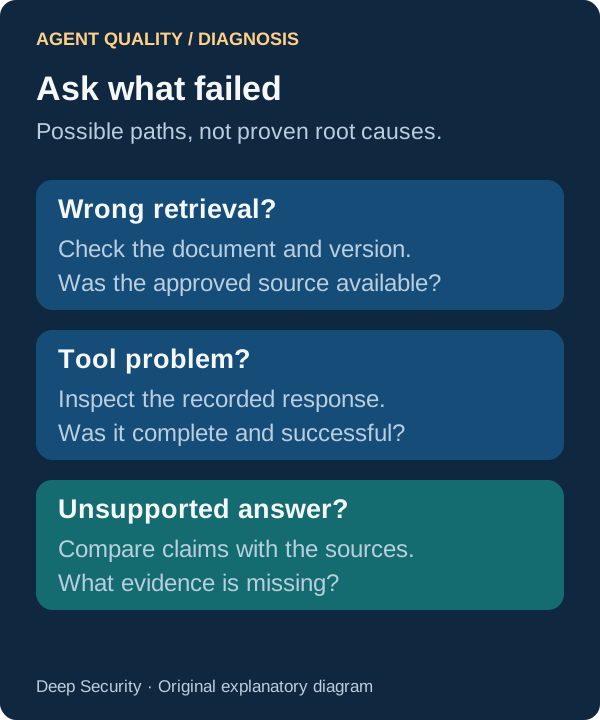
Record the request identifier, time window, agent version and known incorrect statement. Open the relevant trace and examine retrieval, model and tool steps. In the password-reset example, ask whether the retrieved document was outdated, the correct document was ignored, a tool failed, or the final answer went beyond the supplied evidence.
Suggested natural-language investigation prompt: ‘For this request and time window, identify the retrieved source references and tool outcomes associated with the final answer. Separate observed span evidence from possible explanations. Compare the referenced procedure version with the approved version supplied here. List missing telemetry. Do not change the agent or classify a hypothesis as root cause without supporting records.’
Treat the generated query and response as a starting point. Check the query scope, timestamps and matching trace identifiers, then open the underlying records. A correlated database error may be relevant, but timing alone does not prove it caused the wrong instruction.
3. Define a good answer before changing the prompt
Create a small fixed dataset of approved scenarios: the ordinary procedure, a changed procedure, an unavailable source and a request outside the assistant’s allowed scope. For each, record the required source version, acceptable next step and conditions that should trigger escalation. Use synthetic identities and no live credential-reset action.
Omni supports on-demand evaluation against datasets and continuous evaluation of production traces. Evaluators, including custom judge-model criteria, can help identify outputs to inspect. A judge score is still an estimate; compare its explanation with the source and let the procedure owner adjudicate important disagreements.
Change one relevant factor first, such as correcting the document selection or making source-version checks explicit. Run the same dataset against the baseline and candidate with the relevant settings recorded. Do not report an improvement if the candidate was tested on easier examples or an unrecorded model change.

4. Review the whole workload before release
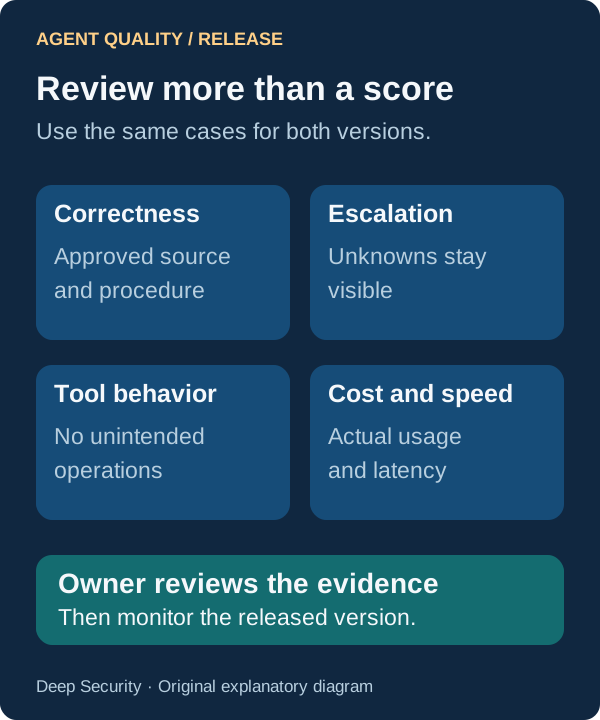
For each scenario, retain the actual output, source references, reviewer decision and evaluator result. Also inspect tool errors, latency, token use and telemetry cost. A correction that improves one answer but exposes extra data or creates repeated tool calls needs more work.
Use the existing change process for a release and retain a recoverable prior configuration. After deployment, watch the same failure category and inspect sampled real outputs only within approved access and retention rules. The article’s suggested workflow does not authorize autonomous password resets, user contact or infrastructure changes.
The useful outcome is an explanation you can check
A good investigation ends with the incorrect statement, the trace evidence explaining it, the correction, the unchanged test cases and the remaining uncertainty. If the source version or tool result was never captured, improve collection and repeat the example safely instead of inventing the missing link.
For a small IT team, one well-instrumented support workflow is a more useful starting point than collecting every conversation. Measure your own investigation effort and correction quality before expanding. Observability can make evidence easier to inspect, but it does not make an evaluator infallible or an AI assistant safe for every operational action.
- Keep answer correctness separate from service availability.
- Trace claims to approved sources and real tool outcomes.
- Compare corrections on the same dataset and monitor the released version.
Put the insight into practice.
Deep Security helps organizations assess risk, validate controls, and build a practical plan to strengthen their defenses.
Talk with Deep Security