
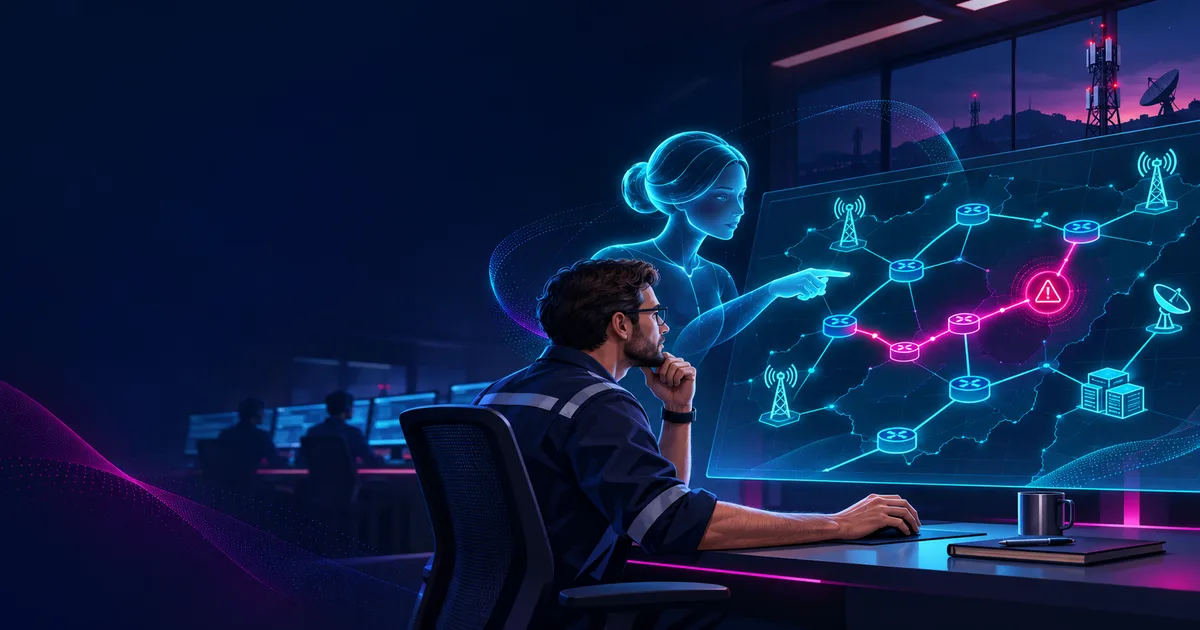
A practical workflow for using AI agents to correlate network alarms, run approved read-only queries and draft cited fault reports while engineers retain every change decision.
Why human-gated network investigation is timely
Microsoft published a November 11 feature describing AIO-Net, a continuous-learning agentic AI platform that KT developed with Microsoft and trained with the operating procedures and specialist knowledge of KT network experts called Meisters. According to KT’s company-reported measurements, agents analyze anomaly data every minute, detect issues in two to three minutes instead of more than ten, and produce an investigation report in about five minutes. The current deployment covers 70 units of critical equipment, with a planned expansion to 280.
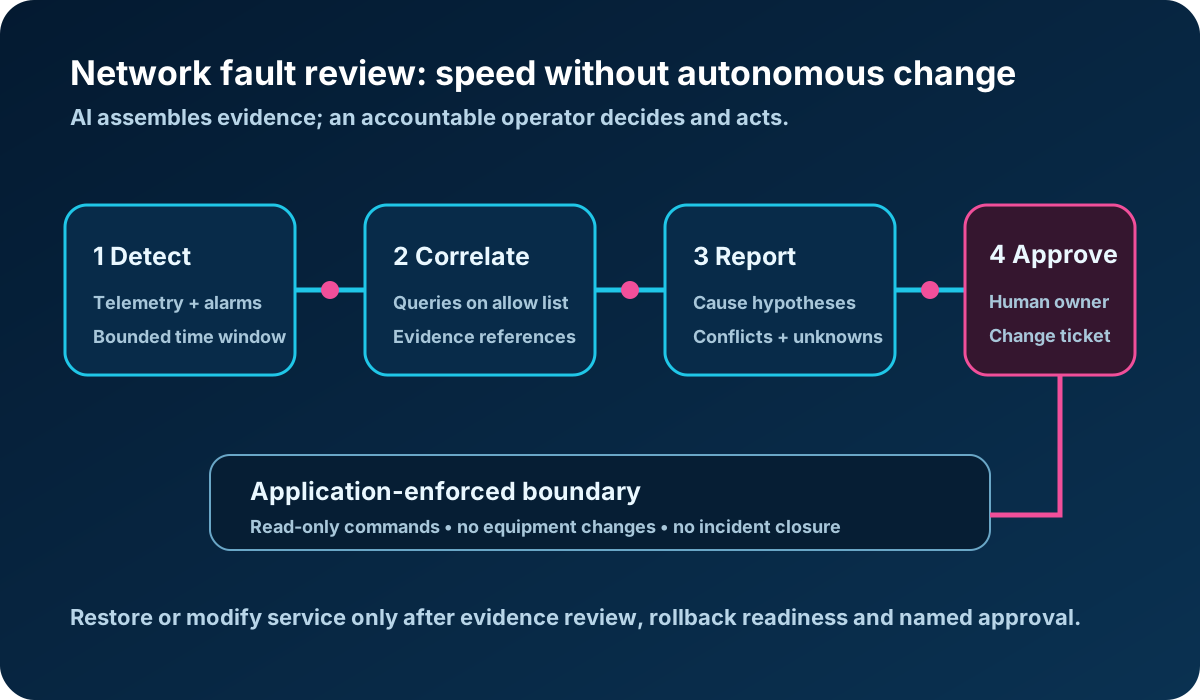
Independent same-day coverage emphasized the control that matters most: the agents can inspect equipment only with application-enforced, allow-listed read-only commands. They cannot repair or reconfigure the network. The published timing and scope are KT’s measurements, not results reproduced by Deep Security. The useful pattern is a faster evidence handoff with human action authority—not a promise that an AI agent can safely run a network.
Audience, tools and the safe operating boundary
This use case fits network operations centers, managed service providers, cloud and infrastructure teams, and security operations groups that already have authoritative telemetry and a controlled change process. You need alarm and performance streams, topology and asset inventories, a read-only query service, an incident system, a change-management system, a secrets broker, audit logging and an organization-approved model or agent platform.
Start with one equipment family and one incident class. The agent may retrieve approved fields, align timestamps, group related alerts and draft a report. It may not send arbitrary commands, change configuration, suppress alarms, contact customers, close incidents or create its own permissions. Keep credentials and raw sensitive configuration outside prompts; expose narrow tools that return redacted evidence IDs.
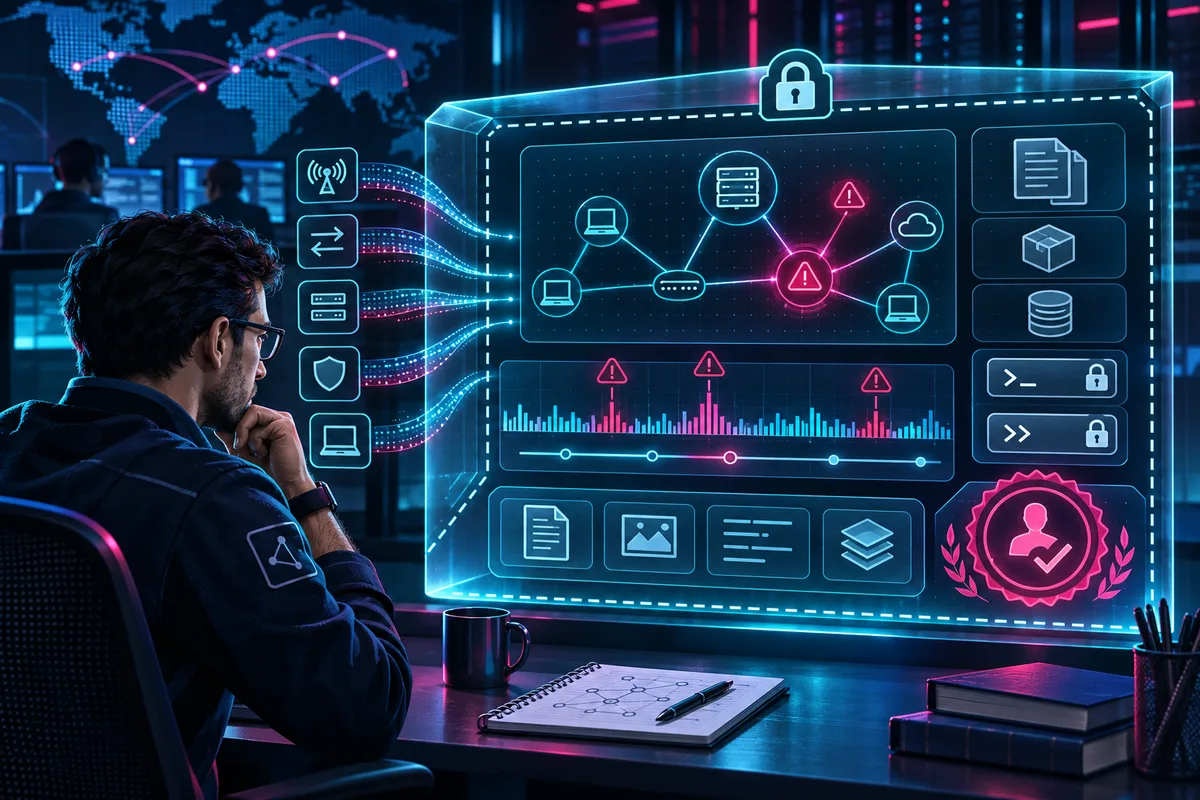
- System of record: monitoring, configuration management and change tickets.
- AI role: correlate events, expose conflicts and draft a cited hypothesis queue.
- Human role: validate cause, choose the change, approve execution and verify recovery.
- Stop condition: missing logs, clock drift, unapproved command, stale topology or unsupported cause.
Step 1: write an evidence contract before a prompt
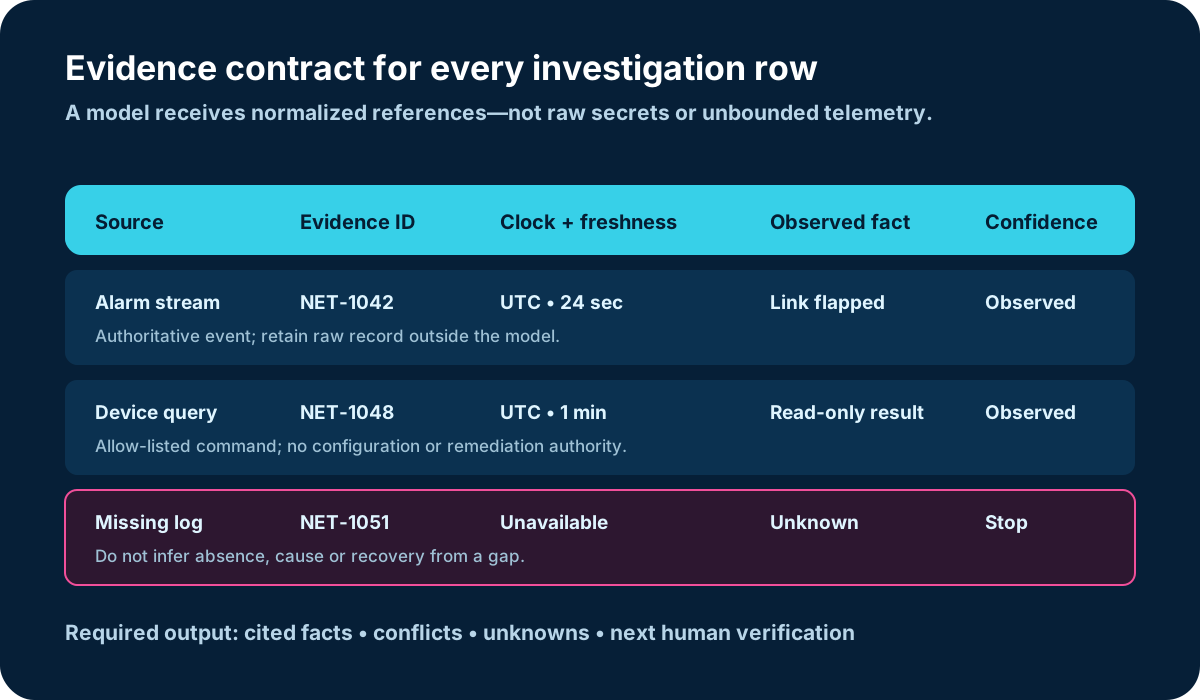
Normalize each event into a small record: source, evidence ID, event time, collection time, asset ID, signal freshness, observed fact, confidence class and link to the immutable record. Separate observed facts from model hypotheses. A missing device response becomes unknown; it does not become proof that the device was healthy or unreachable.
Define a server-side tool allow list. Each query should name the equipment class, permitted command, timeout, maximum result size and redaction rules. Enforce read-only behavior in the application and device account, not in prose. Log the tool request, arguments, result hash, agent run and human reviewer.
Step 2: ask for a cited hypothesis queue
Give the agent a bounded incident window, a current topology snapshot and only the approved tools. Require separate output fields for observed facts, possible causes, contradicting evidence, unknowns, next read-only check and escalation owner. Do not request a single diagnosis without alternatives or supporting evidence.
Example prompt: “For incident NOC-1842, use only evidence NET-1042 through NET-1090 and the approved read-only tools. Return observed facts with evidence IDs, up to three ranked cause hypotheses, contradictory evidence, missing telemetry, and the least invasive next check. Do not send configuration commands, suppress alerts, contact users, claim recovery, or treat an absent log as proof. Route every proposed change to the named network engineer.”
- Expected output: a cited timeline, hypothesis queue and next-check list.
- Reject any factual line without an evidence ID and timestamp.
- Recalculate timing and threshold rules outside the model.
- Show the source records beside the summary during review.
Step 3: earn scope through staged evaluation
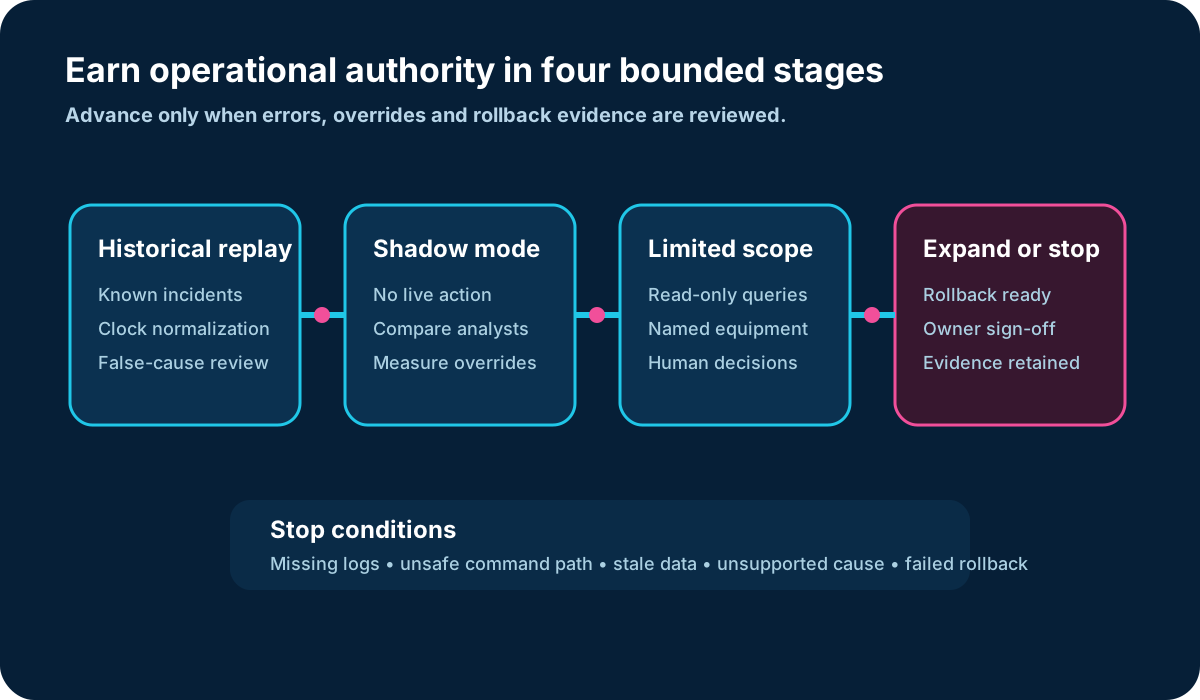
Replay labeled historical incidents first. Measure missed causes, unsupported claims, wrong asset associations, tool errors and the time an engineer spends correcting the report. Move to shadow mode beside the existing workflow, then to a small live cohort with read-only queries. Do not use the vendor’s or another operator’s timing as your acceptance threshold.
Before expansion, test stale topology, duplicate alarms, partial outages, clock skew, poisoned telemetry, unavailable tools and conflicting operator notes. Define rollback as disabling agent access and returning to the established runbook—not asking the same agent to recover itself.
Step 4: make the human handoff operational
The final packet should name the incident, affected assets, evidence window, observations, competing hypotheses, confidence, unresolved gaps, proposed verification, proposed change, risk, rollback and approver. The network engineer should be able to reject the packet, request another bounded query or open a change ticket without copying model prose into an execution console.
After an approved change, collect fresh telemetry and compare it with an explicit recovery condition. Record the operator, command source, change ticket and outcome. The AI assistant may summarize the after-state, but only the accountable owner should declare restoration or close the incident.

Realistic limitations
An agent cannot diagnose what the available telemetry does not reveal. It may merge similar devices, mistake correlation for cause, overvalue a familiar runbook, or hide uncertainty behind a polished explanation. Read-only access reduces destructive risk but can still expose sensitive topology, configuration, customer or credential data if queries and outputs are too broad.
KT’s results come from its environment, scope and operating practices. The reviewed sources do not publish model costs, false-diagnosis rates, full architecture, incident labels or an independent benchmark. This article did not test AIO-Net, Microsoft Foundry or a telecom network. Treat the case as a control pattern to evaluate locally, not a transferable performance claim.
Why this topic was selected
A focused Firecrawl search on November 12 for “KT Meisters Microsoft AI agents spot network issues before customers November 2026” returned Microsoft’s primary customer feature first and same-day independent coverage third. The independent result focused on the human-control boundary rather than merely repeating speed claims. That prominent current placement is a topic-interest signal, not proof of Google rank, search volume or traffic. The information gap was a reproducible pilot that small infrastructure teams can adapt without granting autonomous network authority.
Put the insight into practice.
Deep Security helps organizations assess risk, validate controls, and build a practical plan to strengthen their defenses.
Talk with Deep Security