

Build a cited WordPress upgrade timeline from version, file, proxy and audit evidence after CISA confirmed active exploitation of CVE-2026-119977.
The fresh incident signal and the older fix
CISA added CVE-2026-119977 to its Known Exploited Vulnerabilities Catalog on November 3 based on evidence of active exploitation. The issue is a WordPress Core time-of-check/time-of-use race condition in the upgrade process. CISA encourages all organizations to prioritize KEV remediation; the binding directive it cites applies specifically to federal civilian agencies.
WordPress released version 7.1.4 on October 28 and recommended immediate updates. That primary release is eight days old, just outside this article's seven-day research preference, but the November 3 CISA action and November 4 coverage from BleepingComputer make the active-exploitation context new. BleepingComputer reported that affected versions extend through 7.1.3 and attributed recent attack telemetry to Wordfence; those are third-party claims, not measurements by Deep Security.
The useful AI workload for a web-operations team is a bounded evidence review around the upgrade window: what version ran, when maintenance began, which requests and file changes occurred, what changed after the update and what remains unknown.
- Problem: installing a fixed version does not by itself prove a previously exposed site was not altered.
- Audience: WordPress owners, MSPs, web operations, incident responders and hosting administrators.
- Output: a cited before-during-after timeline with verified state, anomalies, unknowns and a human case decision.
Preserve the evidence before changing the story
If active compromise is suspected, follow the incident plan before routine maintenance. Preserve the current WordPress version, core and plugin inventory, file metadata or hashes, administrator list, scheduled tasks, web-server and reverse-proxy logs, outbound connections, deployment records and hosting audit events. Record clocks, time zones and collection commands.
Keep raw evidence in the authoritative logging, backup or forensic system. Pass the assistant redacted rows or stable evidence IDs, not database credentials, authentication cookies, private keys, customer content or the live site filesystem. Separate the model workspace from production and deny shell, file-write, plugin-install and update permissions.
A clean backup is only useful if its creation time, retention and restore path are known. Preserve the pre-change snapshot according to policy before rolling forward.

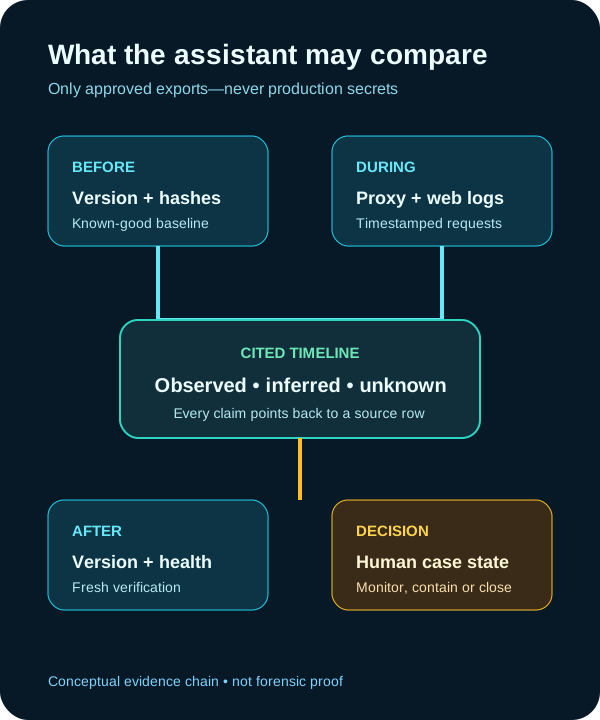
- Before: version, files, accounts, scheduled tasks and known-good snapshot.
- During: maintenance timing, proxy and web requests, process and file events.
- After: fixed version, integrity checks, application health and monitored behavior.
Ask for a timeline that distinguishes facts from inference
Normalize timestamps and create a closed evidence table with source ID, event time, collector, asset, event type, observed value and integrity note. Ask the model to order the rows and identify contradictions or missing periods without filling them in.
Example prompt: “Using only the supplied evidence rows, build a before-during-after timeline for the WordPress maintenance window. Cite a source ID for every fact. Label each statement observed, inferred or unknown. Flag new or changed files, accounts, jobs, processes, outbound destinations and requests that require human review. Do not execute code, infer that absence of a log proves absence of activity, recommend an exploit, or declare the server clean.”
The expected output is a review packet and question list, not a compromise determination. A responder should be able to reproduce every line from the original system of record.
Patch through a controlled maintenance path
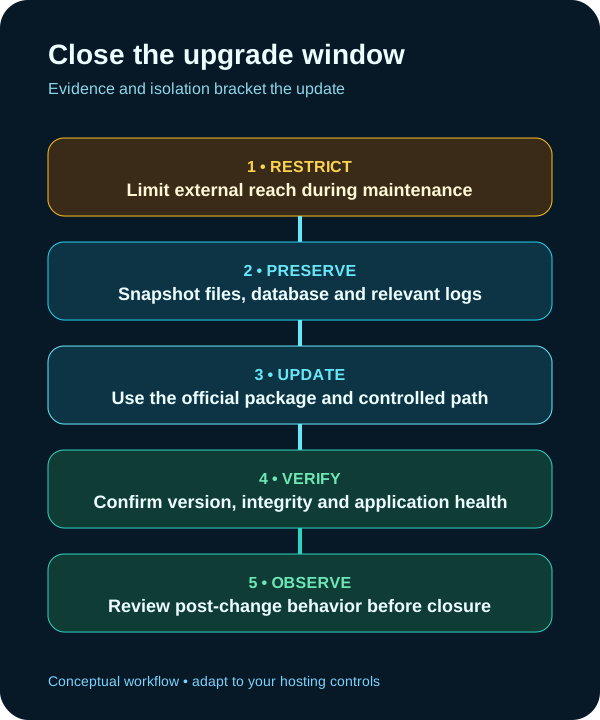
Use the official WordPress release and the hosting provider's established change process. Restrict external reach during the update if the platform supports it, preserve the relevant evidence, verify the package source and record the exact version and time. Do not let the assistant run the update or improvise web-server rules.
Afterward, independently read back the running version and validate core integrity, application health, authentication, scheduled jobs, outbound behavior and any unexpected file or account changes. Rotate credentials only through the incident and secrets-management process when evidence or policy calls for it.
If a suspicious change cannot be explained, keep the case open and follow the organization's containment and recovery plan. Rebuilding from a known-good source may be safer than trying to label every file in place.

Require a closure gate and an observation window
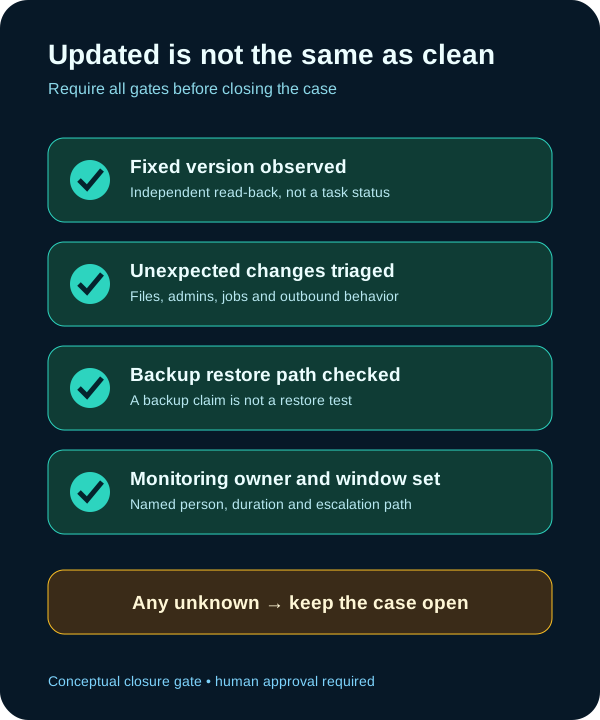
Do not close the case because the updater reported success. Require the fixed version to be observed independently, suspicious changes to be triaged, recovery to be available, monitoring to be active and a named owner to accept the residual uncertainty.
Track time to preserve evidence, timeline coverage, uncited AI statements, unexplained changes, update verification, restoration readiness and post-change alerts. Define the observation window from your site's risk and traffic baseline; no public source reviewed here establishes a universal safe duration.
Store the human disposition beside the generated packet, including who approved closure and which evidence would reopen the case.
Limitations and response boundaries
Incomplete logging, shared hosting, overwritten files, clock drift, caching and attacker cleanup can leave gaps. A model can also overfit normal plugin behavior into an incident or normalize an important anomaly away.
CISA's KEV entry confirms exploitation in the wild, not that a particular site was attacked. Third-party attack counts and affected-version summaries must remain attributed to their publishers and checked against the current vendor advisory.
This workflow is for evidence organization. It does not replace patching, professional incident response, malware analysis, backup validation, legal advice or a hosting administrator with access to the authoritative environment.
Put the insight into practice.
Deep Security helps organizations assess risk, validate controls, and build a practical plan to strengthen their defenses.
Talk with Deep Security