

Reconcile CMDB, DNS, cloud, gateway, repository and traffic records with AI to find forgotten web apps and APIs, verify owners and close exposure gaps.
Why forgotten applications are back in focus
On October 23, 2026, Akamai highlighted a familiar security gap in reporting about South Korean financial-sector incidents: attackers may look beyond flagship systems to loan-broker services, employee applications, partner portals, sales-support tools and APIs that receive less scrutiny. AI-assisted offensive tooling can increase search speed, but it does not create the underlying forgotten route or stale authentication control.
South Korea’s Financial Services Commission said on October 14 that 16 companies had reported incidents involving about 100,000 pieces of customer information. It also said investigators were still determining attack vectors, whether incidents were related and whether AI was used. The FSC’s 12-point review covered 555 firms; 130 reported areas needing improvement, mostly involving patches or control systems.
Focused Firecrawl searches on October 24 surfaced the new Akamai analysis, the FSC release and several recent independent reports about ARTEX and unmanaged systems. That shows current attention to the problem. AI’s exact role across the incidents remains unconfirmed, and search placement is not proof of traffic, universal prevalence or future Google ranking.
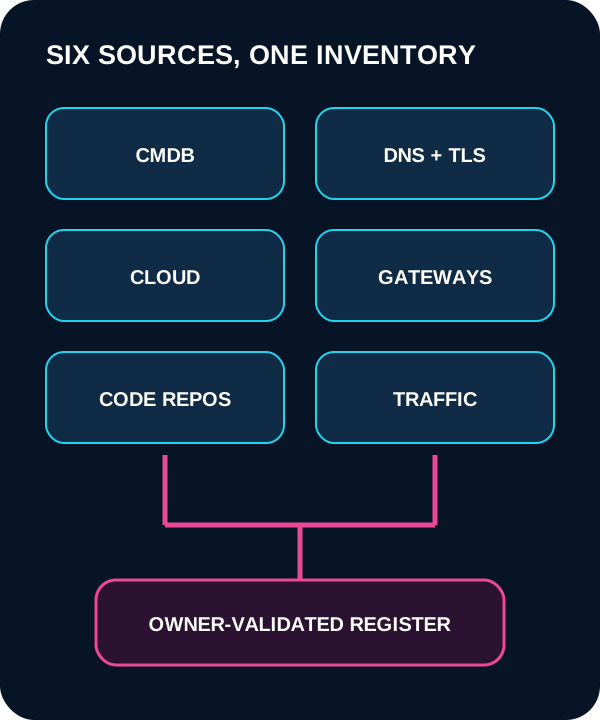
1. Export six approved views of the estate
Collect the current CMDB or service catalog; DNS zones and certificate transparency or approved certificate-management exports; cloud load balancers, IPs and platform services; API gateway and WAF routes; code repositories and deployment manifests; and recent traffic or observability records. Use public and organization-approved data only.
Limit the first pass to metadata: hostname, URL or route, cloud account, environment, repository, last deployment, certificate, observed traffic, authentication control and known owner. Remove credentials, tokens, request bodies, customer records and private source code before an assistant sees the export.
This workflow does not authorize active scanning or testing. If validation requires a request to a system, route it through the organization’s approved vulnerability-management or application-security process with explicit scope.

2. Use AI to normalize and cite—not to invent ownership
A useful prompt is: “Normalize these sanitized asset exports into likely services. Preserve every source identifier. Cluster likely duplicates using hostname, certificate, account, repository and route evidence. For each cluster list contradictions, missing owner, last observed activity and the exact records supporting the match. Do not invent an owner or label a service inactive.”
Expected output: candidate clusters plus a contradiction queue. Common problems include one hostname pointing at several environments, a repository name reused across products, a certificate covering unrelated services or traffic from a health check that makes a retired app look active.
Have an analyst sample both matches and non-matches against the raw exports. The assistant accelerates record linkage; it is not an authoritative discovery sensor and cannot see assets absent from every supplied source.
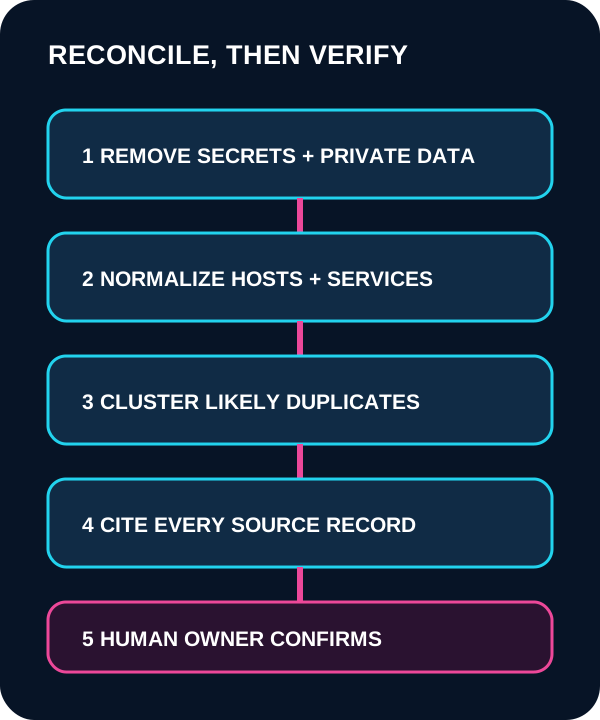
3. Let owners confirm purpose, data and access paths
Send each candidate service to the likely application, cloud and business owners. Ask them to confirm purpose, supported users, data classification, authentication method, external integrations, deployment source, operational need and retirement date. “Unknown” is a valid temporary answer with an accountable investigator and deadline.
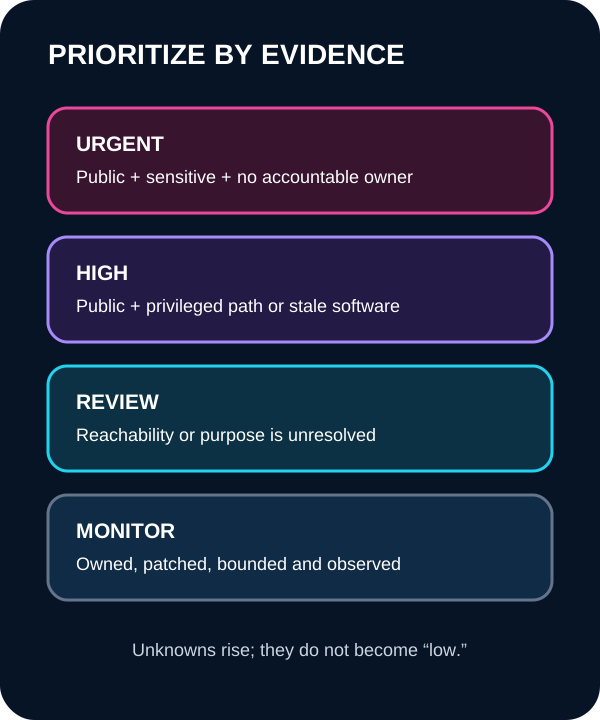
Prioritize services that are internet reachable and handle sensitive data, accept privileged actions, lack a confirmed owner, run stale software or bypass the standard gateway. Do not lower an asset merely because the assistant found no vulnerability or because traffic is quiet.
Use a qualitative, reviewable rubric rather than invented risk scores. An urgent queue can mean public plus sensitive plus unowned; a high queue can mean public plus privileged or stale; a review queue can hold unresolved reachability or purpose.

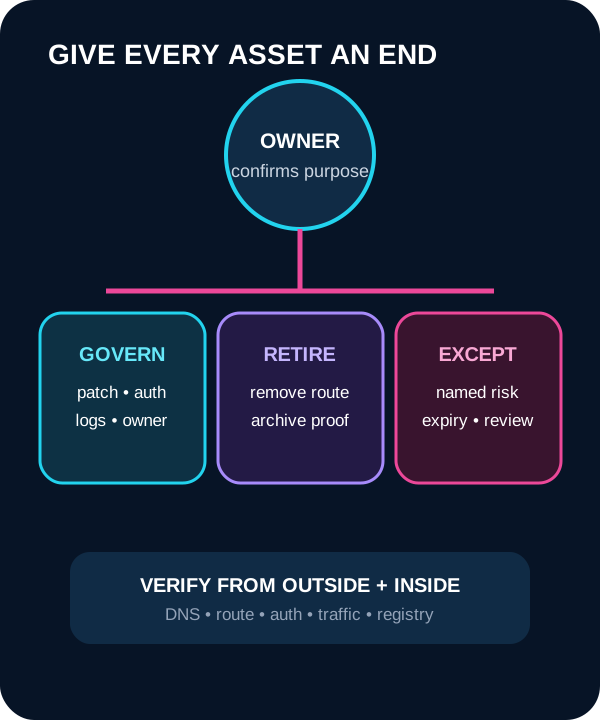
4. Govern, retire or explicitly except every service
For a needed service, restore accountable ownership, patching, authentication, logging, backups, data minimization and standard gateway controls. For an obsolete service, remove DNS and routes, revoke credentials, archive required records and verify from both authorized external and internal perspectives that the old path no longer answers.
Where immediate retirement is impossible, document the risk owner, compensating controls, review date and automatic expiry. An exception without an owner and deadline is just another forgotten asset.
Suggested closeout prompt: “Compare the approved inventory before and after remediation. Cite owner confirmation, deployed version, route or DNS state, authentication check, traffic observation and exception expiry. List every missing record as an open item.”
A repeatable operating rhythm and realistic limits
Re-run reconciliation after acquisitions, cloud-account changes, gateway migrations and major product launches, not only after an incident. Track inventory coverage and aging of unowned assets, but do not publish a coverage percentage unless the denominator and source quality are defensible.
AI can reduce the clerical work of joining inconsistent exports. It cannot prove an undiscovered asset does not exist, authorize probing, determine business necessity or replace external attack-surface monitoring and human application knowledge.
- Reconcile at least six independent sources and retain provenance.
- Require an accountable owner, purpose and disposition for each service.
- Verify retirement or governance using fresh network, identity and traffic evidence.
Put the insight into practice.
Deep Security helps organizations assess risk, validate controls, and build a practical plan to strengthen their defenses.
Talk with Deep Security