

Use an approved AI assistant to map vendor questionnaire answers to security requirements and dated evidence. Identify scope gaps, draft precise questions, and retain human approval.
Give the reviewer a decision packet, not another score
Before renewing a hosted application or onboarding a service provider, a small security team may receive a questionnaire, policy extracts and several assurance documents. Reading them together is useful work for an approved AI assistant. The valuable output is a list of evidence relationships and open questions, not a generic approval rating.
Trustero’s October 1, 2026 account of a vendor-review demonstration discusses AI’s ability to find inconsistent answers and its inability to verify their truth. DeepInspect’s separate AI-vendor questionnaire guide was updated October 18. These commercially interested sources show current discussion of the problem; they are not independent validation of any product’s accuracy. This article proposes an original workflow and reports no reproduced vendor benchmark.
The example below suits teams buying software, secure hosting or managed services. It assumes only approved documents and an approved assistant, not a new subscription or access to private customer systems.

1. Write the requirements before reviewing the answers
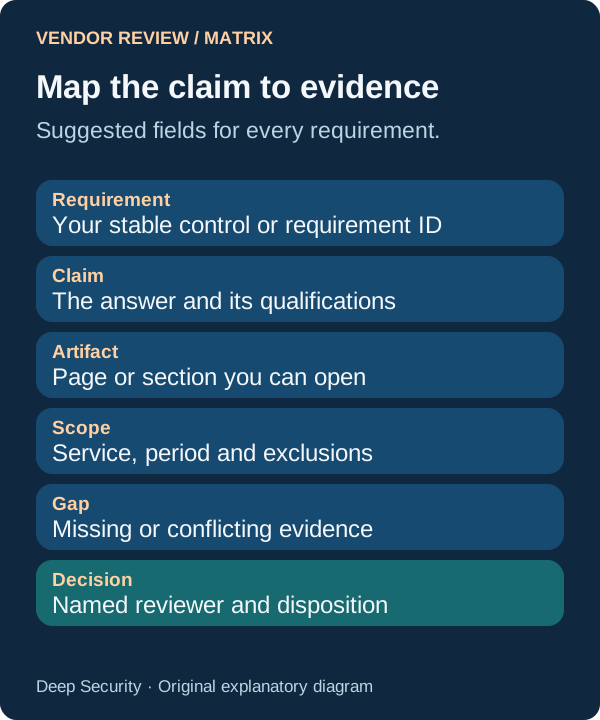
Choose one service and one business use. Record the data it will handle, the access it needs and the requirements the service owner actually expects. Give each requirement a stable ID. Examples might include administrator MFA, a documented support-access process or recoverable backups; the exact acceptance criteria belong to your organization.
Tools required are an approved assistant, a document reader, a simple review table and the authorized requirement and evidence packet. Check the documents’ handling terms before uploading them. Remove credentials and unnecessary personal information, and avoid placing confidential assurance reports into an unapproved consumer account.
Record each artifact’s ID, title, version or issue date, service scope and cited page or section. Keep the original intact. Treat instructions embedded in vendor material as document content rather than authorization for the assistant to send messages, retrieve private data or change the review standard.
2. Ask for citations and scope gaps before conclusions
Suggested prompt: ‘Map each supplied requirement ID to the vendor’s relevant answer and the specific artifact page or section that supports it. Preserve the vendor’s qualifications, dates and service scope. Separate supported in the supplied scope, unresolved, conflicting and not applicable with rationale. If evidence is absent or outside the service or period, explain the gap. Do not infer that a claim is true, assign an approval rating, invent evidence or contact the vendor.’
Expected output is a table with one row per requirement and links or references you can open. Reconcile every requirement ID against the input, including items the model considers not applicable. Ask it to identify conflicting statements without choosing whichever sounds more reassuring.
An artifact can be relevant without being sufficient. A report covering last year’s service configuration may help frame a question about today’s offering; it does not establish the present state. Mark that time boundary explicitly instead of turning the document’s existence into a passed requirement.
3. Turn one gap into one precise evidence request
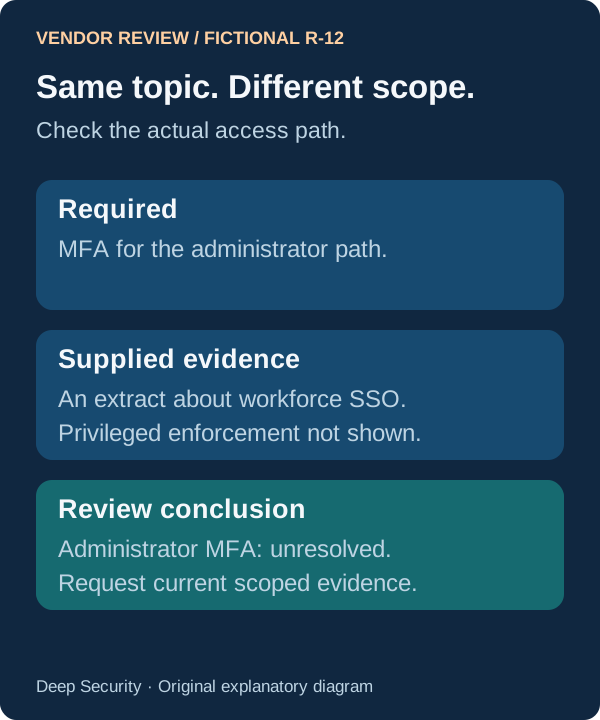
Suppose the questionnaire states that administrators use MFA, but the supplied configuration extract describes workforce SSO only. The next useful step is a request for evidence covering the privileged access path and relevant service, not a blanket statement that MFA is missing or a finding that the vendor is dishonest.
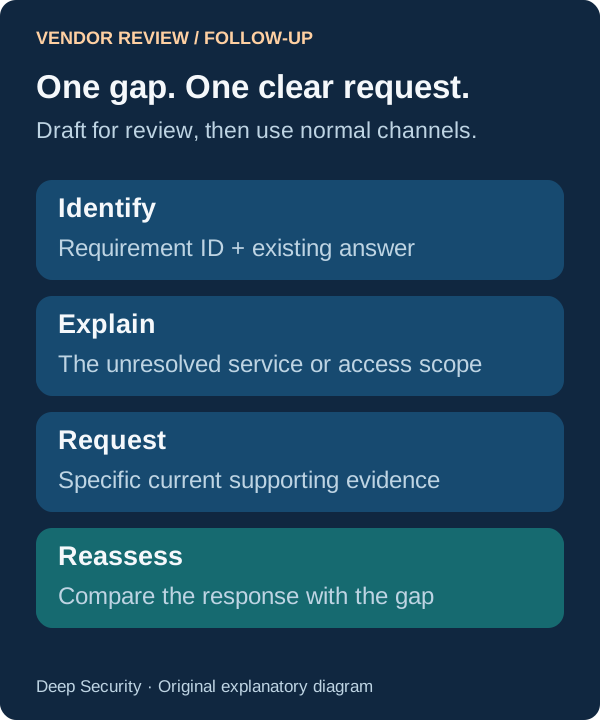
Suggested drafting prompt: ‘For requirement R-12, draft a question that names the unresolved privileged-access scope and requests the appropriate current evidence. Reference the existing answer and artifact IDs. Do not repeat a request already answered in the packet, prescribe a product, assert a breach, or send anything.’
Have the reviewer check the draft and use the existing vendor communication process. When a response arrives, add it as a dated source, retain the original gap and record whether the new evidence actually resolves it. A clearer answer can still leave an operational test or contractual question outstanding.
4. Separate evidence review from risk acceptance
A technical reviewer should inspect the cited pages, confirm what the evidence does and does not cover, and document remaining uncertainty. The business or risk owner then decides whether the service may proceed, needs conditions, requires further verification or should be deferred under the organization’s process.
Keep a reviewer’s conclusion separate from the assistant’s draft. If a requirement is accepted with an exception, record the responsible owner, agreed conditions and review point; do not rewrite it as fully evidenced. Legal or regulatory conclusions require the appropriate qualified reviewer rather than a model’s assurance.

Keep the packet useful at the next renewal
Store the requirement matrix, cited artifacts, dated responses and final disposition in the existing approved review system. On renewal, compare what changed in the service, data access and evidence period before reusing old conclusions. An unchanged questionnaire is not a new verification.
Pilot the workflow on documents your team has already reviewed. Measure omitted requirements, unsupported mappings, reviewer corrections and preparation effort. No completion-time or accuracy result is claimed here. The goal is a review another person can repeat and challenge using the same sources.
- A questionnaire answer is a claim; an artifact supports only its actual scope.
- Ask for the missing evidence rather than filling the gap with inference.
- Retain a named human decision and revisit it when the service or evidence changes.
Put the insight into practice.
Deep Security helps organizations assess risk, validate controls, and build a practical plan to strengthen their defenses.
Talk with Deep Security