

A practical, human-gated workflow for mapping exposed AI chats, secrets, datasets and downstream systems into a cited incident ledger after a vendor breach.
Why AI-vendor incident response has current attention
Fireworks AI’s November 9 update expanded the known impact of an incident first disclosed October 9. Fireworks says a limited set of accounts had impacts involving account and billing information and, for some accounts, secrets, datasets and incomplete models. It also describes separate October 23–24 activity involving a third-party cloud provider and Fireworks development machines. The investigation remains active, so the update is evidence—not a final universal scope statement.
Notion’s separate advisory records that it revoked exposed Notion API keys found in affected user messages on November 11 and reported exposed third-party API keys to their issuers on November 12. TechCrunch reported on November 12 that some Notion AI chat transcripts were accessed and described the downstream exposure as roughly 1% of Notion customers, attributing that figure to Notion. Deep Security did not test either company’s environment, independently validate affected records or run the workflow below.

Audience, tools and a deliberately narrow AI role
This pattern fits security operations teams, SaaS administrators, privacy leads, managed service providers, application owners and counsel coordinating third-party incident response. A pilot needs vendor notices, contracts and data-flow diagrams, identity and API-key inventories, approved logs, a ticket system, an approved model, read-only retrieval and a named incident owner.
The assistant may normalize disclosure changes, match affected data classes to local systems, list contradictions and draft a cited review packet. It may not retrieve private chats without authorization, paste secrets into a prompt, revoke a key, contact a vendor, notify a person, decide legal obligations, declare a user affected or close the incident. Keep source records in their authoritative systems and give the model only minimum necessary excerpts.
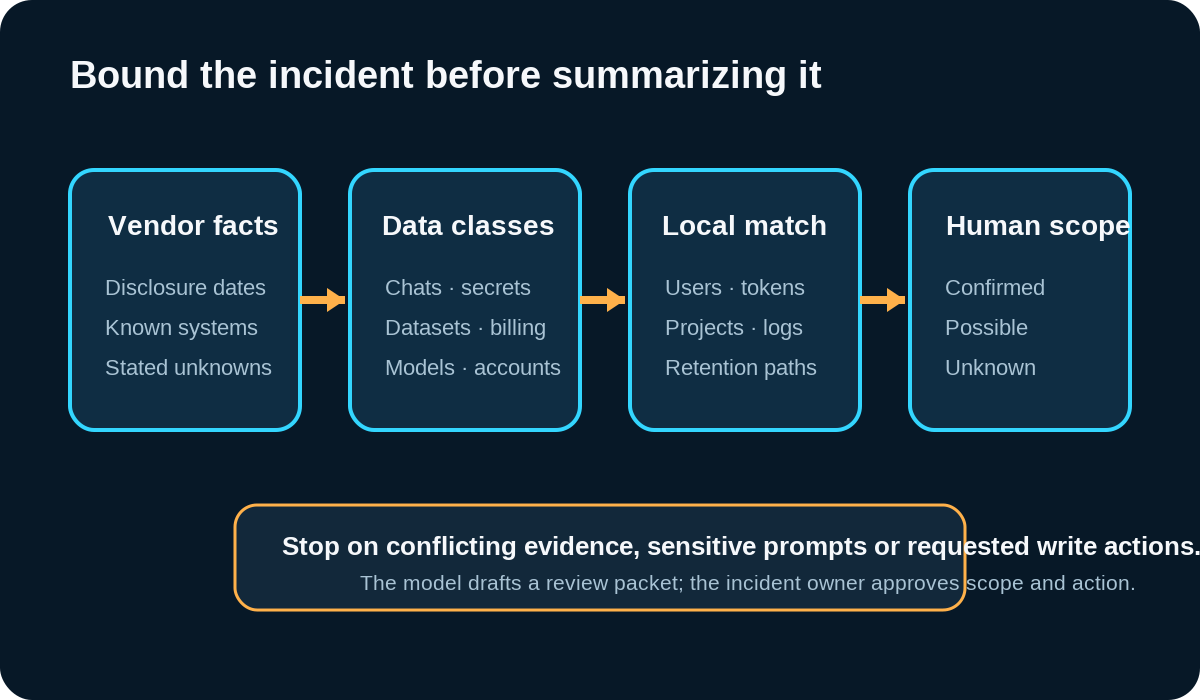
- System of record: vendor notices, data inventory, identity, secrets management, logs and incident tickets.
- AI role: align dated claims, local matches, unknowns and next read-only checks.
- Human role: approve scope, credential actions, notifications, containment and closure.
- Stop condition: sensitive content, unverified identity, conflicting evidence or a requested write action.
Step 1: reconstruct the dependency and exposure boundary
List every application, integration, subprocessor and cloud path that could have touched the vendor during the disclosed window. For each, record tenant or project ID, owner, enabled feature, connected repositories or datasets, secrets supplied, chat or prompt retention, logging destination, and the authoritative contract or architecture source. Do not infer that a named downstream customer proves your organization was affected.
Then map the vendor’s changing data classes—such as stored secrets, account information, datasets, model artifacts or chat content—to local objects. Mark each match confirmed, possible, not applicable or unknown. A missing inventory entry stays unknown; it does not become safe merely because the first disclosure was narrower.
Step 2: create a claim-level incident ledger
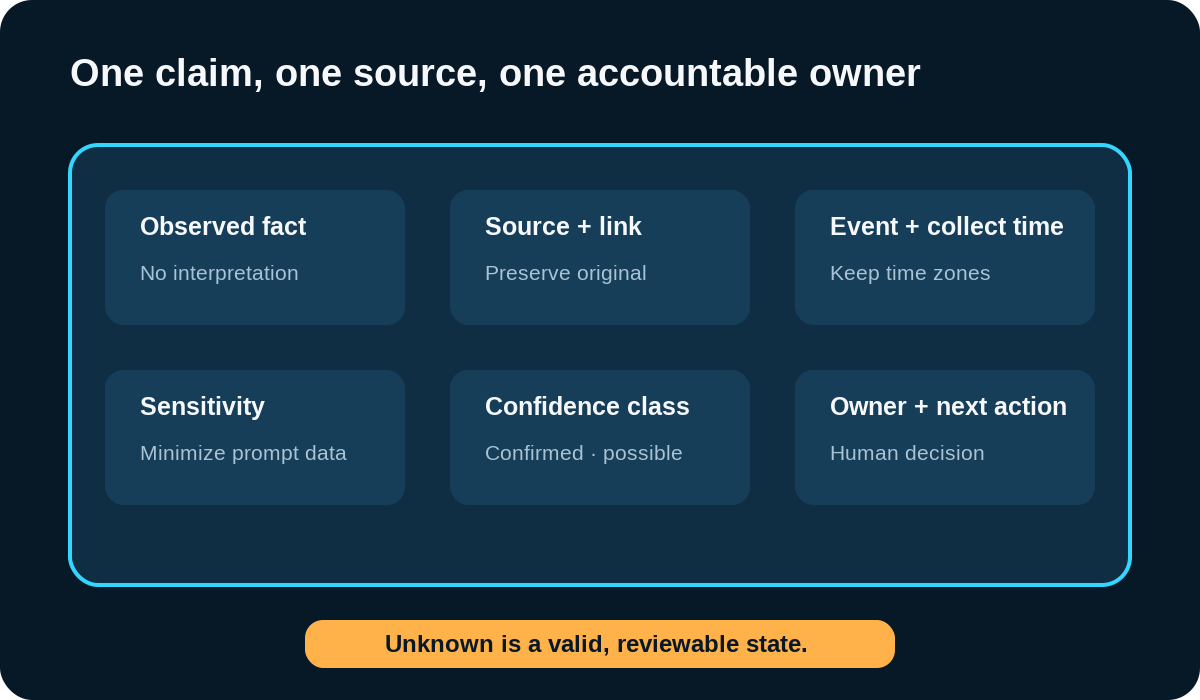
Use one record per claim rather than one narrative summary. Capture claim ID, exact source, publication and revision time, event window, affected system, data class, local match, sensitivity, confidence class, contradiction, owner and next action. Preserve the original page or ticket reference outside the model so later disclosure changes do not erase what the team relied on.
A deterministic rule should reject records without a source, timestamp or owner. The assistant can explain differences between the October bulletin, the November update and the downstream customer advisory, but it should not reconcile them by inventing a shared scope.
Step 3: request a bounded exposure packet
Provide only the approved ledger window and read-only inventory tools. Ask for observations before interpretations, evidence against each proposed match and the lowest-risk next check. Keep raw chat content, API keys and personal data out of the prompt; use hashes, record IDs or redacted excerpts when possible.
Example prompt: “For incident AIV-115, use only disclosure records V-100 through V-126 and local inventory records L-440 through L-518. Return a cited timeline, vendor-chain map, confirmed, possible and unknown local exposures, affected credential classes, contradictions and the next read-only check for each unknown. Cite a record ID and date for every fact. Do not reveal chat content or secrets, revoke access, contact users or vendors, decide notification duties, or claim the incident is contained.”
- Expected output: a review packet, not a breach determination.
- Reject local impact claims without both a vendor statement and a local match.
- Keep legal, privacy and contractual analysis with qualified human owners.
- Log the retrieval set, prompt version, model response and reviewer corrections.
Step 4: rotate and notify from the ledger—not from prose
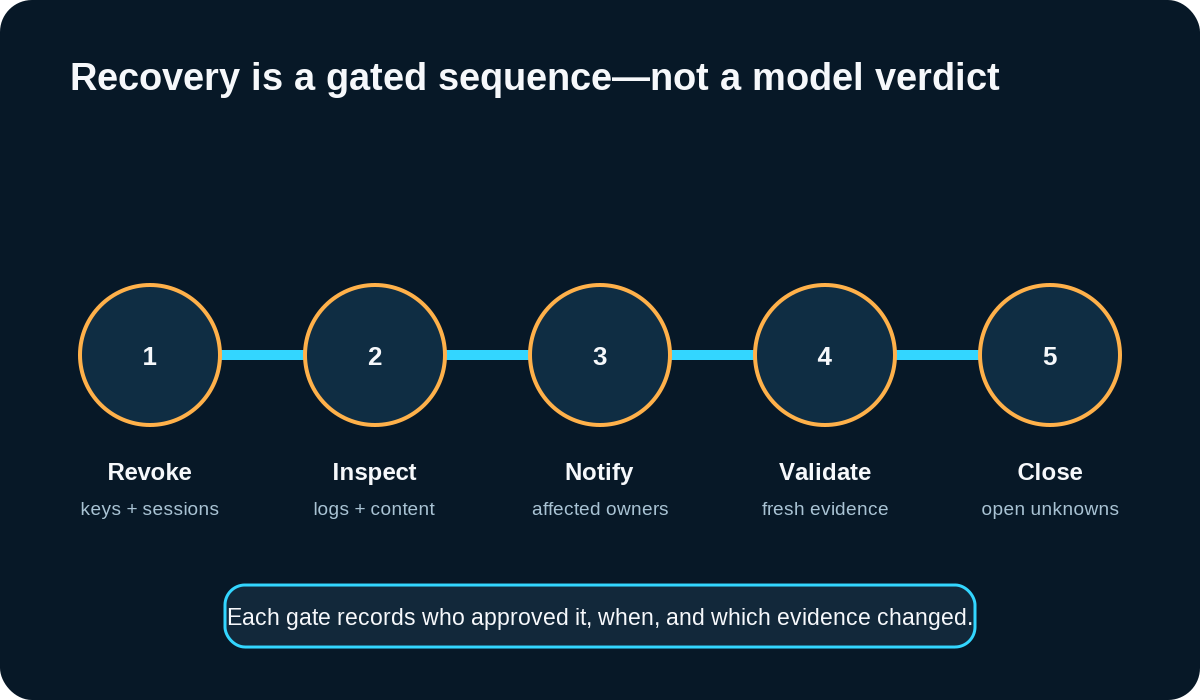
Prioritize credentials by exposure evidence, privilege, reuse, reachability and blast radius. A human owner should revoke or rotate through the authoritative secrets system, verify dependent services, and record the old key’s final use and the replacement’s first successful use. Do not paste a live credential into the model or let a generated list drive a bulk rotation without dependency checks.
Use the same ledger to build notification cohorts. Separate people with confirmed affected records, owners of possibly affected systems and teams who only need a general advisory. A model may draft audience-specific language, but privacy, legal and incident leadership approve recipients, facts and timing.

Step 5: close only after fresh validation
Define closure gates before acting: exposed credentials revoked, active sessions reviewed, affected datasets or prompts accounted for, downstream integrations checked, required notices approved, monitoring updated and remaining unknowns assigned. Re-run local checks after rotation and containment instead of treating a vendor status update as proof of your recovery.
The assistant may draft the handoff with evidence IDs, actions, validation results, residual risk and follow-up owners. The incident commander approves closure. If the vendor changes its disclosure, reopen the relevant claims and preserve the earlier decision trail.
Realistic limitations and why this topic was selected
AI cannot prove which unlogged data an attacker saw, recover content a provider did not preserve, interpret every contract or decide who must be notified. It can merge separate incidents, expose sensitive records, repeat a stale disclosure or turn an unknown into a confident match. Data minimization, privileged human review, secrets hygiene and authoritative logging remain necessary.
A focused Firecrawl search on November 15 for “Fireworks AI security incident November 14 2026 Notion chats breach primary disclosure” placed Fireworks’ primary update first, TechCrunch’s November 12 report third and Notion’s advisory fifth, with additional recent independent coverage. That concentration of dated primary and independent results is a current-attention signal, not proof of search volume, Google rank, adoption or DeepSecurity.io traffic.
Put the insight into practice.
Deep Security helps organizations assess risk, validate controls, and build a practical plan to strengthen their defenses.
Talk with Deep Security