
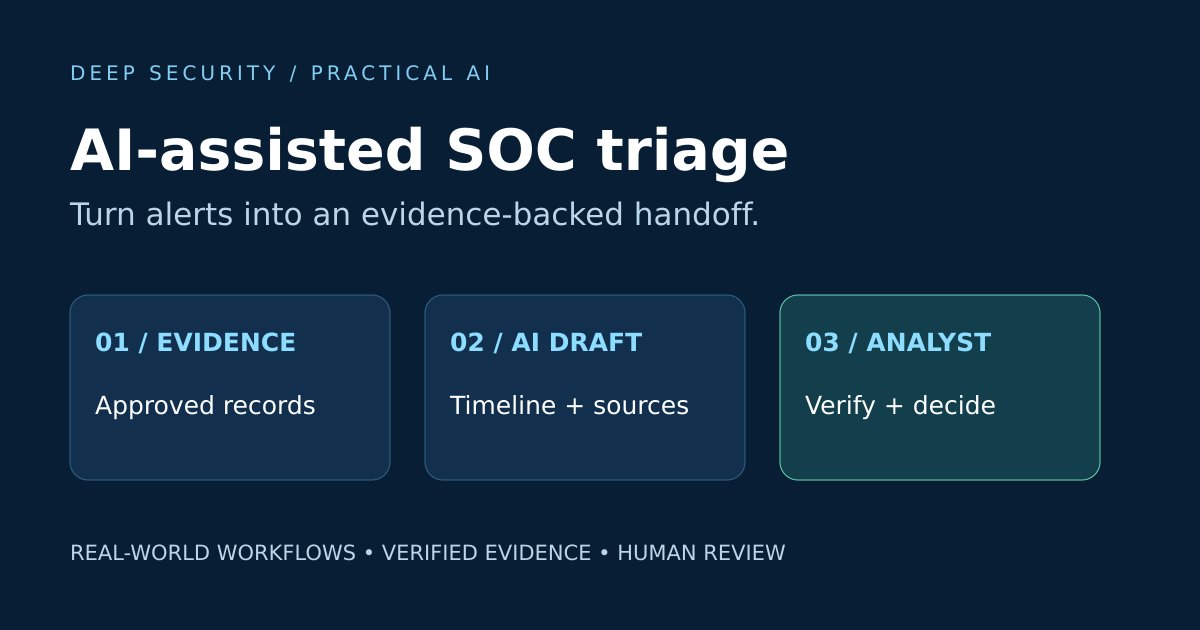
Use AI to organize a suspicious sign-in investigation, build an evidence-linked handoff, and keep analyst approval over security response.
A practical use case for this month’s AI security updates
A suspicious sign-in alert reaches your queue. Before deciding what to do, you need the related identity events, device context, previous case notes, and a reliable account of what is still unknown. This is a useful place to apply AI: organize the investigation material into a handoff that another analyst can verify.
Exabeam’s October 1, 2026 New-Scale announcement describes Nova AI retaining investigation context across parts of its platform, and an Agentic SOC plugin for Claude Code and OpenAI Codex that guides triage and investigation. Those are vendor-described capabilities, not results from a Deep Security product test. This article, researched October 18, uses that recent release as context for an independently proposed workflow; the example below is illustrative and can also be adapted to an approved AI assistant with sanitized exports.
Start with an approved evidence packet
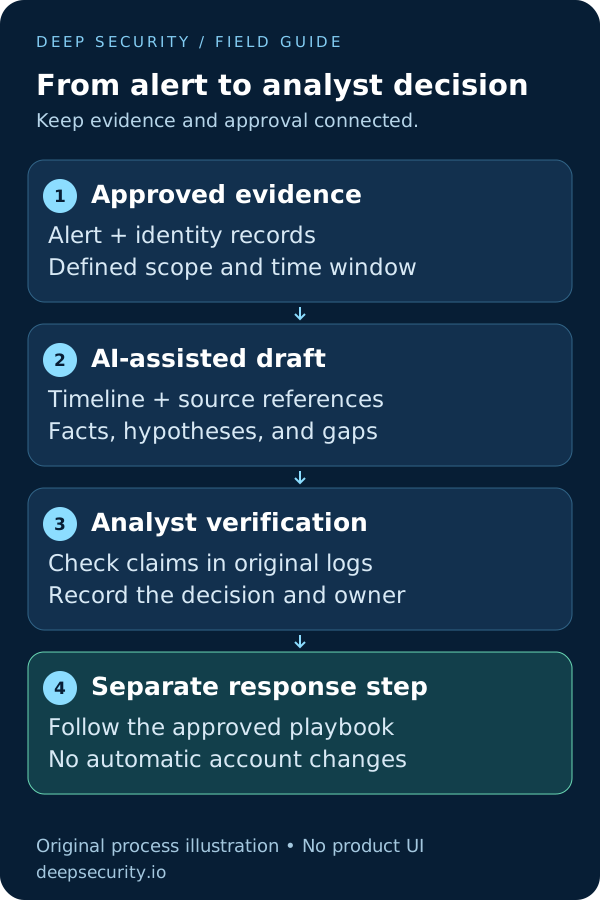
Choose one alert type and one investigation window, such as a suspicious sign-in reviewed alongside the previous 24 hours of identity activity. Record the time zone and export time so a second analyst can repeat the search. This proposed time window is a starting point, not a vendor requirement.
Use your approved SIEM or identity console to gather the alert, relevant authentication records, device identifiers, and any linked case notes. Keep the raw records in the system of record. Give the assistant an authorized connector or a sanitized export with stable event IDs. Remove secrets and unnecessary personal data, and check your organization’s rules before sending telemetry to an AI provider.
- Inputs: an alert ID, a defined UTC time range, and the evidence records the analyst is allowed to review.
- Context: expected user activity, known device information, and prior case references when available.
- Boundaries: read-only access, no account changes, and no instructions embedded in logs treated as commands.
- Output: a draft timeline, evidence references, unanswered questions, and a proposed next investigative step.
Ask for a structured draft instead of a verdict
Use a prompt that gives the assistant a narrow job and makes missing evidence visible. The following is a suggested prompt for your approved assistant, not a product-specific command:
“Review only the supplied alert and records for the stated investigation window. Produce a chronological UTC timeline. For each factual statement, cite the event ID or case reference that supports it. Separate observed facts, hypotheses, and missing information. Identify contradictions and propose the next read-only checks. If a record is absent, say not available. Do not classify the account as compromised without sufficient evidence, close the alert, contact anyone, or change any system.”
Then ask it to identify what could disprove its leading hypothesis. For example, an unfamiliar IP address might require checking approved VPN egress information. That is a question to investigate, not evidence that the activity is either benign or malicious.
Use a handoff that makes uncertainty easy to see
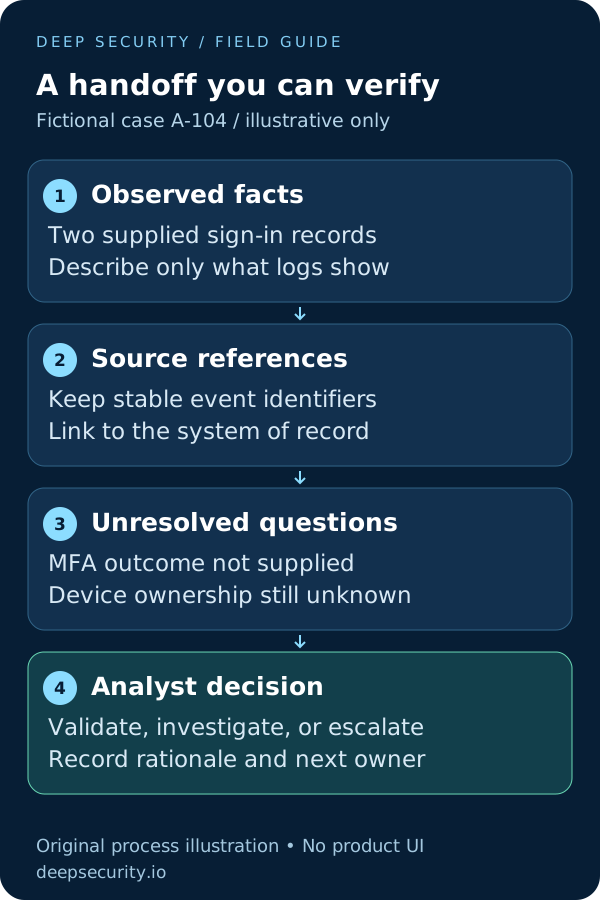
Consider a fictional alert, A-104, where two supplied authentication records show sign-ins for the same account. The assistant can summarize that sequence, but it should not claim the devices are the same person’s or invent a successful MFA result. If the device record or MFA outcome was not supplied, the handoff must retain that gap.
Give the receiving analyst a compact record with four parts: what was observed, where the evidence lives, what is uncertain, and what should be checked next. Put a hypothesis beside its supporting records rather than burying its uncertainty in the conclusion.
Verify the draft before any response
Open each cited source and check the time, account, event outcome, and identifier against the original record. Confirm that the assistant did not confuse an attempted sign-in with a successful one or merge separate accounts because they shared an address. Re-run important searches in the original console where possible.
Keep triage and response as separate decisions. An analyst may decide more evidence is needed, escalate the case, or recommend an action through the existing response process. A polished summary alone is not a reason to disable an account or close an investigation.
- Trace each material statement to an actual record and verify that the cited record supports the claim.
- Keep unknowns visible, including unavailable logs and gaps in the collection window.
- Record the reviewer, review time, decision, and next owner in the case system.
- Keep containment, user notification, and other changes inside the organization’s approved response process.
Evaluate the workflow against your own baseline
Pilot this with a small set of previously reviewed cases that your team is authorized to reuse. Compare AI-assisted preparation with the existing process using the same evidence packet. Measure analyst preparation time, factual corrections, unsupported statements, and missing evidence references. These are proposed evaluation measures; this article reports no measured speed improvement or detection rate.
If a faster draft needs substantial correction, the workflow has not yet earned broader use. Improve the evidence packet and prompt, repeat the review, and expand only when the output is useful to the analyst receiving it. The goal is a clearer, checkable handoff.
Where the October feature update fits
Persistent investigation context and guided triage can support this approach, but confirm which features your own deployment exposes. Exabeam’s announcement does not establish your subscription entitlement, connector configuration, or the quality of your ingested records. Check those with your administrator before planning a rollout.
Start with one alert category and one reviewable deliverable. When AI prepares the timeline and source list, analysts can spend their review on whether the evidence supports the next step. That is a concrete workload to evaluate without assuming autonomous response is ready for your environment.
Put the insight into practice.
Deep Security helps organizations assess risk, validate controls, and build a practical plan to strengthen their defenses.
Talk with Deep Security