

A practical AI-assisted workflow for rebuilding a third-party JavaScript exposure timeline from CSP, browser, identity and vendor evidence without inventing impact.
Why trusted script incidents create a difficult evidence problem
Report URI disclosed on November 16 that malicious JavaScript was served through Optimizely Web snippets used by 178 organizations. The researcher observed 188 affected snippets among 1,611 checked and reported payloads capable of cryptocurrency address swapping, card skimming, cookie and screenshot theft and iOS exploit delivery. Verified cryptocurrency transfers were observed, but the number of exposed cards, cookies or devices remained unknown.
Optimizely's November 18 incident update confirmed that an unauthorized party exploited a flaw in the Web Experimentation signup flow, impersonated users on targeted accounts and inserted JavaScript. Optimizely said the incident affected less than five percent of customers, was limited to Web Experimentation, and that it removed the code and closed the vulnerability. The two sources use different denominators, so do not collapse their percentages or counts into one impact claim.

Preserve four evidence lanes before cleanup
This workflow fits web operations, application security, identity, privacy, payment and incident-response teams. Preserve current and historical vendor snippets, project or tag-manager change history, user and token audit records, CSP reports, proxy or DNS observations, browser captures, page templates, cookie attributes, payment form ownership and the vendor incident notice. Use authorized records only.
Give the model redacted copies with stable source IDs. Separate code capability from observed execution and observed execution from confirmed harm. A payload that contains a skimmer is not proof that a specific visitor submitted card data; an affected page is not proof that every session was exposed.
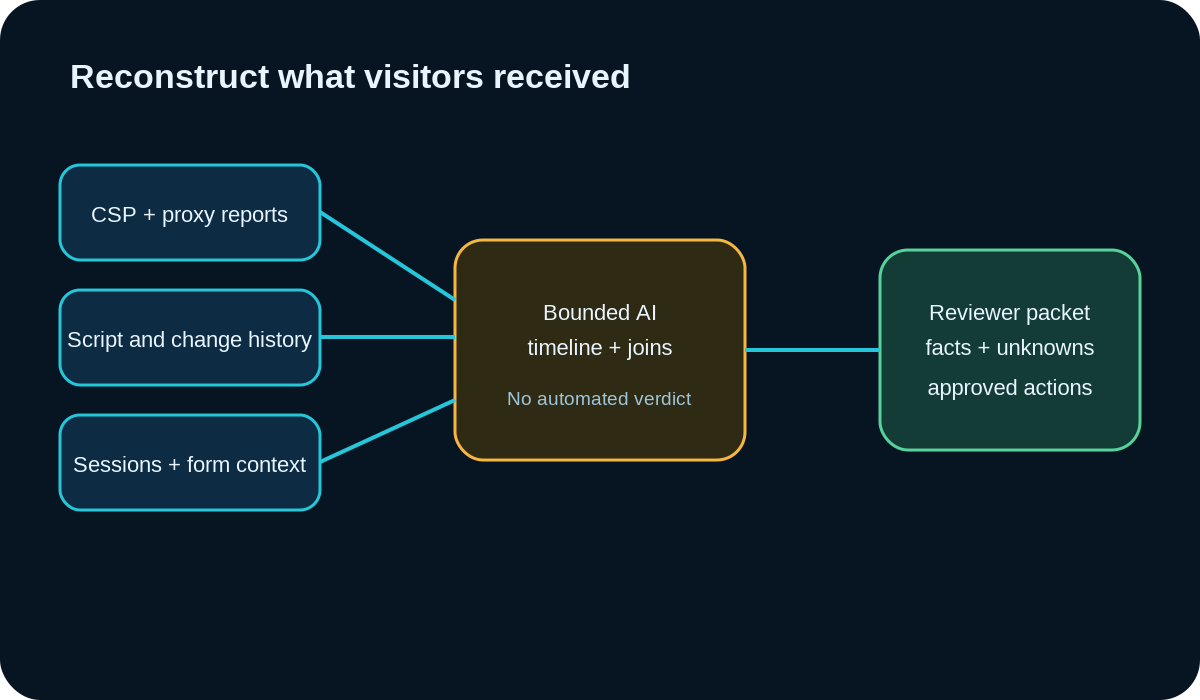
- Code lane: file versions, hashes, custom project code and cleanup time.
- Delivery lane: pages, browsers, devices, regions and CSP or proxy observations.
- Identity lane: non-HttpOnly cookies, sessions, write-capable users, tokens and integrations.
- Business lane: form ownership, payment boundaries, privacy duties and communications authority.
Step 1: build a minimum and maximum exposure window
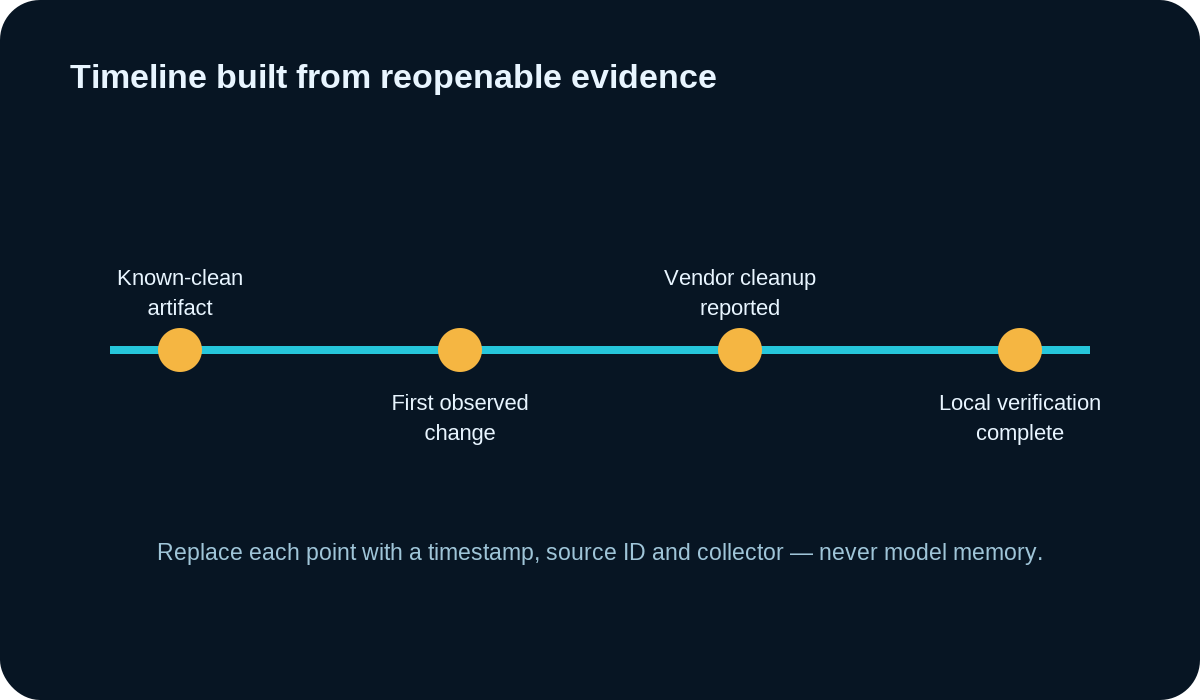
Example prompt: “Build a timeline from these authorized artifacts. For every event, include timestamp, timezone, source ID, collector and whether it is observed, vendor-reported or inferred. Identify the last known clean artifact, first observed change, affected delivery evidence, vendor cleanup and our local verification. Do not fill gaps or treat publication time as compromise time.”
The expected output is a reviewable timeline with explicit gaps. Compare CDN headers, archived captures, deployment records, project history and CSP reports. Keep the vendor timeline and your local evidence separate until a reviewer confirms the join.
Step 2: map capability to verified visitor exposure
Ask the model to create one row per page and visitor class: third-party script present, form type, payment ownership, cookie attributes, browser or device evidence, outbound destination observed and missing telemetry. Example prompt: “Separate payload capability, observed delivery and confirmed harm. Cite every field. Use unknown when the supplied evidence cannot answer.”
Review sensitive pages first. If a hosted payment iframe kept card entry outside the affected page, record that boundary rather than assuming exposure. If a non-HttpOnly session cookie was present on a page that executed the payload, route it for identity review; do not revoke all sessions solely from the model's narrative.
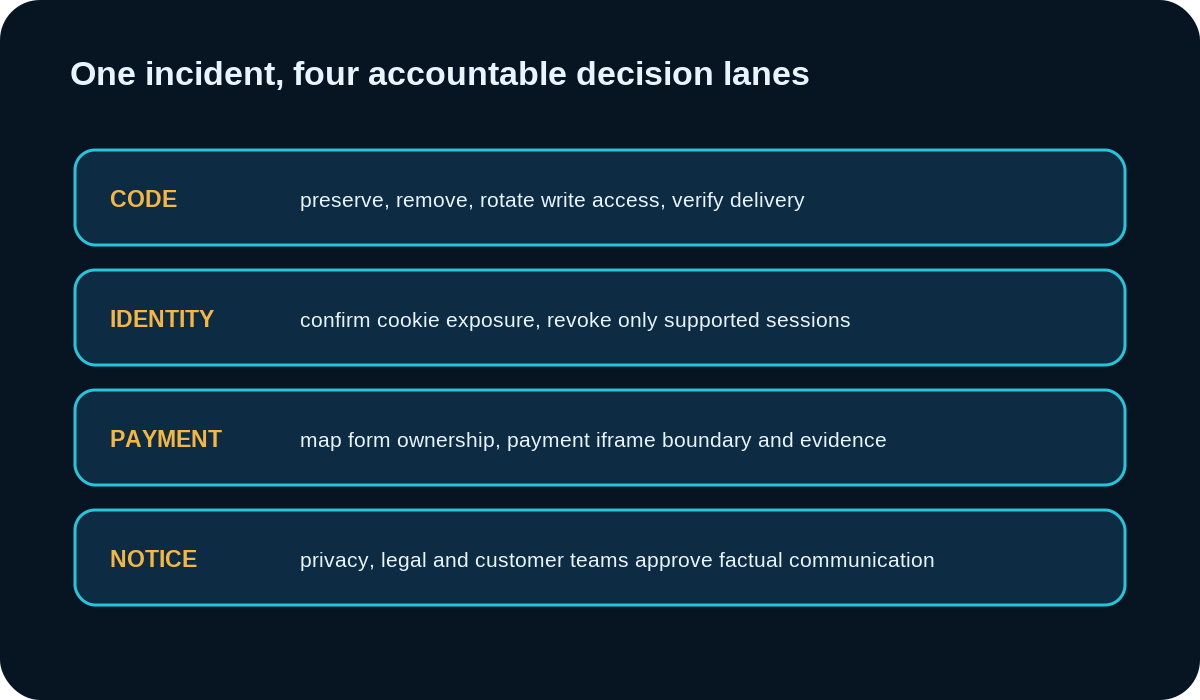
Step 3: approve containment, recovery and communication separately
Code owners preserve suspicious artifacts, remove unauthorized code, rotate verified write-capable users, tokens or integrations and confirm what the CDN now serves. Identity owners evaluate cookie and session evidence. Payment and privacy teams determine whether forms, users or legal duties are in scope. Communications teams use only verified facts and approved uncertainty language.
Track time to preserve evidence, affected-page coverage, source-cited claims, reviewer corrections, sessions revoked with evidence, vendor-access changes and recurrence after verification. A fast summary is useful only when it remains auditable.

Limitations and topic-selection signal
Browser and CSP evidence may be missing, historical scripts may be overwritten and CDN state can change during collection. AI can confuse delivery with harm or merge unrelated destinations. Preserve originals, record collection times, isolate malware analysis and involve payment, privacy and legal specialists where appropriate.
Focused Firecrawl research on November 25 returned Report URI's detailed November 16 disclosure first, Optimizely's incident notice and multiple November 17–25 independent articles. That is a prominent, multi-source freshness signal for web operations; it does not prove search volume, rankings or the performance of this article.
Put the insight into practice.
Deep Security helps organizations assess risk, validate controls, and build a practical plan to strengthen their defenses.
Talk with Deep Security