

An evidence-first workflow for inventorying SonicWall CVE-2026-19868 exposure, reviewing alternate-auth sessions and verifying remediation with human change control.
What CVE-2026-19868 changes
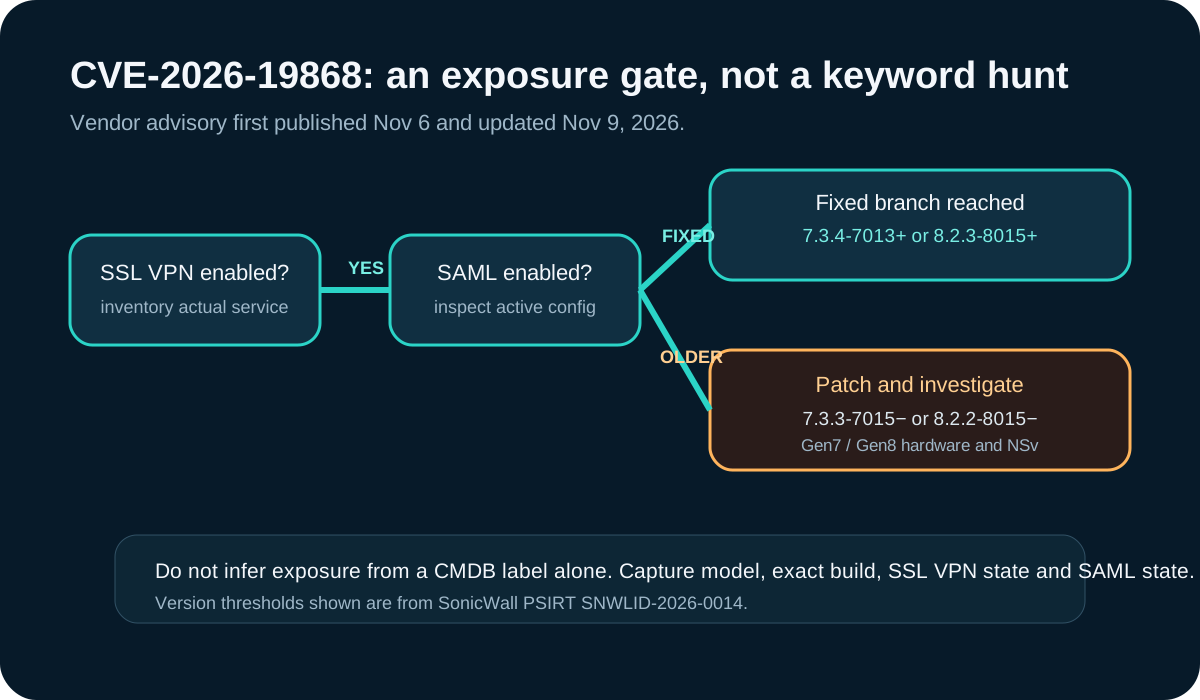
SonicWall first published PSIRT advisory SNWLID-2026-0014 on November 6 and updated it on November 9. The advisory describes an authentication-enforcement vulnerability in SonicOS SSL VPN where valid alternate-authentication credentials may bypass SAML controls and SAML-enforced multifactor authentication. SonicWall assigns CVE-2026-19868 a CVSS score of 7.1 and says the issue affects the SSL-VPN service when SAML is enabled.
The Canadian Centre for Cyber Security published an alert on November 6 describing exploitation and urging updates. BleepingComputer covered the issue the same day. Those dated sources establish current defensive attention; they do not establish that an individual firewall was targeted or compromised.
Audience, tools and safe boundaries
This workflow is for network administrators, SOC analysts and incident responders authorized to review SonicWall appliances. Use a current asset inventory, configuration export, installed-build record, change history, SSL-VPN session logs, alternate-authentication server logs, SAML identity-provider events and multifactor events. Export read-only, time-bounded evidence to a controlled workspace.
Do not give a model configuration secrets, shared keys, passwords, tokens, full user identities or raw packet captures. Replace them with stable device, account and session IDs. Keep patching, session revocation and authentication-server changes behind normal human change control.

- Record appliance model, exact build, SSL-VPN state and SAML state.
- Preserve firewall, identity-provider and backend-authentication clocks and time zones.
- Separate exposure, suspicious activity and confirmed impact.
- Use the live SonicWall advisory as the remediation authority.
Step 1: create an exposure gate from exact facts
SonicWall lists Gen7 and Gen8 hardware and NSv builds 7.3.3-7015 and older, and 8.2.2-8015 and older, as affected. The advisory lists 7.3.4-7013 and later, and 8.2.3-8015 and later, as fixed. Build one row per appliance with evidence for the installed version rather than matching only a product family name.
Filter for appliances that actually expose SSL VPN and use SAML. An unknown configuration is not the same as disabled. Record internet reachability, business owner, maintenance window, authentication servers configured on the firewall and active VPN sessions.
Step 2: review the expected and alternate paths
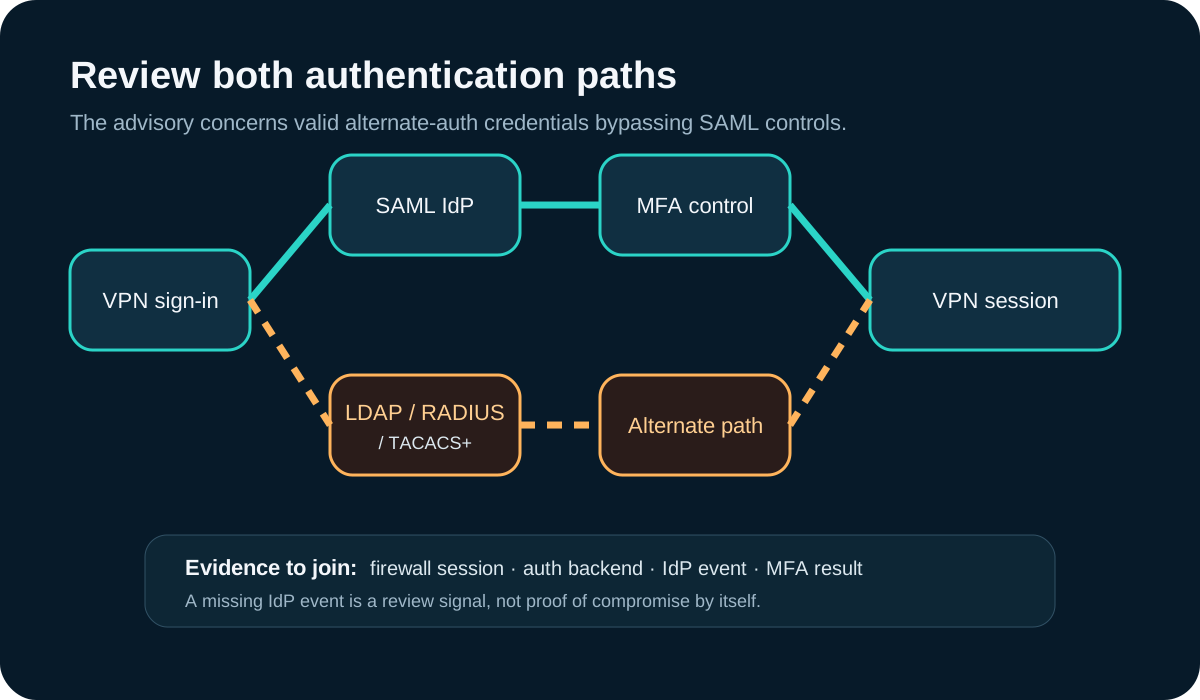
For the investigation window, join each VPN session to the firewall authentication result, the alternate LDAP, RADIUS or TACACS+ backend event, the SAML identity-provider event and the MFA result. The vulnerability concerns a path where valid alternate-auth credentials may avoid expected SAML enforcement, so a VPN session with no matching IdP event deserves review. It is not proof of exploitation by itself.
Example prompt: “Using only these redacted records, produce one row per SSL-VPN session. Include device ID, exact build, SAML state, alternate-auth backend event, IdP event, MFA result, source-network label, session ID, supporting evidence IDs, contradictions and next human check. Flag missing expected IdP evidence, but do not label a session malicious or make configuration changes.”
- Expected output: a cited session-review queue with explicit unknowns.
- Normalize time zones before joining events.
- Review successful alternate-auth sessions and unusual source networks first.
- Validate important joins in the original firewall and identity systems.
Step 3: patch with an evidence-backed change record
Upgrade to a fixed release from the official SonicWall source, following the organization’s tested backup, compatibility and rollback process. SonicWall’s advisory says that if SAML is in use and an upgrade cannot be performed immediately, administrators can disable or delete active LDAP, RADIUS or TACACS+ authentication servers configured on the firewall. That workaround can disrupt access and must be evaluated and approved by an authorized network owner.
After the change, capture the running build and relevant configuration, review or expire active VPN sessions according to the incident plan, and test the intended SAML and MFA path with approved accounts. Do not let the AI assistant generate or execute device commands.

Step 4: verify four closure conditions
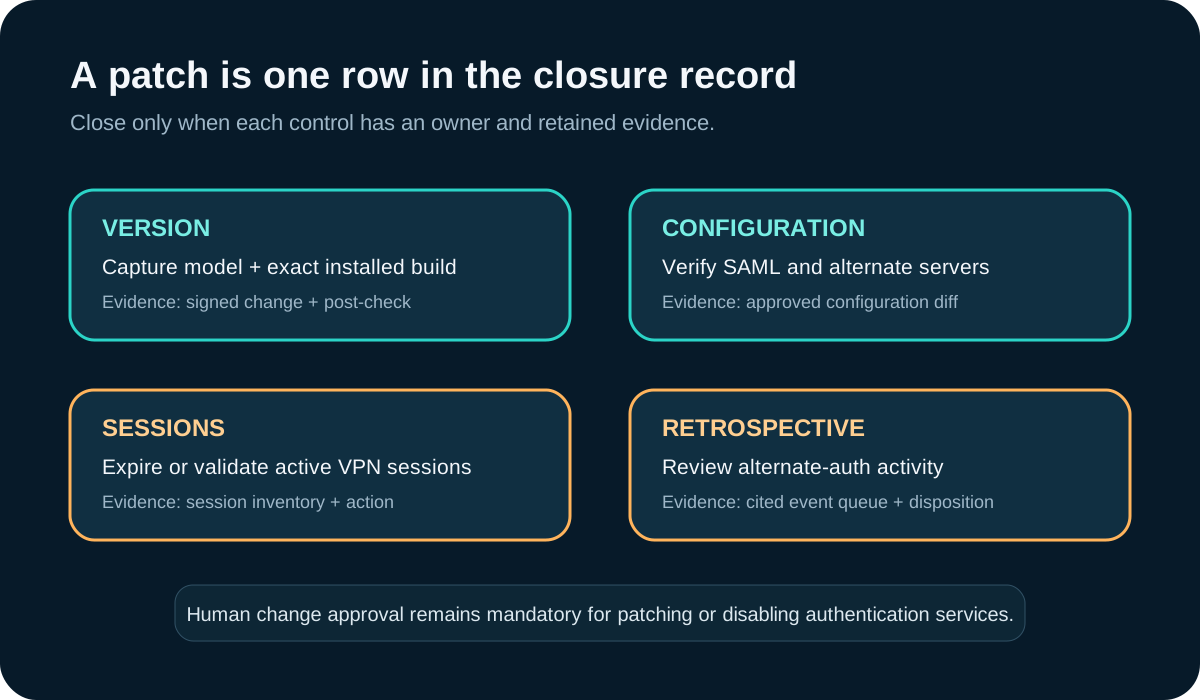
A ticket is not complete because a package uploaded successfully. Verify the exact fixed build, the intended authentication configuration, the disposition of active sessions and the retrospective review of alternate-auth activity. Attach source evidence and name an owner for every exception.
Re-run the inventory query after the maintenance window and compare the result with the pre-change list. A second reviewer should sample devices across business units and hosting models. If logs are missing, record the detection gap and extend monitoring rather than treating the appliance as clean.
Realistic limitations
AI can misjoin users with similar names, hide time-skew problems, treat missing logs as negative evidence and produce confident but unsupported compromise labels. A configuration export may be stale, a cluster may contain mixed builds, and a backend-auth event may serve another application. Validate important findings in the source systems.
This workflow was not tested on a production SonicWall appliance and does not replace SonicWall support, incident-response procedures or change review. It does not prove exploitation. It uses public information available on November 9 and should be updated if the vendor advisory changes.
Why this topic was selected
A focused Firecrawl search on November 9 for “CVE-2026-19868 SonicWall SSL VPN SAML MFA bypass exploited” returned the SonicWall PSIRT advisory, the Canadian government alert and multiple November 6 reports including BleepingComputer. The sources identify a concrete, time-sensitive inventory and authentication-review workload for DeepSecurity readers. Search prominence is a current-attention signal, not proof of search volume, ranking or traffic.
Put the insight into practice.
Deep Security helps organizations assess risk, validate controls, and build a practical plan to strengthen their defenses.
Talk with Deep Security