

Investigate a firewall access request with AI-assisted policy evidence, least-privilege options, independent reachability checks and human change approval.
Why access-request investigation is attracting attention now
FireMon announced Agentic AI and an MCP Server on October 27 for investigating network policy, preparing recommendations and staging Policy Plan changes. Its examples cover a familiar workload: determine how one application can reach another across multiple devices and policies, then bring the consequential choices to a practitioner.
FireMon says the platform and MCP Server will be available in November and that the initial offer carries no additional FireMon charge. The vendor also says AI is optional and off by default. The pre-built change workflow requires Policy Planner, and accepting a proposal saves staged work rather than deploying directly to firewalls. Customers should confirm their release, license, supported models and current commercial terms before planning a pilot.
A focused Firecrawl search on October 28 returned FireMon's October 26 launch blog, the October 27 press announcement and same-day Help Net Security coverage among the leading results. That is a current-attention signal, not evidence of adoption, accuracy, time savings, traffic or search ranking.
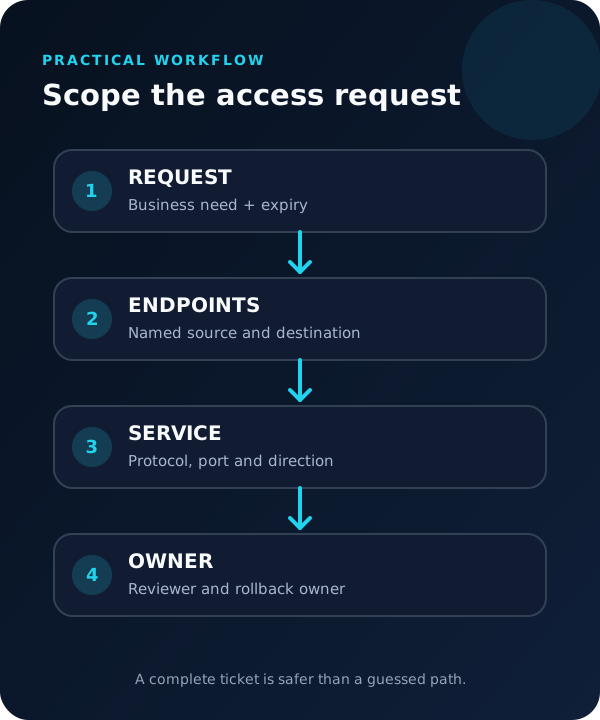
1. Turn the ticket into a testable requirement
Start with the business owner, application owners, source identities, destination, protocol, port, direction, environments, requested start and expiry, and a named rollback owner. Reject placeholders such as any, temporary or production-like until they are resolved.
Ask what success means at the application layer. A firewall rule can permit a packet while routing, NAT, DNS, service health, host controls or application authorization still block the transaction. Conversely, an existing broad rule can make a new change unnecessary but expose more access than intended.
Keep production credentials and sensitive configuration out of the prompt. Give the assistant approved policy records, redacted topology and the ticket ID through a read-only service account. Record the product, model, instructions, tool permissions and data-retention choice used for the investigation.

- Name the exact source, destination, service and environment.
- Set an expiry and rollback owner before proposing a rule.
- Separate policy evidence from end-to-end application proof.
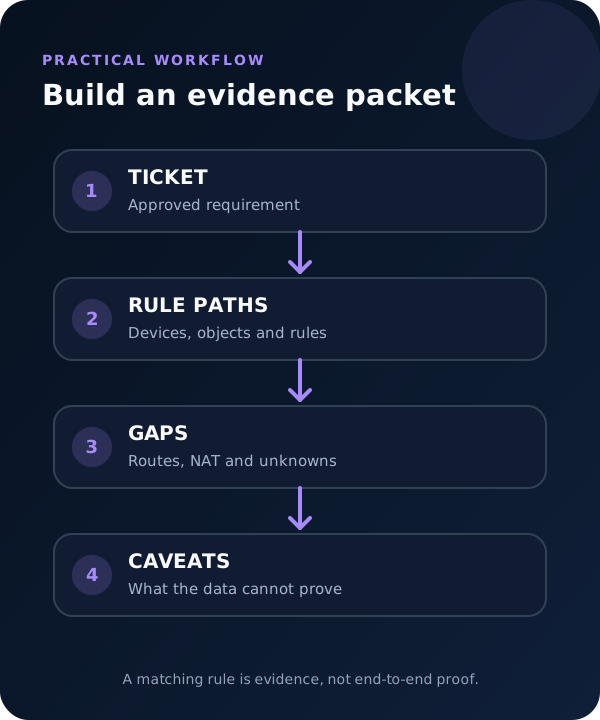
2. Ask for cited evidence, alternatives and unknowns
The useful output is not a yes-or-no answer. Require the relevant devices, rules, objects, routes and policy records; the evidence supporting each statement; alternative paths; conflicting controls; and the information the tool cannot see. A matching firewall rule alone does not prove reachability.
Example prompt: 'Using only the approved read-only policy data, evaluate ticket NET-241 for source group app-web-prod to destination app-db-prod on TCP 5432. Cite every rule and object used. Separate observed facts, inferred paths and unknowns. Propose least-privilege alternatives with expiry and rollback checks. Do not save, deploy or modify any policy.'
FireMon documents a starting MCP catalog with search, discovery, recommendation, change-preparation and authorized-save operations. Its personal access tokens inherit the user's underlying roles and device-group restrictions rather than carrying separate token scopes. For an external assistant, use a dedicated account without change-writing permission until the team has validated the retrieval-only path.
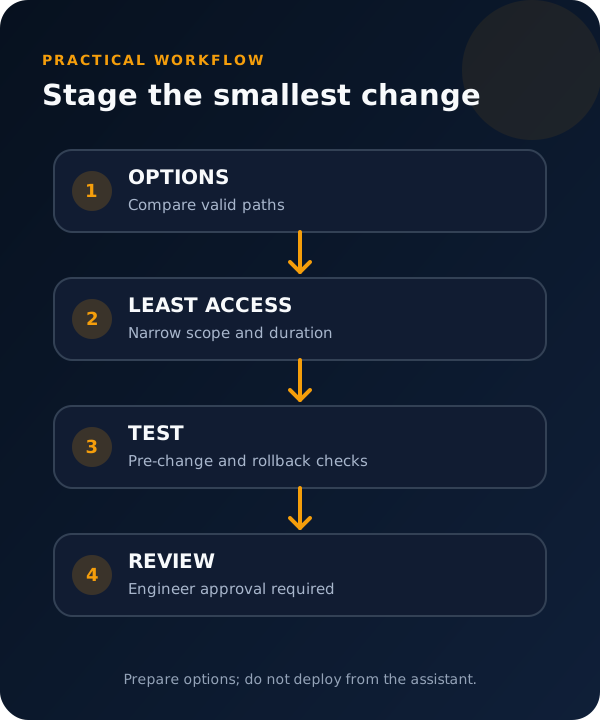
3. Stage the smallest viable change
Compare no-change, new-rule and rule-refinement options. Prefer the narrowest source and destination objects, the required service only, an explicit environment boundary and a time limit where the request is temporary. Flag shared objects whose modification would affect unrelated systems.
Require pre-change checks, a rollback trigger, post-change validation and expected logging. If several policies are technically valid, return the tradeoffs to the network owner instead of letting the assistant select a route based on convenience.
Save the recommendation as a draft or ticket attachment only after a practitioner reviews the evidence. Keep the deployment system, production firewall credentials and emergency override outside the assistant's authority. Product-specific staging is not a universal approval control; verify every tool exposed to the connected identity.
4. Verify the path independently
Use the normal network and application validation tools to test the approved proposal in a safe window or nonproduction environment. Confirm DNS, route and NAT behavior, device order, destination listening state, authentication and application response. Compare the observed path with the assistant's cited policy path.
Run negative tests: an unapproved source, neighboring port and expired access should remain blocked. Check that the expected firewall and cloud-control logs arrive with the correct source, destination, rule and decision. A successful connection without the expected telemetry is not a complete validation.
DeepSecurity.io did not run FireMon Agentic AI or measure its accuracy. FireMon's statements about capacity, time savings and accuracy are vendor claims. The expected result here is a reviewable evidence packet and staged plan, not an autonomous network change.

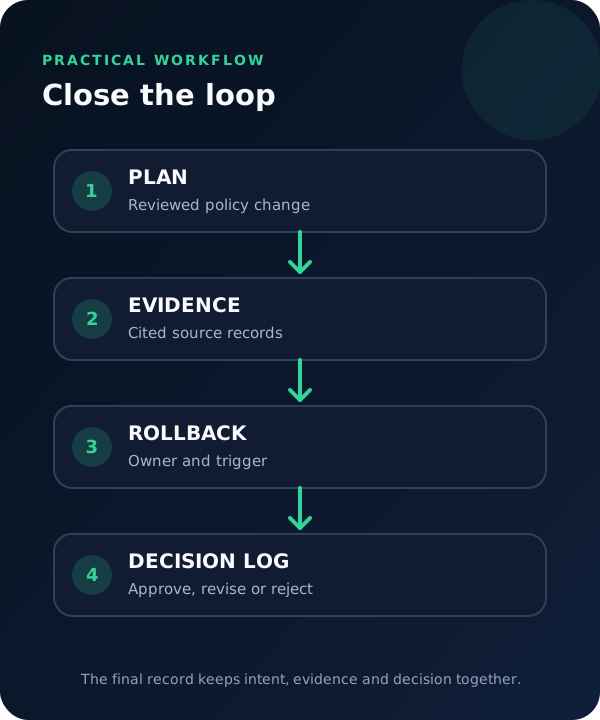
5. Make the pilot leave a defensible record
Pilot with historical tickets or one low-risk nonproduction request. Record evidence completeness, unsupported claims, correct and missed policy paths, reviewer corrections, time spent, changes rejected and whether access was revoked on schedule. Do not convert a vendor example into a local performance claim.
Set stop conditions before connecting write-capable tools: missing citations, an unexplained device or rule, repeated overbroad recommendations, attempted actions outside scope, or incomplete audit records. Revoke the integration and preserve the case if the agent crosses its assigned boundary.
The closeout packet should include the ticket, approved scope, evidence sources, alternatives, selected plan, validation results, rollback evidence, residual risk and the named approver. That record is useful even if the organization decides not to adopt the product.
Put the insight into practice.
Deep Security helps organizations assess risk, validate controls, and build a practical plan to strengthen their defenses.
Talk with Deep Security