

A practical AI-assisted workflow for distinguishing legitimate shopping agents, unknown automation and confirmed commerce abuse without trusting user-agent strings.
Why the holiday traffic mix is harder to classify
Arctic Wolf's November 25 retailer advisory says legitimate shopping agents and malicious automation increasingly share behaviors that older fraud controls treated as distinctive, including rapid browsing, transaction velocity and unusual device or network patterns. HUMAN's November 10 forecast reports a sharp rise in the agentic traffic seen by its platform during 2026 and says distinguishing legitimate agents from malicious bots is now part of holiday defense.
Those are provider observations, not universal internet measurements. The useful workload for a web security or fraud team is a bounded evidence review: determine what the client claimed to be, what it actually did, whether the customer authorized it and whether a transaction produced a confirmed outcome.

Build one privacy-aware session evidence contract
This workflow fits ecommerce operations, fraud, API security, identity and customer-support teams. Collect approved exports from the CDN or bot manager, WAF, API gateway, identity provider, device-risk service, cart and promotion systems, payment decisioning and customer-authorization records. Remove payment details, secrets and unnecessary personal data before model use.
Normalize each review unit into session ID, declared agent identity, signature or issuer evidence, account state, device and network observations, API sequence, transaction outcome, customer authorization, source IDs, collection time and contradictions. A user-agent string is a claim; a high request rate is a signal; neither proves abuse.
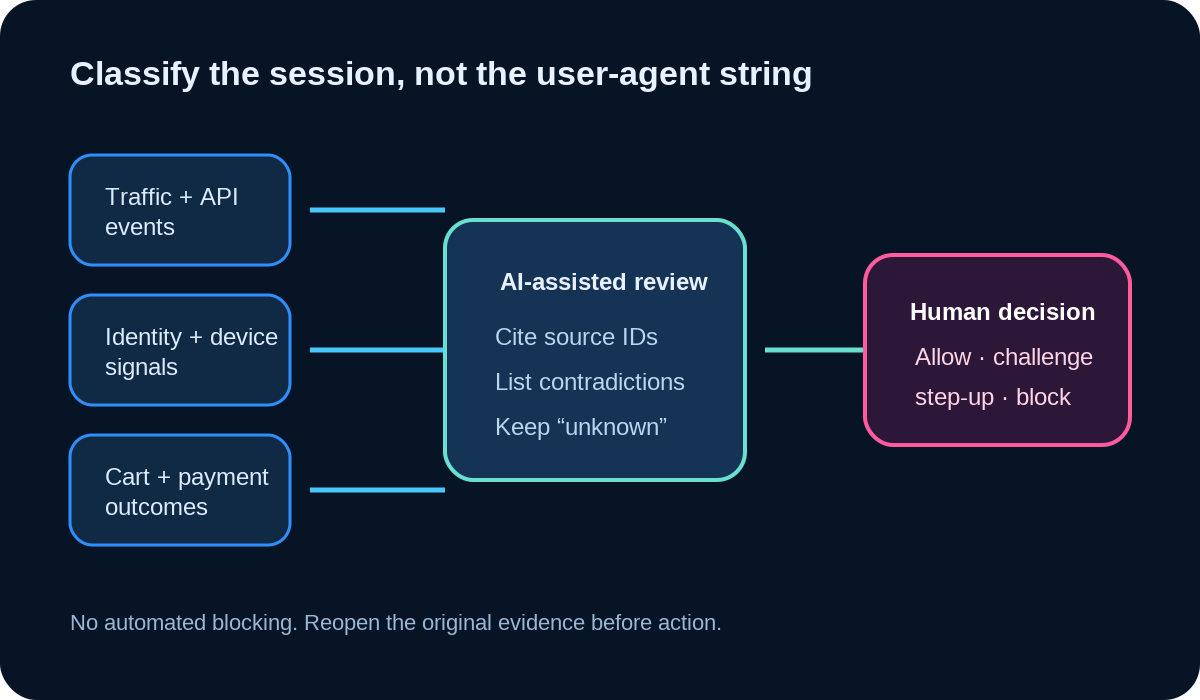
- Declared: what the client or intermediary says it is.
- Observed: behavior directly supported by supplied telemetry.
- Confirmed: a verified authorization, transaction or fraud outcome.
- Unknown: a question the current evidence cannot answer.
Step 1: classify evidence without making the decision
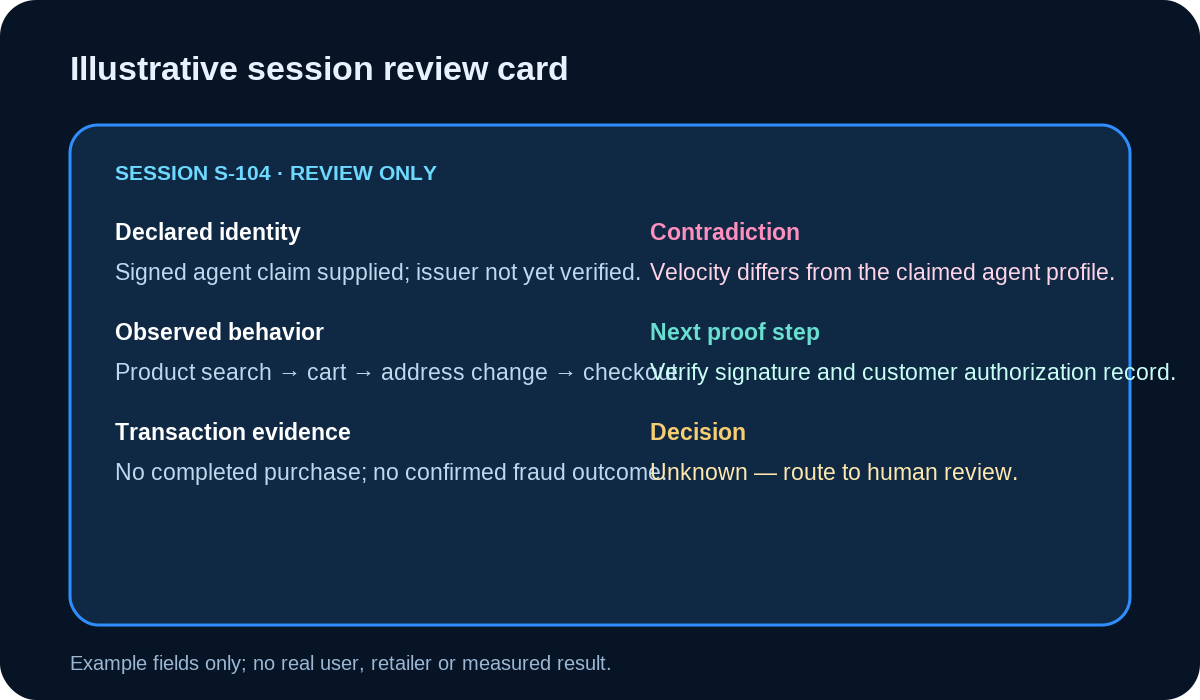
Example prompt: “Using only these approved records, create one row per session. Preserve every source ID. Separate declared identity, observed behavior, customer authorization and confirmed transaction outcome. List contradictions and benign alternatives. Use unknown when evidence is missing. Do not infer intent, identify a person or recommend a block.”
The expected output is a cited review queue with an explicit next proof step. Analysts reopen the original records, verify any agent signature or intermediary assertion, and split sessions the model joined incorrectly. Route high-value actions such as address changes, loyalty redemption and stored-payment use for additional evidence.
Step 2: use reversible controls and record the outcome
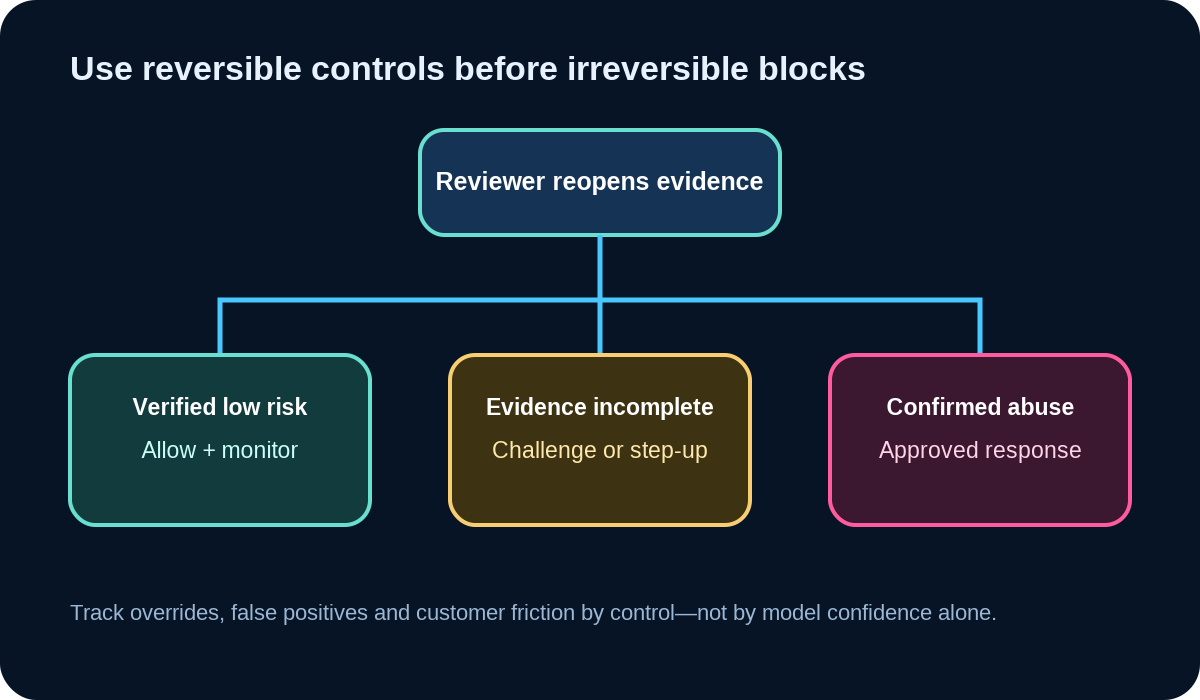
A reviewer may allow and monitor a well-supported low-risk agent, apply a reversible challenge or step-up when evidence is incomplete, or send confirmed abuse through the established fraud-response process. The AI output should never directly block a session, change an account or decline a payment.
Record the control applied, reviewer rationale, customer impact and later confirmed outcome. Useful operating measures include reviewer overrides, evidence completeness, challenge completion, false-positive appeals, confirmed-abuse precision and latency to a human decision. Do not report model accuracy without a defensible labeled denominator.
Step 3: review the workflow as customer-facing security
Replay a sanitized mix of ordinary customers, approved accessibility tools, known shopping agents, synthetic unknown automation and previously confirmed abuse before the seasonal peak. Confirm that a legitimate customer can recover from a challenge and that an analyst can explain the evidence behind a block.
Security, fraud, privacy, accessibility and customer-support owners should review the packet together. The goal is not the highest block rate; it is a defensible control that reduces confirmed abuse without turning unfamiliar automation or customer behavior into guilt.

Limitations and topic-selection signal
Agent identities can be spoofed, legitimate intermediaries may hide device context, shared networks create misleading similarity and later fraud outcomes can change the label. Protect customer data, preserve originals, monitor bias and accessibility impact, and keep a manual recovery path.
Focused Firecrawl research on November 26 found Arctic Wolf's November 25 advisory, HUMAN's November 10 platform analysis and Akamai's July commerce research prominently for this problem. The first two establish current seasonal attention; the older Akamai report supplies clearly labeled background. This search-result signal does not prove search volume, rankings or DeepSecurity.io traffic.
Put the insight into practice.
Deep Security helps organizations assess risk, validate controls, and build a practical plan to strengthen their defenses.
Talk with Deep Security