

A practical AI-assisted workflow for reconciling internet-facing assets, credentials, API controls and logs before fast agentic attacks exploit familiar weaknesses.
Why familiar weaknesses now need a faster evidence loop
The U.K. National Cyber Security Centre reported on November 24 that it has seen a marked rise in AI-assisted attacks since September. According to the NCSC, agentic offensive frameworks have rapidly tested internet-facing services across multiple sectors, contributing to downtime and system compromise. The weaknesses were not novel: committed credentials, infrastructure-as-code mistakes, missing authentication, insecure APIs and forgotten services remained the entry points.
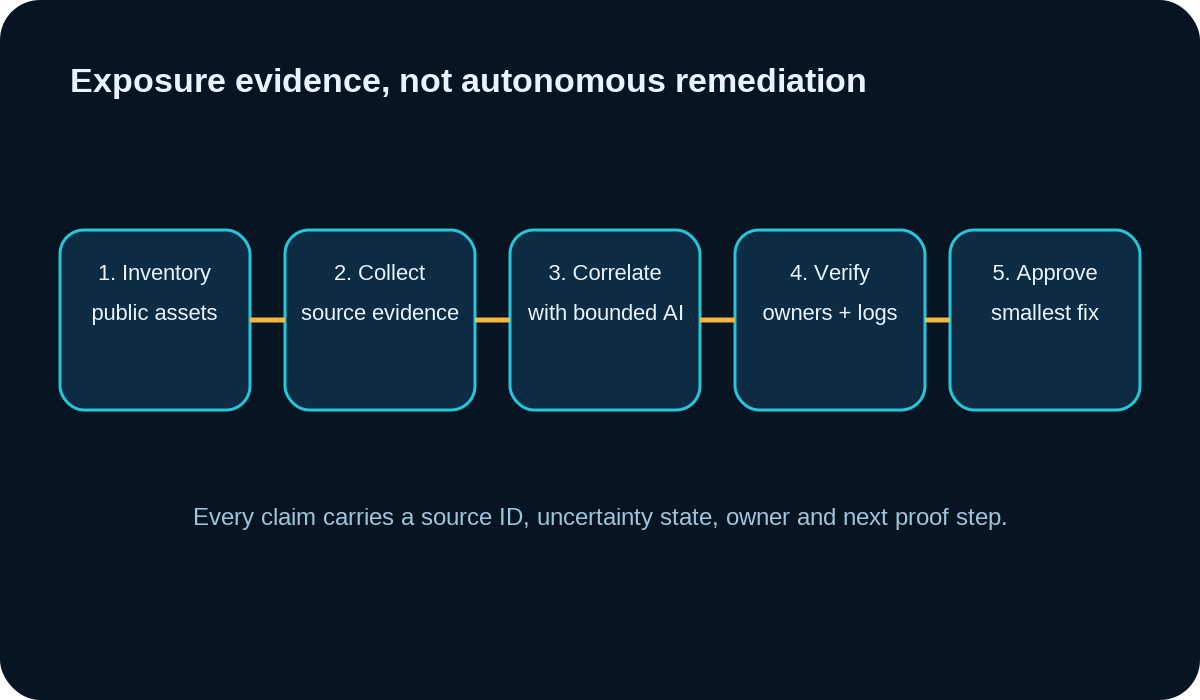
Independent November 25 coverage gave the topic same-day attention. The useful defensive workload is not autonomous counterattack. It is faster reconciliation: determine what is public, what control is actually present, which logs support the conclusion and who owns the smallest safe correction.

Build a read-only exposure evidence contract
This workflow fits security operations, cloud, infrastructure, application and identity teams. Collect authorized exports from DNS, load balancers, cloud inventories, external attack-surface tools, API gateways, identity systems, source-control secret alerts, vulnerability management and recent configuration changes. Do not let a model scan systems or try credentials.
Normalize each candidate record into asset, route, environment, owner, authentication boundary, credential or token class, observed weakness, source ID, collection time, confidence and next proof step. Keep secrets out of the model context. A path name or exposed port is a lead, not proof of vulnerability.
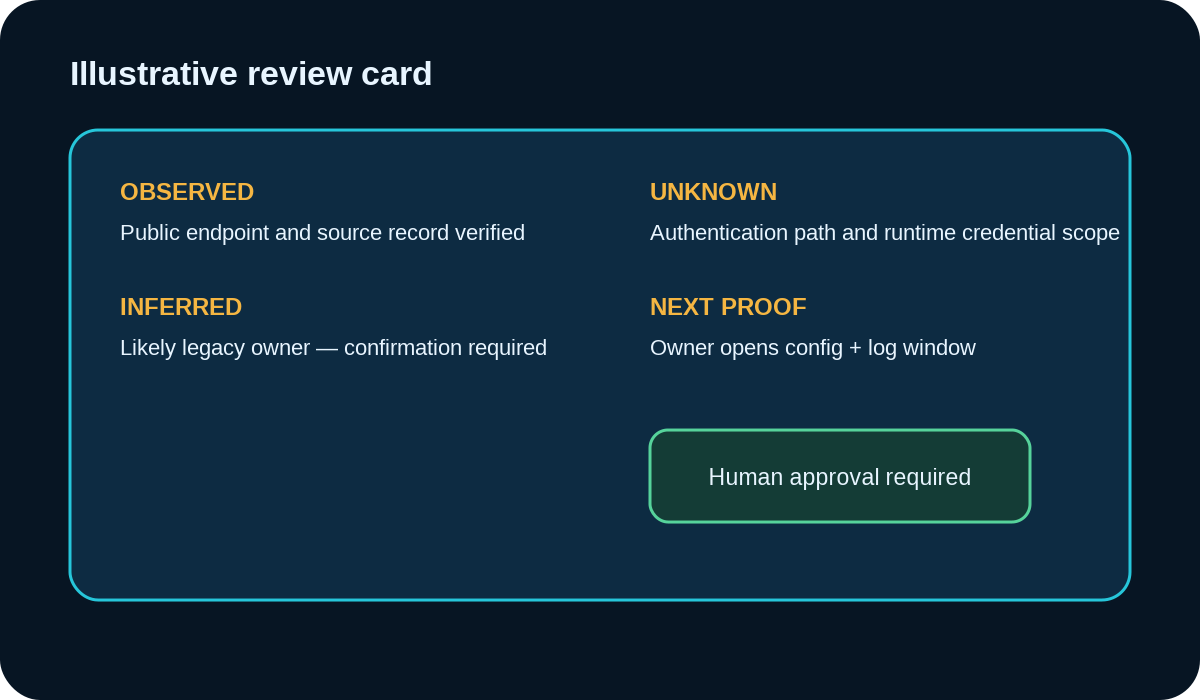
- Observed: directly supported by a current configuration, response, inventory record or log.
- Inferred: plausible from naming or architecture but still awaiting an owner or runtime check.
- Unknown: no current evidence for authentication, ownership or exposure.
- Approved: the accountable owner confirmed the record and accepted the change plan.
Step 1: reconcile assets without declaring them vulnerable
Example prompt: “Using only these authorized exports, group records that may describe the same internet-facing service. Preserve every source ID. For each record, list authentication evidence, credential exposure evidence, API controls, owner, last verified time and contradictions. Label observed, inferred or unknown. Do not probe, try credentials or call an asset vulnerable.”
The expected output is a review queue, not a scan result. An analyst should reopen the original evidence, split false joins and confirm the service from an approved vantage point. Prioritize records with no owner, default or missing authentication, committed credentials, exposed administration paths or ambiguous API controls.
Step 2: correlate noisy agent behavior with real weaknesses
NCSC says these frameworks often trade stealth for speed: bursts of varied requests, short pauses, rapid failures and broad endpoint discovery can be visible across web, API, identity and network logs. Ask the model to organize an authorized time window by asset and source ID, but never treat a behavioral pattern alone as attribution.
Example prompt: “Create a timestamped sequence of unusual request bursts, authentication failures, error-rate changes and follow-on access. Cite each record and list benign alternatives. Separate detection evidence from exposure evidence. Do not name a framework or actor unless the supplied source does.” A reviewer confirms the joins and determines whether the activity touched a verified weakness.

Step 3: apply the smallest evidence-backed correction
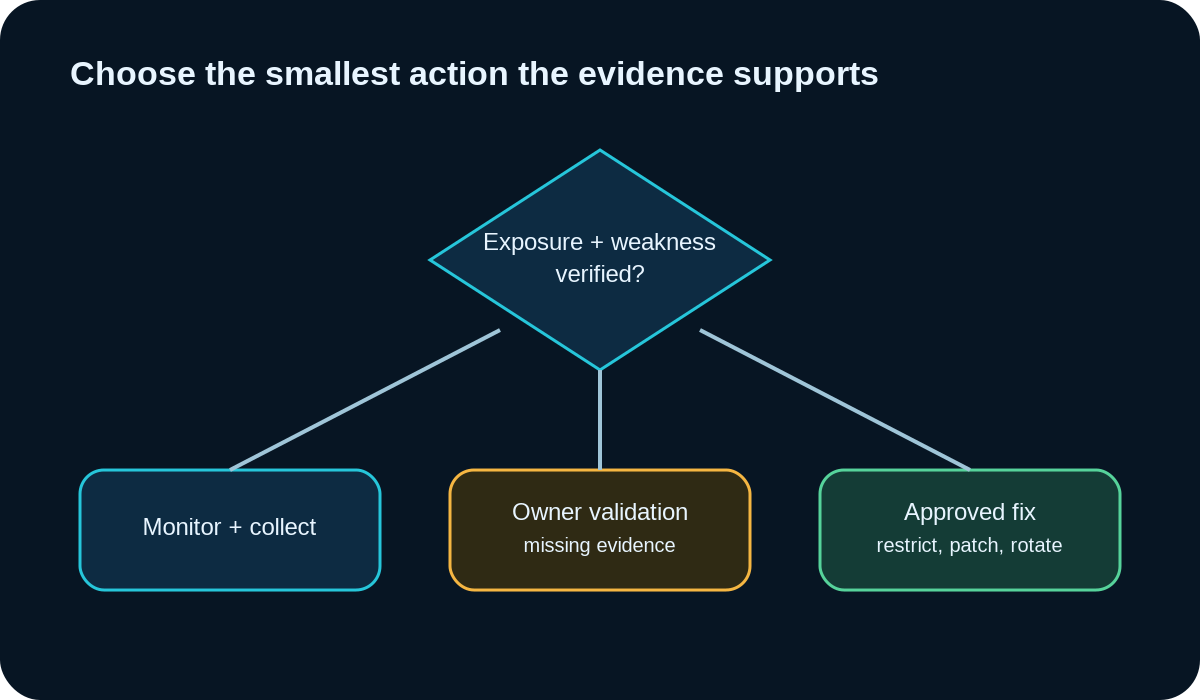
Route unverified records to an owner-validation queue. For confirmed exposure, use the existing change process to remove public access, place the service behind an identity-aware proxy, restrict source networks, require strong phishing-resistant authentication, rotate a verified exposed secret, add API rate controls or patch the documented weakness. Test rollback and preserve completion evidence.
Track stale public assets, owner-confirmed exposures, time to proof, reviewer corrections, approved fixes and recurrence after verification. Do not report a single coverage percentage unless the inventory denominator is defensible.
Limitations and topic-selection signal
External inventories miss internal dependencies, cloud records become stale and a noisy client is not necessarily hostile. Models can merge unrelated hosts or overstate missing controls. Preserve originals, bound time windows, require citations, protect architecture data and retain a manual workflow. The NCSC explicitly warns that defensive AI is not a reason to wait on basic cyber hygiene.
Focused Firecrawl research on November 25 returned the NCSC's November 24 primary guidance first and same-day independent coverage prominently. That establishes current multi-source attention around a concrete defensive workload; it does not prove search volume, adoption, DeepSecurity.io traffic or ranking.
Put the insight into practice.
Deep Security helps organizations assess risk, validate controls, and build a practical plan to strengthen their defenses.
Talk with Deep Security