

A practical workflow for reconciling local AI-agent processes, identities, tools and network activity so security teams can find ownerless or unsanctioned use without automating containment.
Why shadow-agent reconciliation has current attention
Microsoft’s November 17 Ignite announcements put local-agent discovery, lifecycle governance, tool mapping and action-level controls into one current cluster. Microsoft says Agent 365 can register connected agents, discover more than 60 types of local agents, map tools and activity, and combine signals into dynamic risk. Its own availability notes matter: local discovery, the tools registry and some Windows runtime protection are generally available, while many cross-platform, dynamic-risk, network and Conditional Access capabilities are previews or limited previews.
Cisco published an identity-centric security framework the same day. Its practical example uses a verifiable workload identity, a short-lived narrowly scoped token, contextual enforcement and a log tying the action to the agent, owner, target and policy decision. Independent WindowsForum coverage also warned that previews carry no production SLA, licensing remains uneven and signal quality depends heavily on the surrounding Microsoft stack. Unlike Deep Security’s October 21 pre-production access review, this workflow addresses the new post-deployment problem: reconciling local and shadow-agent activity already appearing across a fleet.

Audience, tools and a safe boundary
This workflow fits identity teams, SOC analysts, cloud administrators, endpoint defenders and platform owners who need to govern coding agents, digital teammates, local assistants or third-party agents. A useful pilot needs an authoritative identity directory, endpoint or agent discovery, cloud and SaaS audit logs, a tool or MCP catalog, ticketing, and a reviewer who can confirm business ownership.
Give the model read access only to a curated export. Do not give it the ability to issue tokens, change Conditional Access, disable identities or edit firewall policy. Its job is to normalize records, cite evidence, expose contradictions and assemble a review packet. Existing identity and change-management controls remain authoritative.
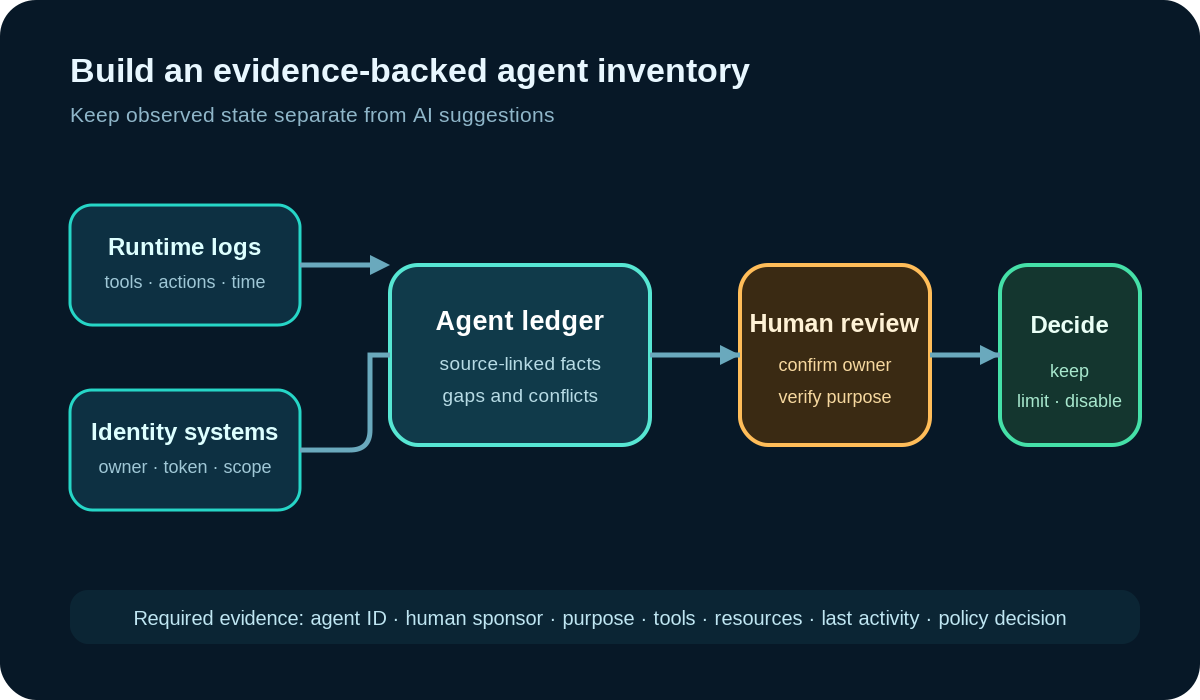
- Identity fact: agent or workload ID, source system and discovery time.
- Ownership fact: named human sponsor, team and approved purpose.
- Access fact: resources, tools, scopes, token lifetime and policy decision.
- Activity fact: last use, actions, destinations and supporting log IDs.
Step 1: build the agent ledger from authoritative records
Start with a seven- or fourteen-day slice. Join agent registry, workload identity, endpoint process, network destination and tool-use records on stable IDs. Preserve each original timestamp and source. If a local process is discovered but has no registered identity, record it as unmanaged; do not invent an owner from a username or device name.
Minimum columns are agent ID, platform, model or runtime where known, sponsor, purpose, tools, resources, token type, grant time, expiry, last activity, policy result and evidence links. A blank value is a finding to review, not permission for the model to fill the gap.
Step 2: prompt for a review queue, not a verdict
Example prompt: “Using only ledger AG-19 and its linked logs, list agents with no current sponsor, activity after expiry, unused access, new tools, broader scopes or destinations outside their approved purpose. For each item, cite the exact source IDs and timestamps, state the missing evidence, propose the least disruptive next check, and label every conclusion as observed, inferred or unknown. Do not issue, revoke or modify access and do not treat a vendor risk score as proof.”
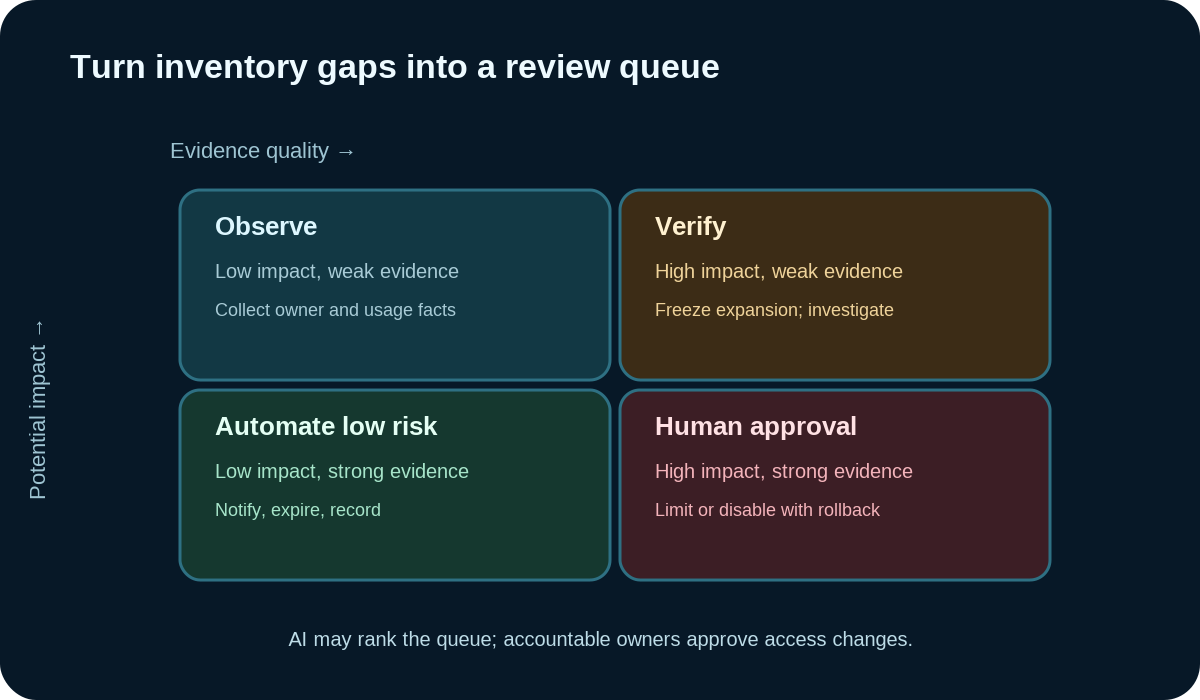
Expected output is a compact queue with agent, concern, evidence, contradictory evidence, impact if wrong, next safe query and accountable reviewer. Reject entries without source IDs, entries that merge human and agent activity, and recommendations that skip an application owner.
- Rank ownerless privileged agents above dormant low-impact assistants.
- Require evidence for both the grant and recent use.
- Separate preview telemetry from an authoritative identity state.
- Record prompt, model, evidence manifest and reviewer correction.
Step 3: investigate shadow use with reversible gates
Route low-impact cleanup, such as an expired test agent or an unapproved extension, to the named endpoint owner with a deadline. For privileged, production or cross-tenant activity, require a second reviewer, exact target, expected effect and rollback. Use staged tool or network restrictions where the platform supports them; do not isolate an employee device from an AI-generated label alone.
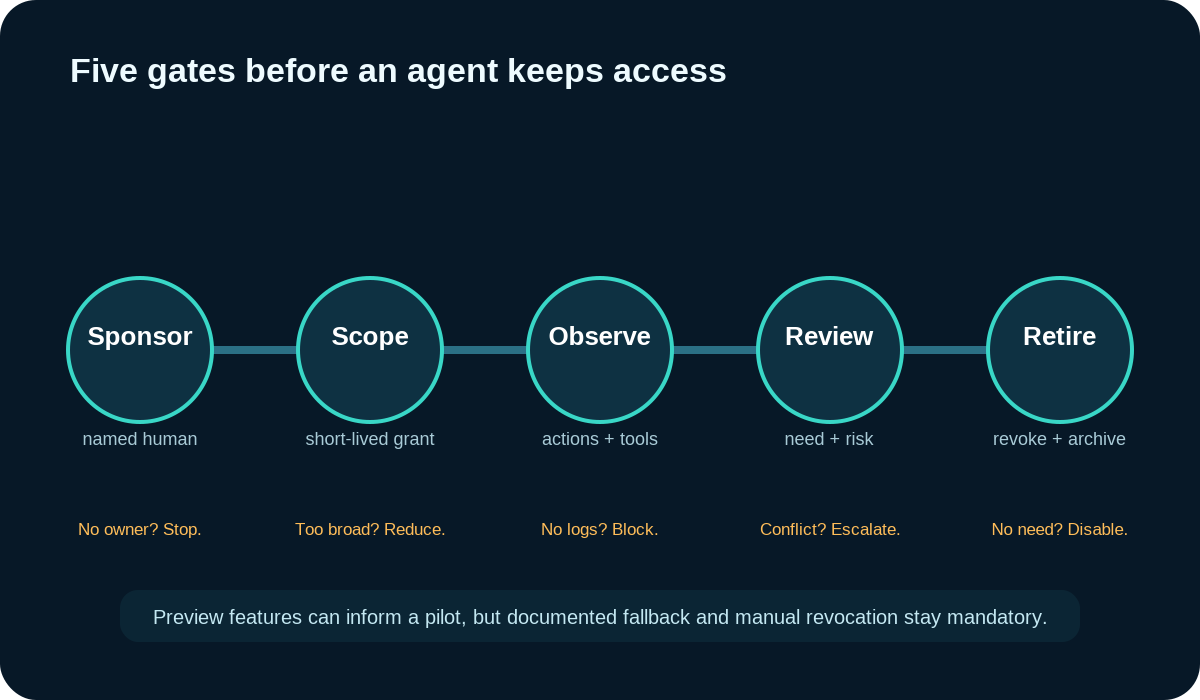
Stop when the owner cannot be confirmed, logs disagree, the capability is preview-only without a fallback, or the proposed change could strand a service account. A risk number may help order work, but it cannot replace scope, evidence or authority.

Step 4: make lifecycle checks repeatable
Run the same ledger comparison on a schedule and after material model, tool, owner or policy changes. Track unknown owners, expired grants still used, unused privileges, new destinations, reviewer corrections, time to decision and reversals. Do not optimize for the number of identities disabled.
Microsoft says automated lifecycle management of agent identities is generally available, while many local-agent identity and dynamic-risk capabilities remain preview. Validate the actual tenant, SKU and admin-center status before designing around any announced feature. Non-Microsoft environments can apply the same evidence pattern with their existing IAM, endpoint, network and case tools.
Limitations and why this topic was selected
Agent discovery can miss short-lived processes, shared credentials can blur attribution and product telemetry may not cover every cloud, endpoint or SaaS. AI can also infer ownership from weak clues or overreact to unusual but approved automation. Keep a manual inventory path and periodically test whether the same action can be reconstructed without the model.
A focused Firecrawl search on November 19 for agent identity inventory and just-in-time access returned Microsoft’s Entra announcement first, Microsoft’s Agent 365 update second, and fresh independent preview cautions third; Cisco’s dated framework supplied a vendor-neutral control model. That result cluster establishes current public attention and direct relevance to Deep Security readers. Search placement is a discovery signal, not proof of traffic, adoption or Google rank.
Put the insight into practice.
Deep Security helps organizations assess risk, validate controls, and build a practical plan to strengthen their defenses.
Talk with Deep Security