

A reproducible workflow for comparing AI security tools against a sealed evidence set before granting production data, decisions or response authority.
Why tool evaluation is now a security workload
The U.S. Government Accountability Office reported on November 20 that AI can improve defensive analysis while also magnifying the speed, scale and precision of cyberattacks. Its technology assessment found no widely accepted criteria for judging the offensive or defensive capability of generative AI and identified testing, data quality, privacy, governance, trust, cost and integration gaps.
Independent November 23 coverage emphasized the same practical problem: organizations cannot reliably infer that an AI-powered cybersecurity tool is effective or safe from a product claim. A useful response is a controlled, reproducible shadow evaluation tied to the work the local team actually performs.

Create a sealed truth set and an evidence contract
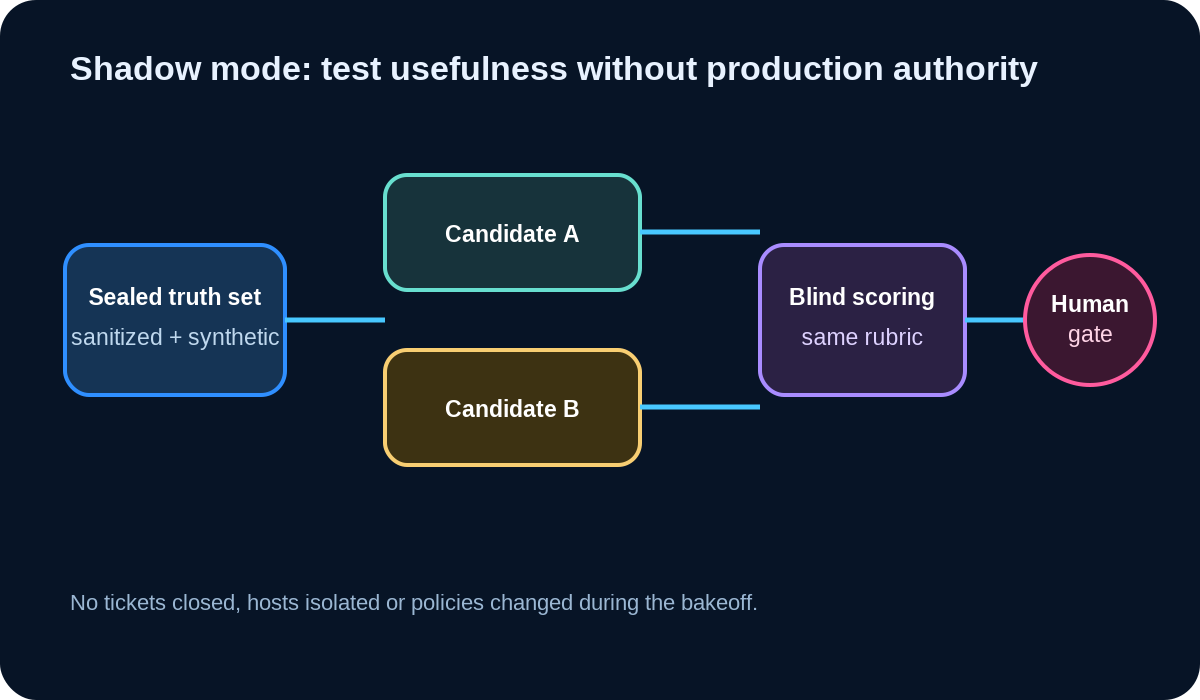
This workflow fits security architecture, SOC engineering, procurement, privacy, model-risk and operations teams. Assemble a small approved corpus of sanitized historical cases, synthetic edge cases and known benign activity. Each case needs a stable source ID, expected facts, allowed uncertainty, prohibited action and reviewer-authored rationale.
Remove secrets and customer identifiers. Keep candidate tools outside production write paths and give each the same inputs, time window and task. Separate correctness from usefulness: a fluent summary that cannot reopen evidence is not operationally trustworthy.
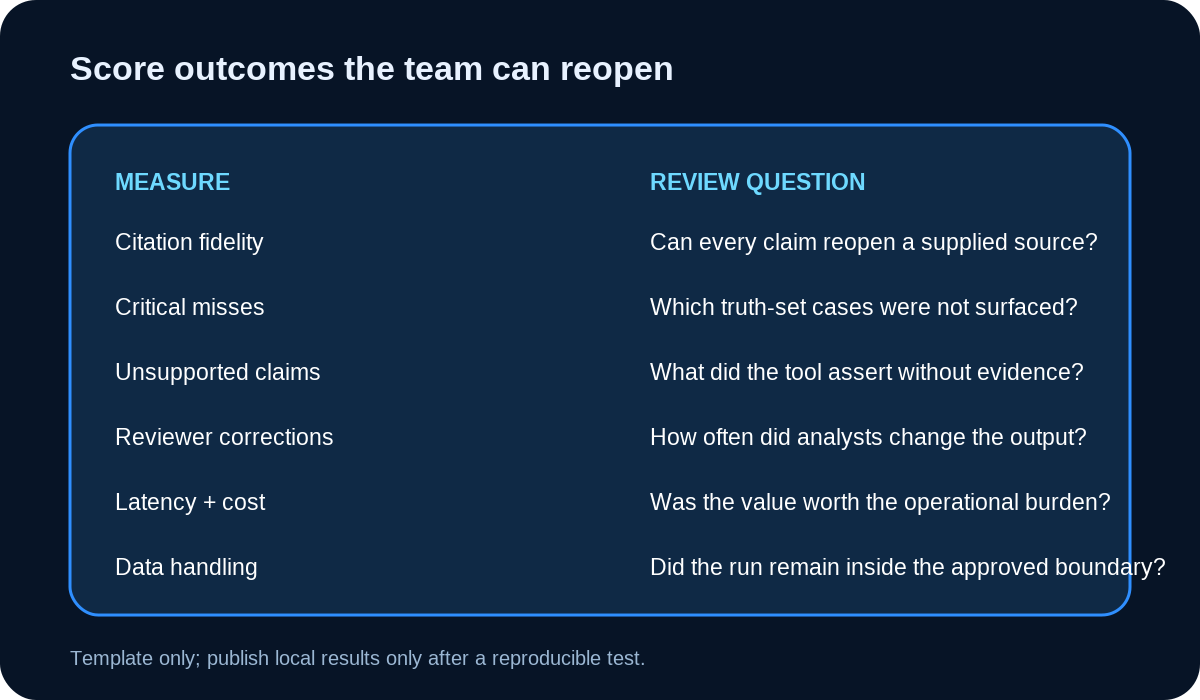
- Facts: claims directly supported by the supplied case records.
- Misses: expected critical findings that were not surfaced.
- Unsupported claims: statements the reviewer cannot trace to a source.
- Operational burden: latency, cost, setup, correction and data-handling work.
Step 1: run a blind, source-cited replay
Example prompt: “Analyze only the supplied case. Preserve every source ID. Separate observed facts, inferences and missing evidence. Identify the next verification step and benign alternatives. Do not close a ticket, isolate a host, change a rule or decide whether this product should be adopted.”
Randomize case order and hide reviewer labels from the candidate. Capture the raw response, cited sources, runtime, configuration and cost. A separate evaluator script can check formatting, but people must judge whether the reasoning and citations survive contact with the original evidence.
Step 2: score failure modes before average performance
Review critical misses, invented evidence, unsafe action suggestions and data-boundary violations before calculating an average. Also count analyst corrections and cases where the tool correctly stayed uncertain. Break results down by the work being evaluated—alert triage, vulnerability review, cloud change analysis or evidence summarization—rather than publishing one blended score.
Repeat selected cases to reveal instability, then rerun after material model, prompt or connector changes. Record the exact version and configuration. A vendor benchmark, including any claim quoted in sales material, is context rather than a substitute for this local test.
Step 3: make adoption a cross-functional decision
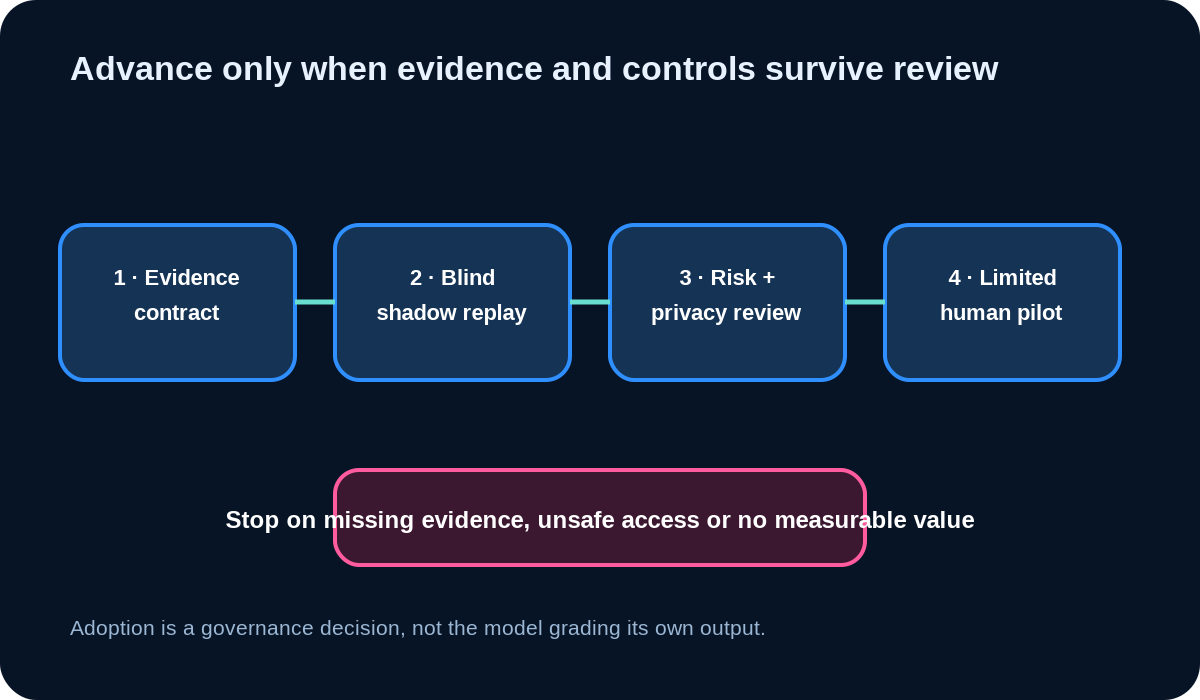
Security operations confirms workload value, privacy and legal owners verify the data path, platform owners validate isolation and rollback, procurement records license and support terms, and an accountable executive accepts residual risk. If the tool advances, begin with a limited read-only pilot and a kill switch.
Track citation fidelity, critical misses, unsupported claims, reviewer corrections, time saved after correction, cost per reviewed case and policy exceptions. Publish local results only when the test is reproducible and the denominator is clear.

Limitations and topic-selection signal
Historical cases can encode analyst bias, synthetic cases can be too tidy and a shadow environment does not reproduce every production dependency. Test drift over time, protect evaluation data and maintain a non-AI path for critical functions. The GAO presents policy options, not a certification scheme or proof that a particular tool works.
Focused Firecrawl research on November 26 returned the November 20 GAO report and multiple November 23 independent articles prominently. That establishes fresh, multi-source attention around a concrete evaluation gap; it does not establish search volume, product performance, rankings or traffic.
Put the insight into practice.
Deep Security helps organizations assess risk, validate controls, and build a practical plan to strengthen their defenses.
Talk with Deep Security