

A practical, human-approved workflow for turning generative-AI policies into source-linked evidence checks, live tests and auditable remediation.
Why AI governance needs executable evidence
A November 20 AWS and Standard Bank Group case study describes a production workflow that gathers documentation, code and live application results, then evaluates them against international standards and the bank’s own policies. AWS and the bank report that six assessments produced reports in about two hours instead of a traditionally manual two-week review, and that risk scores improved after remediation. Those are vendor-and-customer results, not a benchmark for other organizations.
Independent November 20 coverage emphasized the important boundary: the workflow prepares evidence, while the bank’s risk committee keeps final approval. That is the reusable idea for security, compliance and platform teams—make policy checks repeatable and traceable without treating a model’s score as certification.

Define the assessment contract before choosing a model
This pattern fits security architecture, model-risk, privacy, compliance and delivery teams reviewing internal copilots, customer-facing assistants or agentic workflows. Start with the organization’s existing policy, approval gates and evidence owners. Map each question to one authoritative source and one accountable reviewer. Use an enterprise-approved model only for bounded extraction or comparison; keep source repositories, test outputs and decisions in systems with access control and retention.
Separate what the system may do from what it must never do. It can locate evidence, draft a yes-or-no answer and highlight gaps. It must not certify compliance, silently rewrite policy, approve an exception or infer a missing control from persuasive prose.
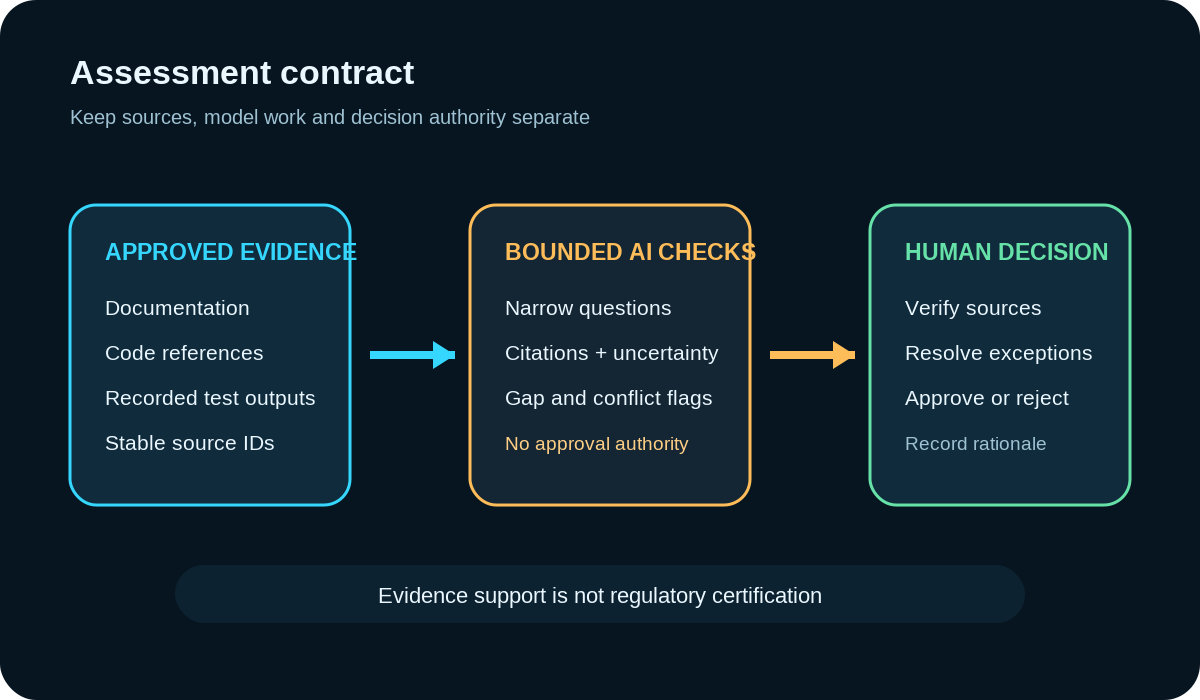
- Inputs: approved documentation, code references, system prompts, test cases and change records.
- Checks: narrow questions tied to a policy clause, standard or documented risk event.
- Outputs: cited evidence, missing evidence, contradictions, test results and named mitigations.
- Decision: human reviewers confirm findings and the authorized committee approves or rejects.
Step 1: assemble a claim-to-source packet
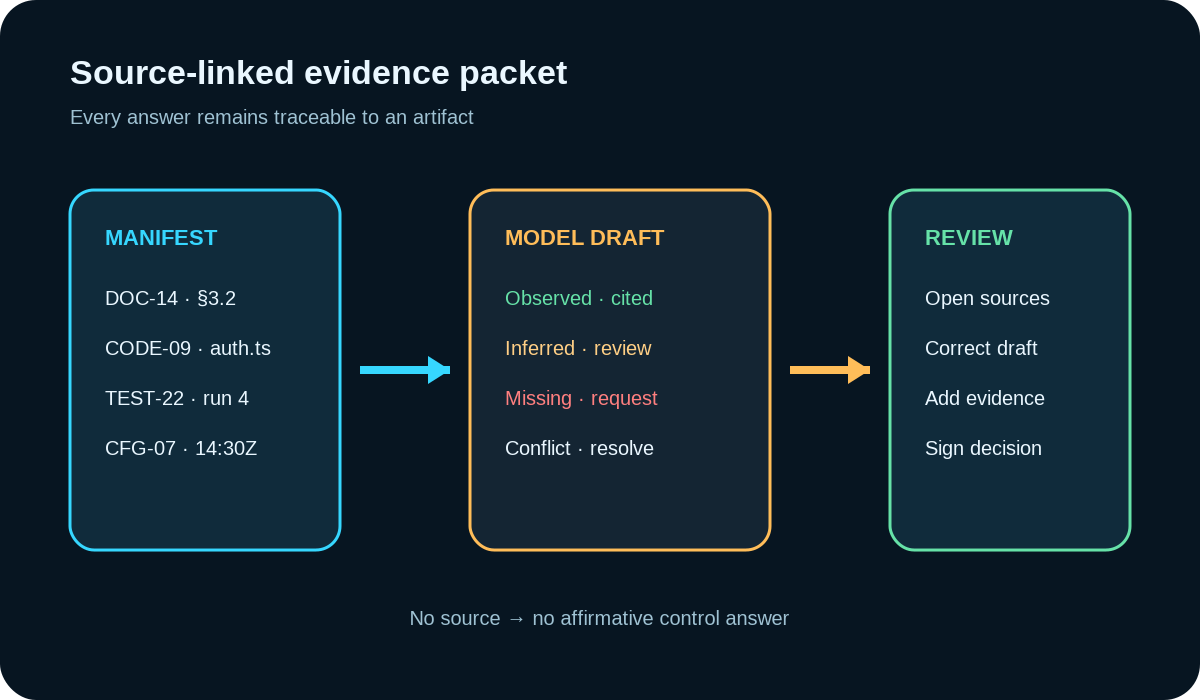
Give the model a manifest, not unrestricted repository access. Example prompt: “For assessment AR-22, answer only controls C-01 through C-12 from the attached evidence manifest. For each answer, cite the artifact ID, exact section and timestamp; label observed, inferred or missing; list contradictions and the smallest additional evidence needed. Do not score compliance, invent evidence or recommend approval.”
Expected output is a compact table that a reviewer can reopen at the source. It is an illustrative format, not a tested accuracy result. Require the delivery team to correct draft answers and supply anything the model could not find.
Step 2: run bounded behavior tests
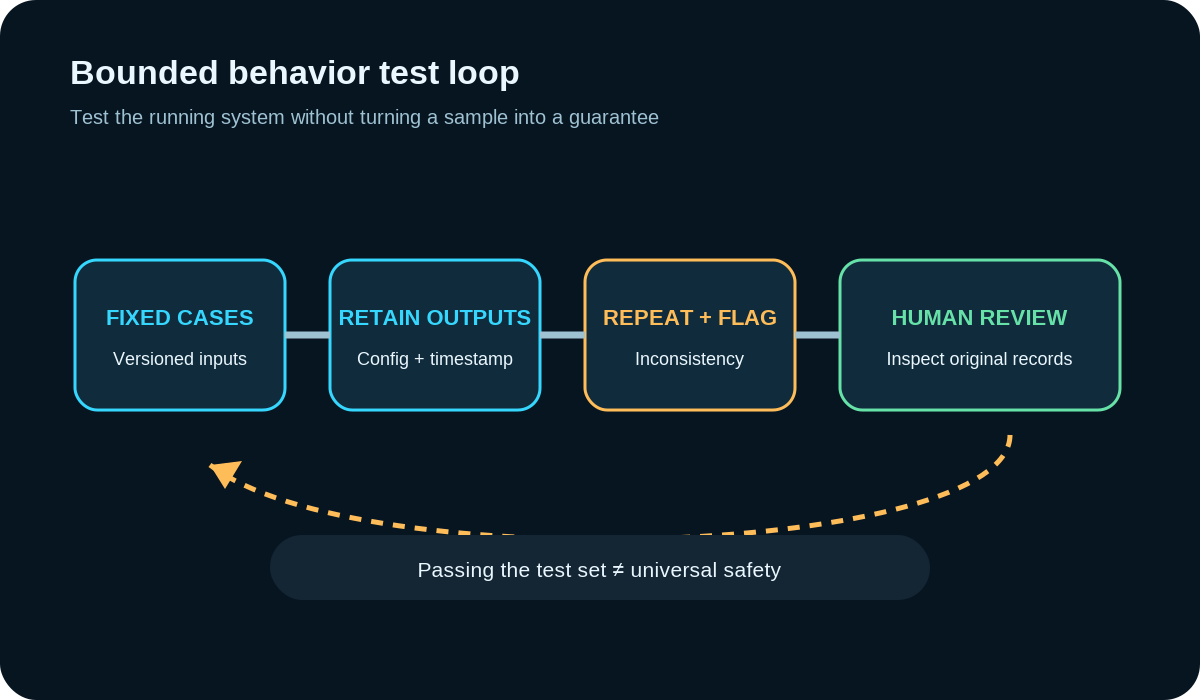
Documentation says what should happen; a guarded test environment shows what the application actually returns. Use approved representative prompts, expected-answer checks, off-topic requests and adversarial cases that are safe for the system under review. Record the test version, model configuration, guardrail version, input class, output and evaluator criteria. Keep customer and regulated data out of the test set unless an approved process permits it.
A model may group outcomes or compare them with explicit acceptance criteria, but do not ask it for an open-ended opinion. Repeat non-deterministic checks, flag inconsistent judgments and let a reviewer inspect the underlying outputs. A passing sample is evidence about that test set, not proof that the system is universally safe.
Step 3: bind remediation to human approval
Turn each missing control into a ticket with the policy clause, evidence gap, proposed fix, owner and retest. The reviewer confirms whether the gap is real, whether the proposed fix changes residual risk and whether an exception needs a separate authority. The final packet should preserve original evidence, reviewer edits and decision rationale.
Re-run the relevant checks after a material model, prompt, data-source, permission or application change. Version the questions and scoring formula so a later audit can reproduce what the committee saw. Measure reviewer corrections, reopened findings, missing-source rates and time to remediation—not just how quickly the model emits a report.

Limitations and topic-selection signal
Models can miss evidence, accept polished but weak documentation, vary between runs or expose sensitive artifacts. Policy questions can also become stale. Use access controls, source citations, deterministic formulas where possible, repeated checks, independent review and a manual route. This workflow produces decision support; it does not certify legal or regulatory compliance.
Focused Firecrawl research on November 22 returned the November 20 AWS case study, same-day independent coverage and Standard Bank’s own AI governance context among the prominent results. That cluster establishes fresh public attention and a practical governance problem; it does not prove search volume, adoption, DeepSecurity.io traffic or ranking.
Put the insight into practice.
Deep Security helps organizations assess risk, validate controls, and build a practical plan to strengthen their defenses.
Talk with Deep Security