

A practical workflow for using coding, security and operations agents in one auditable delivery path while people approve releases, incidents and rollbacks.
Why governed AI delivery has current attention
AWS published a November 13 reference implementation connecting Kiro, AWS Security Agent—now part of AWS Continuum—and AWS DevOps Agent through GitHub, GitHub Actions, Lambda and optional Slack notifications. The example covers code authoring, pull-request creation, security review, deployment and incident investigation. AWS explicitly says it is an architecture example and does not provide compliance by itself.
On November 18, incident.io described incident management for AI-native software factories, including build-phase timelines, human approval for high-risk changes, model versioning, alert grouping, private incidents and audited rollback. Fresh November 19 coverage on securing the software factory focused on the same reader questions: which agent acted, through which sanctioned path, with which permissions, and which policy allowed the action. Together, those dated sources show current attention around the operational control problem—not a claim that one product solves it.

Audience, tools and separation of duties
This workflow fits platform engineering, DevSecOps, application security, incident response and compliance teams piloting coding or operations agents in a regulated environment. A minimal stack needs version control, CI/CD, deterministic tests, a security scanner, deployment records, observability, incident management and an evidence store. The agents can be vendor products or internal services if they produce source-linked output.
Do not let the coding agent approve its own pull request, the security agent waive its own finding, or the operations agent trigger an unreviewed production rollback. Use separate service identities and least-privilege scopes. An accountable person owns merge, another owns production change, and the incident commander owns containment and recovery.
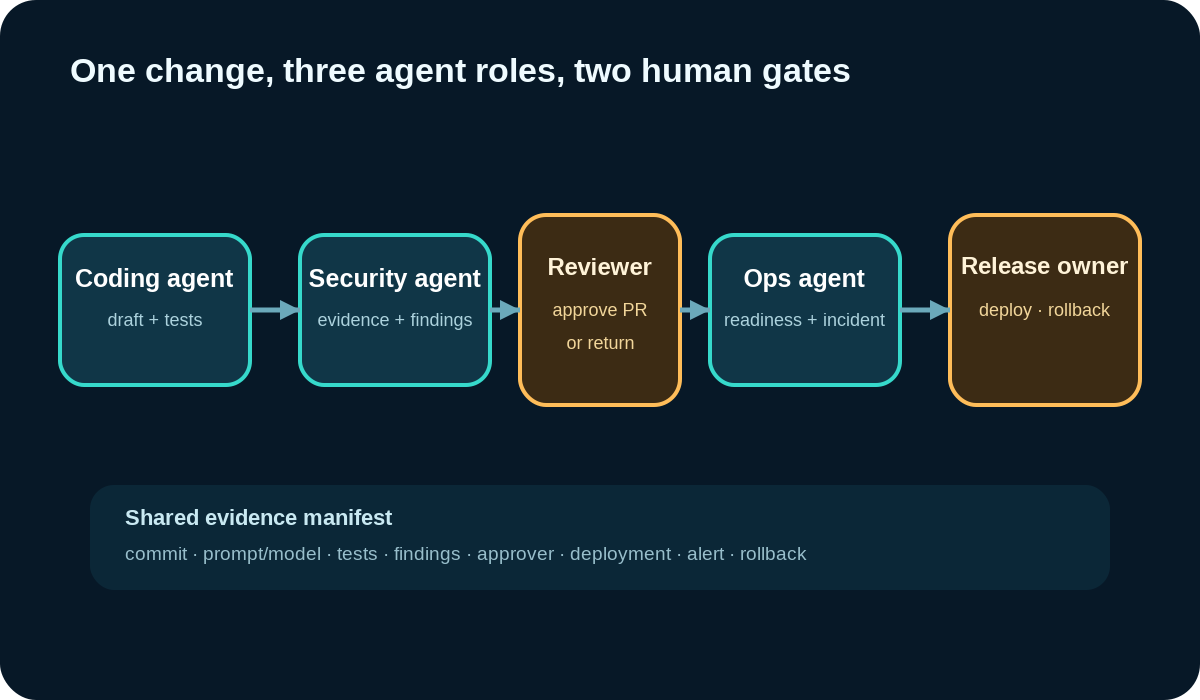
Step 1: define the change and evidence manifest
Choose a low-risk service and a bounded change, such as adding an input validation test or improving a non-sensitive runbook. Create a manifest before an agent starts: repository, branch, issue, authorized files, prohibited paths, test commands, security checks, deployment target, owner, rollback and retention.
Every agent appends its prompt or task, model or tool version, action, source IDs, outputs and errors. Preserve rejected attempts and reviewer corrections. A release summary generated later is useful only if the underlying evidence can be replayed.
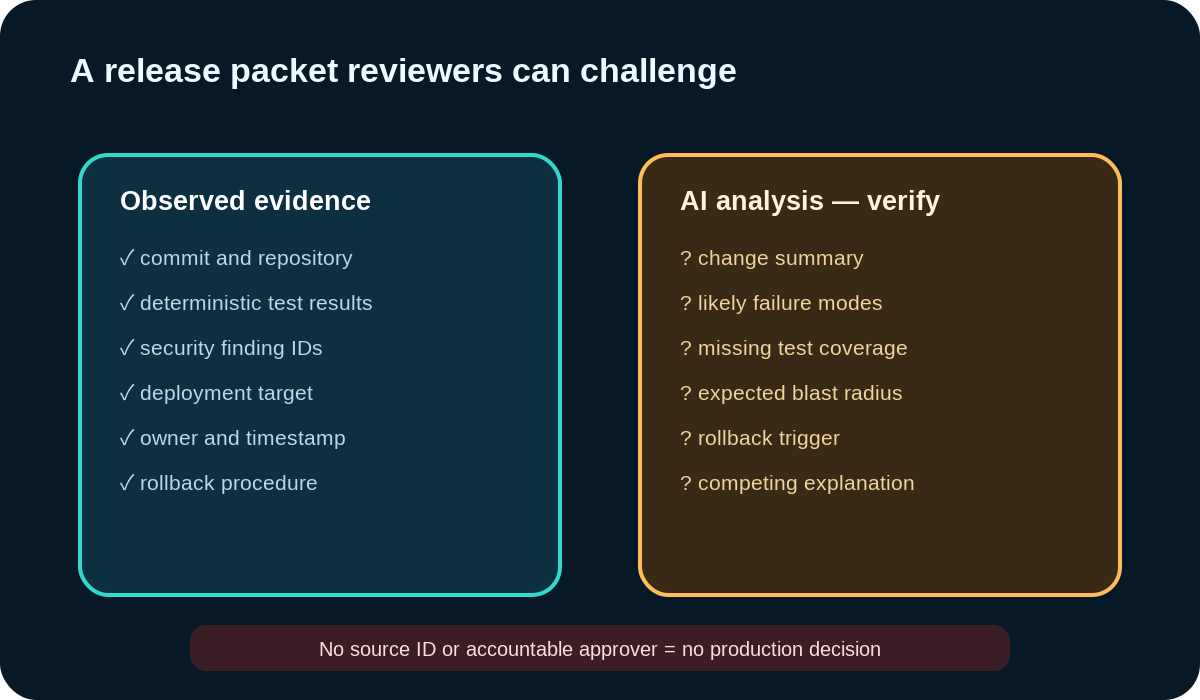
Step 2: ask agents for bounded contributions
Example coding task: “For issue APP-219, modify only the approved validation module and its tests. Run the listed tests, report every changed file and command, cite failures, and stop before commit if a prohibited path or new dependency is required.” Example review task: “Using manifest APP-219, compare the diff, test artifacts and scanner findings. Cite each source, list missing coverage and conflicting results, and draft questions for the reviewer. Do not approve, merge, waive or deploy.”
Expected output is a proposed diff, deterministic test evidence, security findings and explicit unknowns. Reject a response that only says the change is safe, omits failed commands, silently changes dependencies or converts a scanner absence into proof of security.
- Use separate identities and scopes for authoring, review and operations.
- Require source IDs for claims about tests, vulnerabilities and deployment state.
- Make prohibited actions fail closed in tooling, not only in the prompt.
- Keep a manual path for outages or models that cannot access the evidence.
Step 3: approve the release packet, not the prose
The reviewer confirms the diff matches the issue, tests cover the intended behavior, findings have owners and the rollback still works. Production approval includes target environment, maintenance window, expected telemetry and a stop condition. The agent may summarize these fields but cannot supply missing evidence.
Incident.io says its Investigations capability can analyze telemetry, deployments, code changes and prior incidents and draft a pull request, but it is a paid add-on requiring Response on Pro or Enterprise. Audit-log retention and export are Enterprise capabilities. These restrictions make entitlement and data-flow review part of the pilot, especially because the product documents third-party AI subprocessors.

Step 4: begin the incident timeline at the pipeline
If a build, review or deployment signal fails, open the incident timeline there—not only when production alerts. Link commit, agent session, test, approval, deployment, service owner, alert and rollback. Ask the model for competing explanations and missing evidence rather than a single root cause.
Example incident prompt: “Using only incident INC-219 evidence, build a timestamped sequence from agent task to customer impact. Cite every transition, separate observation from inference, list benign alternatives and identify the next safe query. Do not change code, deploy, isolate or roll back.” Human responders verify scope, preserve evidence and authorize recovery.
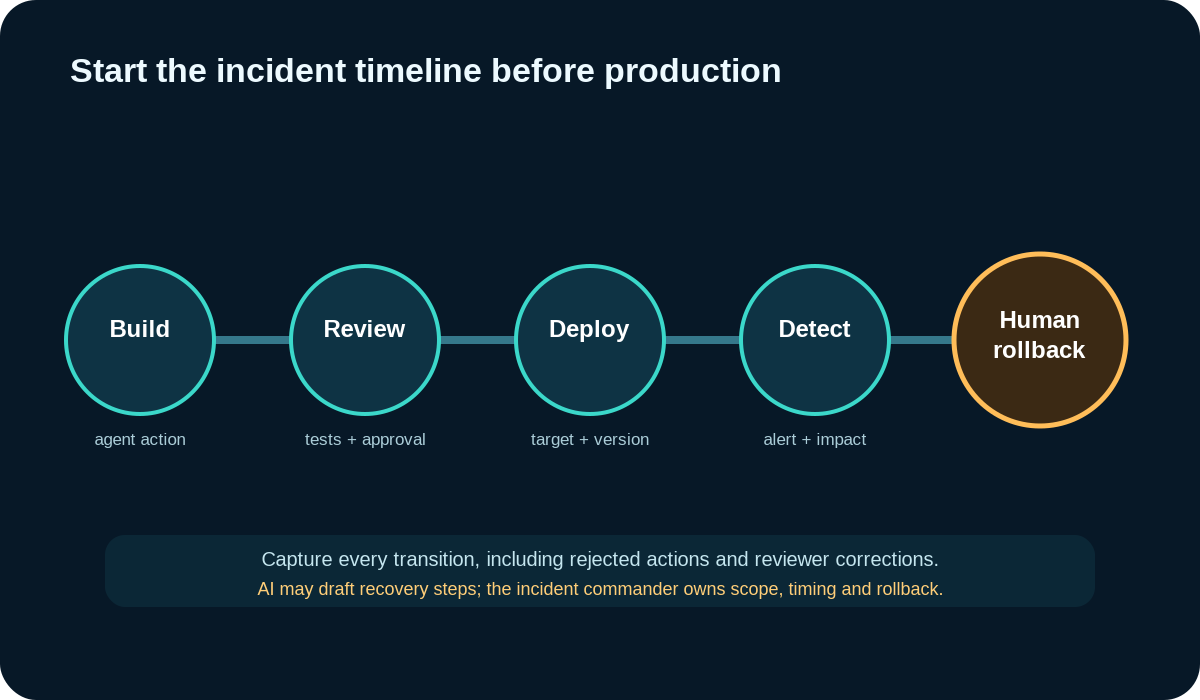
Step 5: measure trust, not agent activity
Track reviewer corrections, unsupported claims, prohibited-action blocks, security finding resolution, time from detection to verified remediation, rollback rehearsal success and incidents reconstructed without missing evidence. Do not reward the number of agent-authored changes or the percentage of automatic approvals.
Expand only after the same controls work across cold starts, failed tests, ambiguous findings and unavailable models. Map the reference workflow to your own segregation-of-duties, model-risk, retention and regulatory obligations; AWS’s example is not a compliance certificate.
Limitations and why this topic was selected
Agents can share the same blind spots, a passing test can miss the real failure mode and audit data can expose code or incident details if retention is poorly scoped. Tool integrations also change. Keep deterministic controls, minimize evidence access, test provider outage behavior and review current plan, region and subprocessor terms.
A focused Firecrawl search on November 19 returned AWS’s current governed AI-DLC architecture, incident.io’s November 18 software-factory incident guide and November 19 independent coverage about machine-speed software security. The cluster directly matches Deep Security’s secure-development audience and exposes a practical information gap: many articles describe agents, but fewer show the evidence and authority needed across the whole change. Search placement does not prove traffic, adoption or Google rank.
Put the insight into practice.
Deep Security helps organizations assess risk, validate controls, and build a practical plan to strengthen their defenses.
Talk with Deep Security