

A practical guide to reordering stable instructions, schemas and examples ahead of unique documents so regulated AI extraction can reduce repeated input work without weakening tenant isolation or review.
Why production prompt caching has current attention
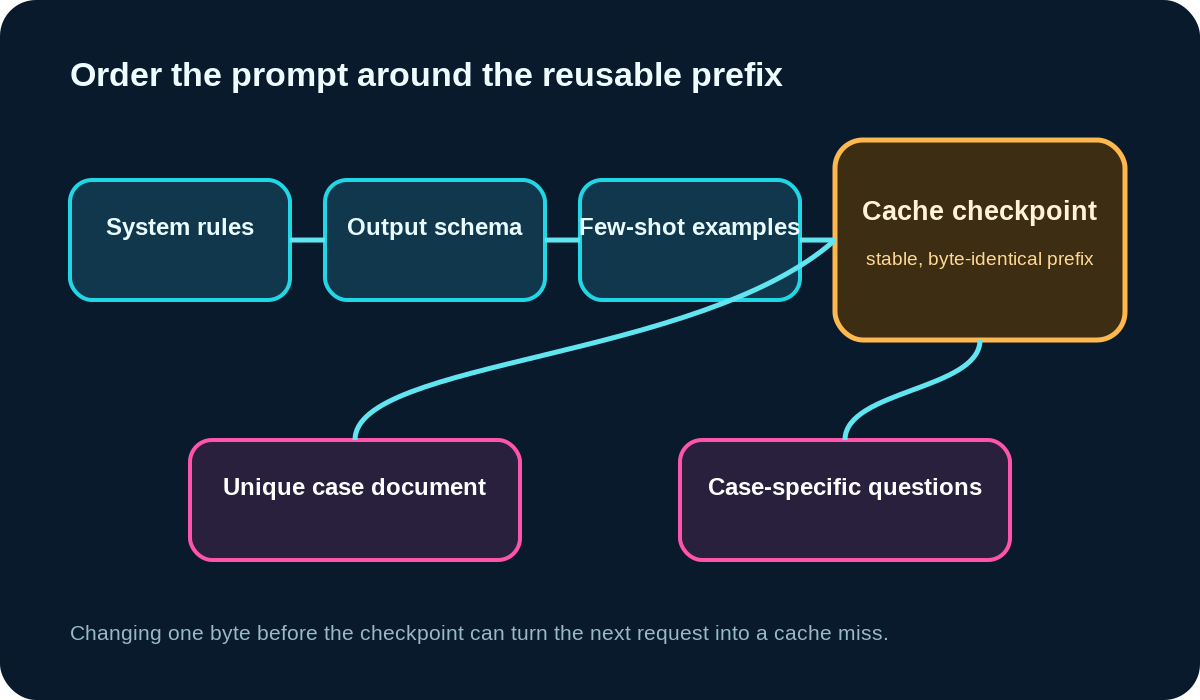
AWS published a November 17 account of how ArisGlobal restructured prompts for NavaX, which processes multi-page safety documents and extracts roughly 130 fields over sequential requests. The stable system instructions, compliance rules, output schema and examples were placed before a cache checkpoint; case documents and questions followed. AWS and ArisGlobal report that 65% of input tokens came from cache, cached requests had up to 25% lower latency, effective input cost fell about 50% and monthly inference spending fell about 40% at more than 19 billion tokens per month. Those are customer and vendor claims, not outcomes Deep Security independently tested.
Fresh independent coverage from Superpower Daily highlighted the same engineering lesson: prompt order, not a different model, changed the cost shape. For security, cloud and compliance teams, the useful application is broader than pharmacovigilance. Repeated incident packets, audit evidence, policy documents and customer forms often share a large stable instruction set but contain unique sensitive records.

Audience, tools and the cacheable boundary
This pattern fits teams running repeated structured extraction or classification through a managed model API: compliance operations, incident response, insurance, legal intake, cloud governance and customer-document workflows. A pilot needs prompt version control, a model endpoint that supports caching, synthetic or approved documents, tenant-aware routing, quality evaluation, cost and latency telemetry, redaction and an immutable change record.
The reusable prefix may contain instructions, approved policy, schema and examples that are identical across eligible requests. Unique documents, customer facts, secrets and case questions belong after the checkpoint. Confirm the provider’s current minimum cache size, time-to-live, model and regional support, billing and data-handling terms before implementation; those conditions can change.
Step 1: inventory the repeated prefix
Sample 50 to 100 approved requests and split every token block into stable, versioned, tenant-specific and case-specific content. Remove timestamps, request IDs and other accidental variability from the stable prefix. Do not move sensitive material earlier just to increase the hit rate.
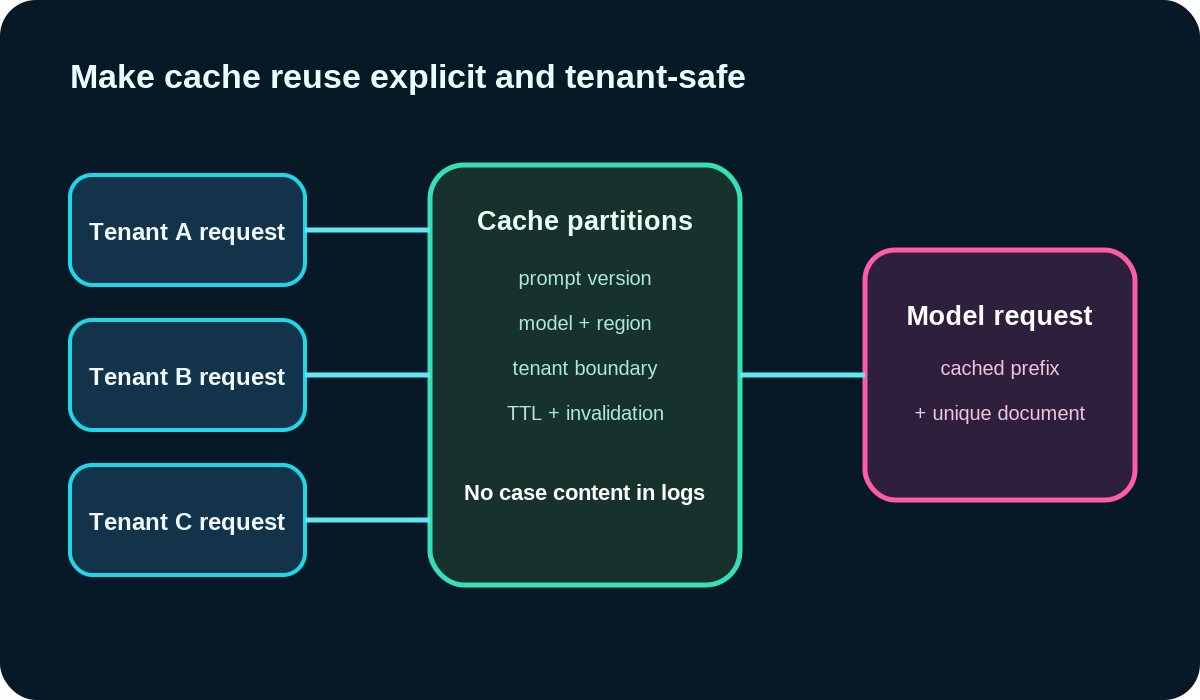
Assign a prompt version to the exact prefix bytes and record model, region, cache parameters, policy owner and effective date. A schema or compliance-rule change creates a new version and invalidates comparisons with the old cache.
Step 2: make the extraction output reviewable
Example prompt suffix: “For case DOC-218, use the cached policy prefix PC-7 and only the attached approved document. Return the named schema fields with page and text-span evidence, mark missing or conflicting fields, and list any rule that could not be applied. Do not infer an identity, copy unrelated personal data, use another tenant’s examples or declare the record complete. Route high-impact fields and all conflicts to a reviewer.”
Expected output is structured data plus evidence and exceptions. The reviewer should see cache status, prompt version, model version, document hash, field evidence and correction. The cache must not obscure which instructions governed a specific result.
- Keep secrets and raw document text out of analytics logs.
- Measure field-level corrections, not only valid JSON.
- Record cache hit, miss and invalidation without storing case content.
- Retain a deterministic non-AI path for fields that control legal or safety action.
Step 3: benchmark with approved workload shape
Run uncached and cached variants over the same synthetic or approved document set. Compare input token billing, hit rate, time to first output, total latency, throttling, field accuracy, omissions and reviewer time. Include cold starts, prefix changes and requests that arrive after the cache expires.
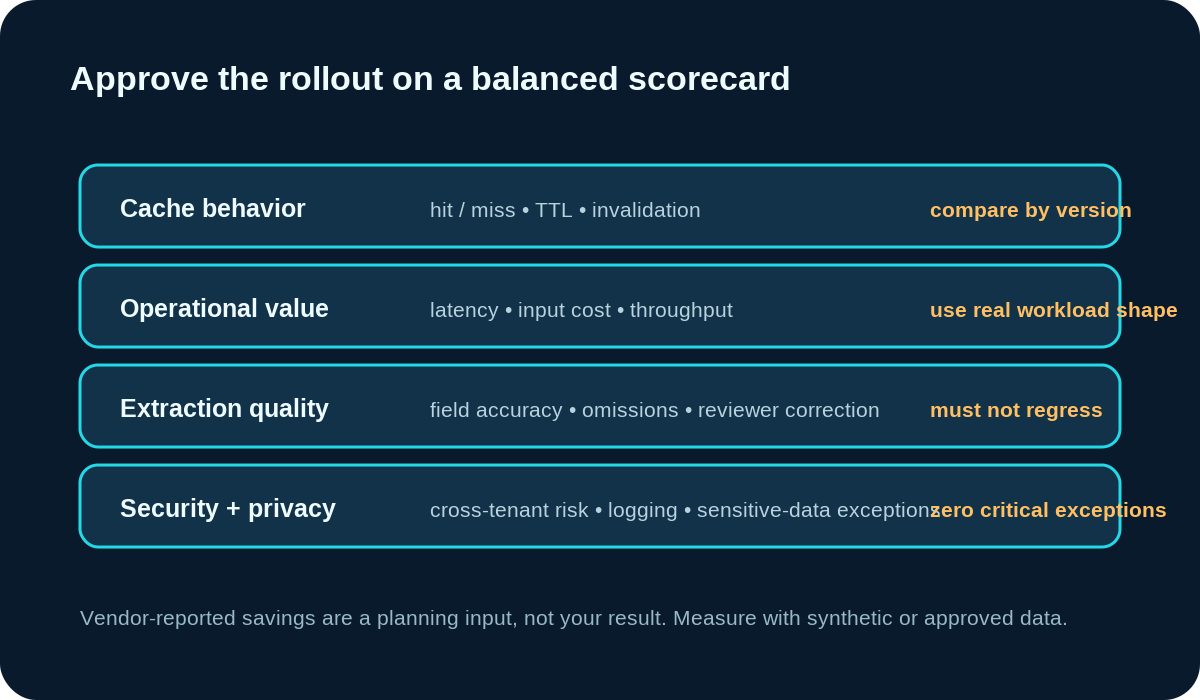
The ArisGlobal percentages are useful planning context, not a promise. Your savings depend on prefix size, request cadence, provider pricing and how much of each document remains unique. Stop if the cached version changes extraction quality, crosses a tenant boundary or makes audit reconstruction harder.

Step 4: roll out with a balanced scorecard
Start with one low-risk extraction schema, one model and a small tenant cohort. Alert on sudden miss rate, unexpected prefix growth, cost regression, schema mismatch and cross-tenant routing. Roll back by prompt version rather than editing the live prefix in place.
Approve expansion only when extraction quality stays within the agreed threshold, critical privacy exceptions remain zero, audit reconstruction works and observed cost or latency justifies the complexity. Review pricing and cache limits when the provider or model version changes.
Realistic limitations and why this topic was selected
Prompt caches are sensitive to exact prefix changes, minimum token thresholds, expiry and model-specific behavior. A miss can erase expected savings; over-sharing a prefix can create privacy risk; stale instructions can create systematic errors. Caching also does not reduce the unique document tokens or eliminate model hallucination and reviewer work.
A focused Firecrawl search on November 18 for “ArisGlobal scaled generative AI inference Amazon Bedrock prompt caching November 17 2026” returned the AWS primary article first and fresh independent coverage. Exact-title searches surfaced Superpower Daily prominently. That combination showed current attention and a concrete production workload relevant to Deep Security’s cloud and business-technology readers. Search placement does not establish traffic, typical savings or Google rank.
Put the insight into practice.
Deep Security helps organizations assess risk, validate controls, and build a practical plan to strengthen their defenses.
Talk with Deep Security