

A practical, security-aware workflow for using AI to convert product analytics, session evidence and feedback into reviewed build packets and controlled experiments.
Why the product signal-to-experiment loop has current attention
OpenAI published a November 12 customer story describing Amplitude’s proactive product agent, Wave. According to Amplitude, Wave combines analytics, session replays, feedback and code to identify opportunities, prepare implementation plans for coding agents and measure the result. Amplitude estimates a product improvement can move from roughly a month to one or two days. In one homepage experiment it reported a 160% relative lift in messages sent through personalized suggestion cards after one day.
Those figures are vendor and customer claims, not independent benchmarks, and Deep Security did not reproduce them. The OpenAI story says Wave is in beta, customers can choose automation levels, and larger features usually receive human review. Independent coverage from The Tech Buzz on November 13 highlighted the practical appeal but also noted that pricing, failure rates, guardrail details and broad availability were not disclosed.

Audience, tools and a safer operating boundary
This pattern fits product managers, web teams, growth engineers, UX researchers, software developers, security reviewers and analytics owners. A pilot needs an approved event taxonomy, consent-aware session evidence, customer feedback, source control, a ticket or experiment system, a coding agent in a restricted workspace, feature flags, CI checks, security tests and named product and engineering owners.
The model may group evidence, propose a hypothesis, draft acceptance criteria and prepare a bounded coding-agent packet. It may not browse unrestricted customer sessions, move personal data into a prompt, merge code, enable a flag for all users, choose a business metric, waive security review or declare an experiment successful.
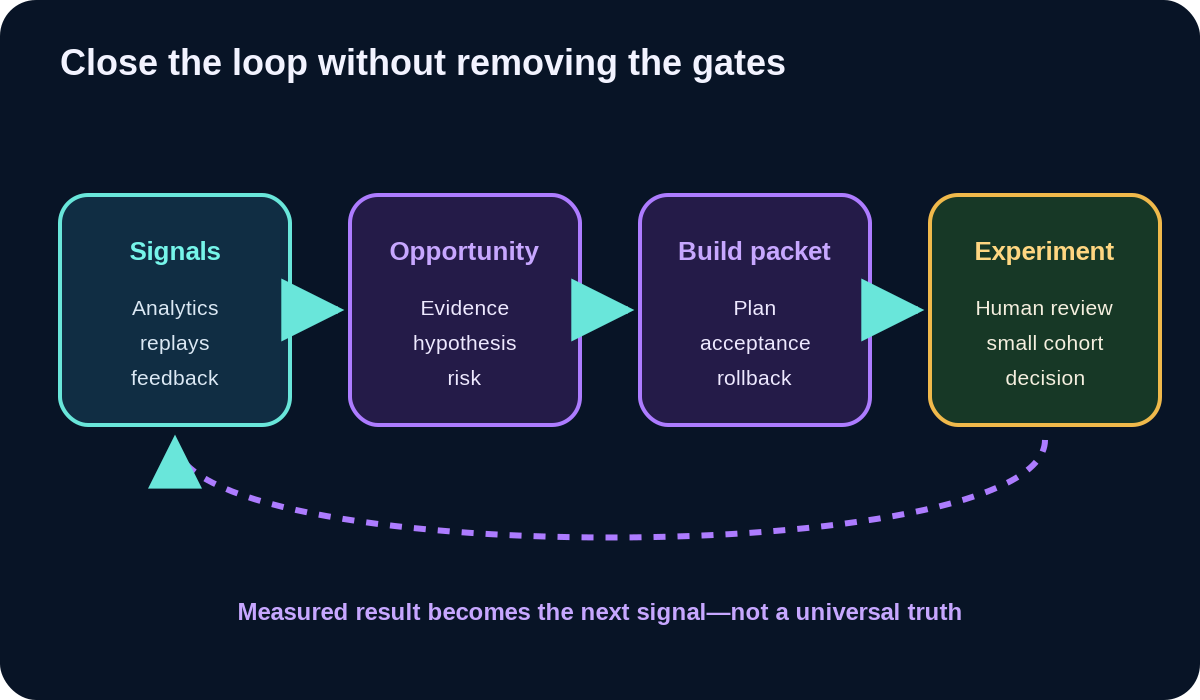
- Evidence boundary: approved events, redacted replays, feedback IDs and a fixed observation window.
- Build boundary: named repository, allowed files, test commands, no production credentials and no direct merge.
- Experiment boundary: predeclared metric, guardrails, cohort, duration, stop rule and rollback.
- Decision boundary: product, engineering, security and analytics owners approve according to impact.
Step 1: define one decision before asking AI for ideas
Select one product surface and one decision, such as whether to test a clearer onboarding prompt. Record the current behavior, primary metric, guardrail metrics, eligible population, accessibility requirement, privacy limits and owner. Choose a fixed evidence window and preserve the query or dataset version outside the model.
Ask the assistant to cite observations before it proposes a change. A session replay is a qualitative clue, not proof of causation. Analytics can show association, not user intent. Keep raw recordings and identifiers in their approved systems; give the model redacted excerpts, aggregated events or record IDs.
Step 2: create a build packet a coding agent cannot reinterpret
The packet should include the evidence IDs, hypothesis, user segment, allowed files, non-goals, acceptance checks, accessibility criteria, threat considerations, data constraints, feature flag, test plan, rollback trigger and named reviewers. An agent can propose code only inside that envelope.
Example prompt: “Using approved analytics records A-410 through A-468 and redacted replay notes R-80 through R-105, return the top three evidence-backed friction points for onboarding step O-3. For each, give the observation, contrary evidence, hypothesis, smallest reversible experiment, acceptance checks, security and privacy risks, guardrail metric and owner. Cite every observation. Do not access raw replays, infer protected traits, change code, create a flag or claim an outcome.”
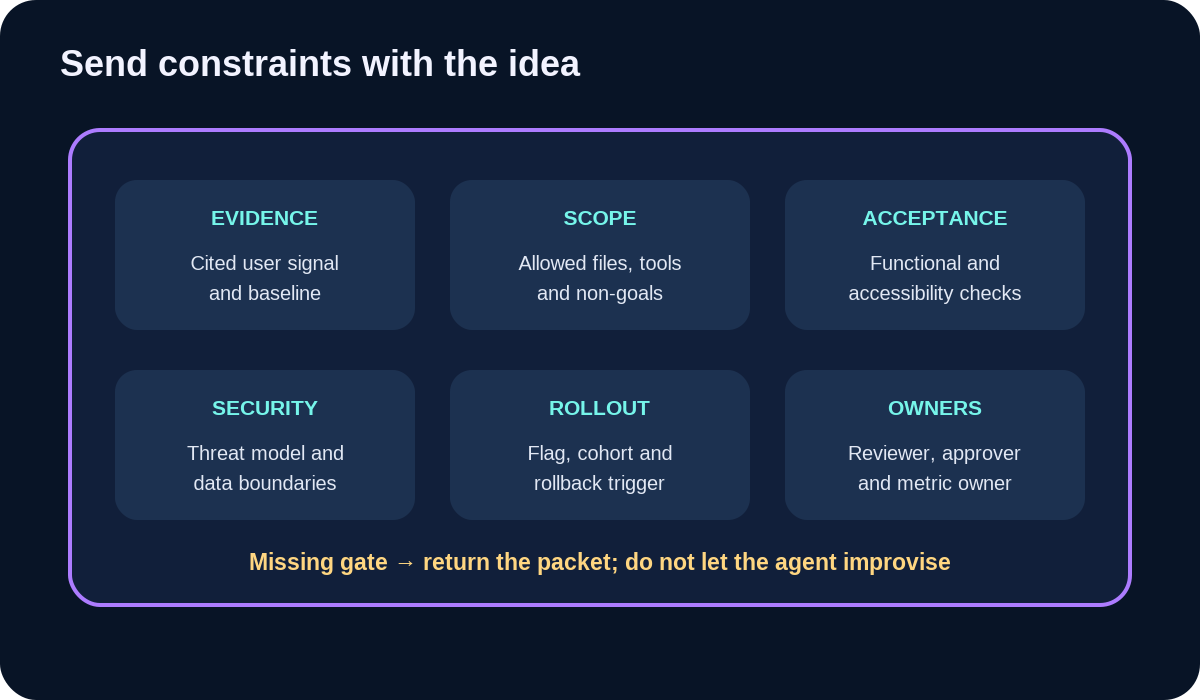
- Expected output: a ranked experiment brief with uncertainty and source IDs.
- Reject a proposal that lacks contrary evidence or a measurable stop rule.
- Keep source control, CI and feature-flag permissions outside the model.
- Require a human to review both the plan and the generated diff.
Step 3: run the change as a controlled experiment
Use an isolated branch and test environment. Run deterministic unit, integration, accessibility, security and dependency checks before a reviewer sees the diff. If approved, place the change behind a feature flag for a small eligible cohort with an automatic stop on severe errors, privacy events, security regression or guardrail breach.
Do not let the same agent propose the change, write it, grade it and expand the rollout. Separate generation from evaluation and authorization. Preserve the model version, prompt, tool calls, code diff, test results, reviewers, flag changes and experiment query.

Step 4: decide with declared evidence, then feed back the lesson
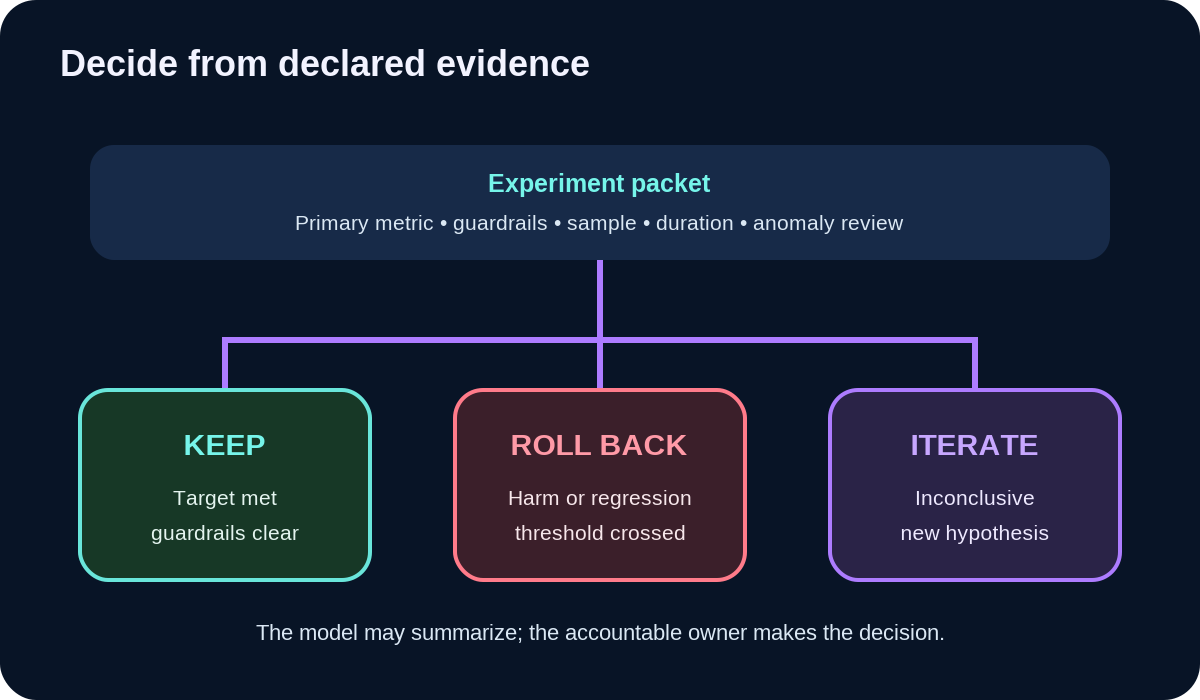
At the agreed checkpoint, compare the primary metric and guardrails against the predeclared rule. Investigate instrumentation changes, novelty effects, uneven exposure and anomalous segments before interpreting the result. A relative increase in one interaction does not automatically equal retention, revenue, accessibility or customer value.
Choose keep, rollback or iterate. Record why, who approved it and what remains unknown. Only the resulting evidence—not a celebratory narrative—returns to the opportunity queue for the next cycle.
Realistic limitations and why this topic was selected
AI cannot infer true user intent from analytics, prove a change caused an outcome, identify every privacy risk or know whether a faster release was worth the maintenance cost. It can overfit a small sample, expose session content, optimize a vanity metric, generate insecure code or repeatedly propose similar ideas. Consent, data minimization, code review, security testing, statistical judgment, feature flags and rollback remain necessary.
A focused Firecrawl search on November 16 for “Amplitude Wave agent product development 1-2 days official OpenAI customer story November 2026” returned OpenAI’s dated November 12 customer story first and recent independent coverage from The Tech Buzz. The combination established a current, reproducible product-development pattern while also surfacing missing pricing and failure-rate information. Search placement is not proof of traffic, Google rank, adoption or DeepSecurity.io performance.
Put the insight into practice.
Deep Security helps organizations assess risk, validate controls, and build a practical plan to strengthen their defenses.
Talk with Deep Security