

A practical AI-assisted workflow for turning certificate, key and configuration evidence into an owner-validated post-quantum migration queue.
Why the inventory is the practical first workload
NIST published the final NIST IR 8547 transition guidance on October 27 and emphasized moving away from quantum-vulnerable algorithms across the full cryptographic supply chain. FedScoop reported on November 23 that federal security leaders see discovery and inventory gaps as a central migration problem: a deadline does not reveal where cryptography is used or which dependencies could fail during change.
DigiCert's November 19 predictions added a current supplier signal, saying large buyers and industry groups are likely to ask for a cryptographic inventory, a named migration owner and a phased plan. That is a vendor prediction, not a requirement for every organization. The useful near-term workload is still concrete: reconcile what scanners, certificate systems, configuration files, code repositories and owners say, then expose what remains unproven.

Define the evidence contract before prompting
This workflow fits infrastructure, cloud, application-security, compliance and vendor-management teams. Start with authorized exports from certificate lifecycle tools, load balancers, web servers, VPNs, SSH inventories, code-signing systems, HSMs, source repositories, asset management and vendor attestations. Do not scan systems or repositories without permission.
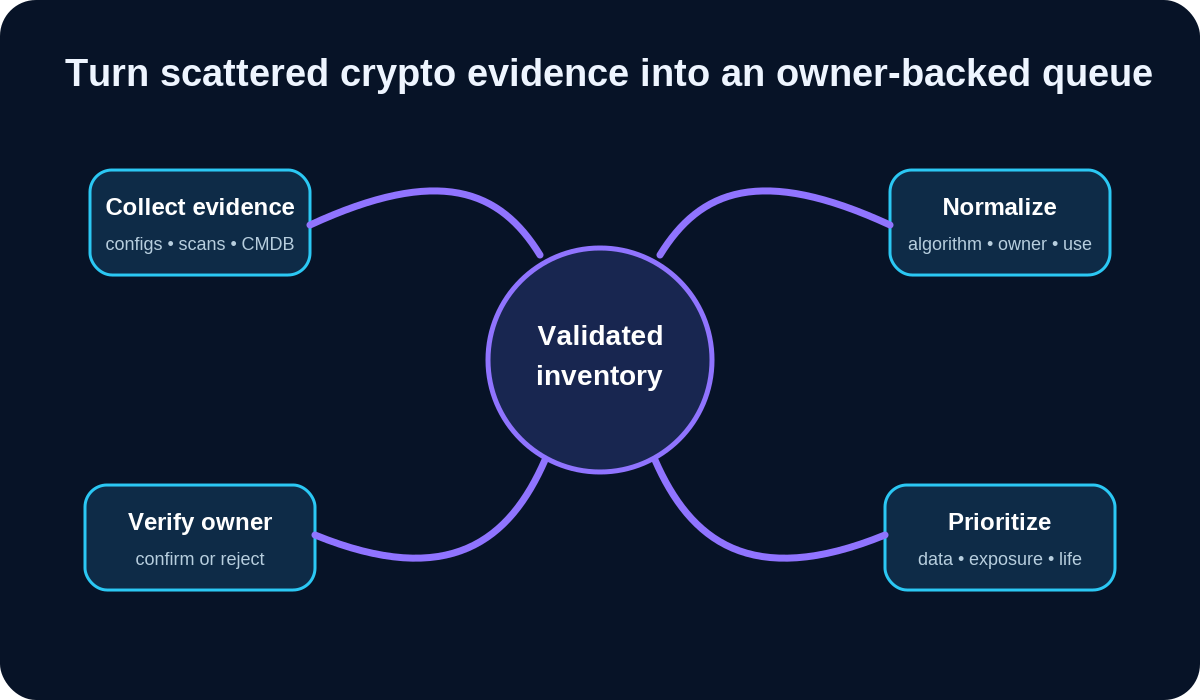
Normalize records into a small schema: asset, environment, cryptographic function, algorithm or protocol, key or certificate size, data classification, expected lifetime, owner, upstream and downstream dependencies, source evidence, confidence and next validation step. Keep sensitive key material out of the model. Only metadata and approved configuration evidence belong in the review set.
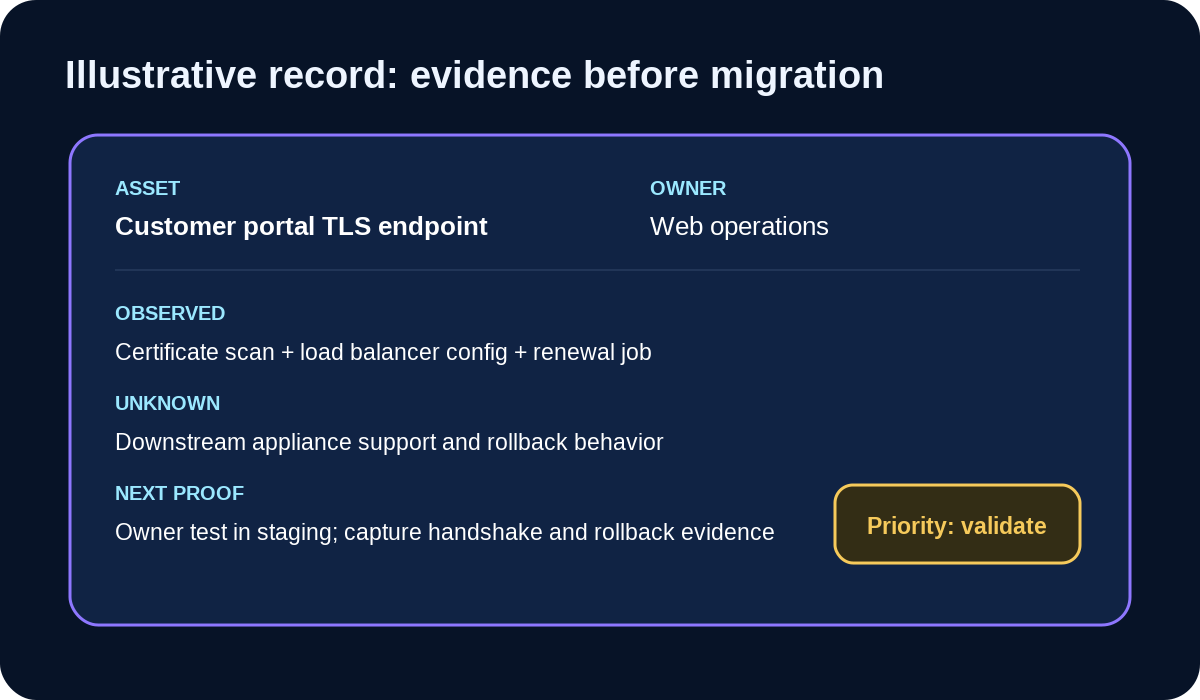
- Observed: directly supported by a scan, configuration, certificate record or signed vendor statement.
- Inferred: suggested by naming, architecture or code context but not yet verified.
- Unknown: no reliable evidence or owner confirmation.
- Validated: owner confirmed the use, dependency and next migration test against source evidence.
Step 1: reconcile duplicates and contradictions
Give the approved model a bounded batch, not an entire estate. Example prompt: “Normalize these authorized records into the provided schema. Keep every source ID. Group possible duplicates without merging them. Flag contradictory algorithms, owners or environments. Label each field observed, inferred or unknown. Do not declare coverage complete or recommend a production change.”
The expected output is a candidate inventory plus a contradiction queue. It is an illustrative format, not a tested completeness result. A reviewer should reopen every high-impact source, split mistaken duplicates and reject model-added facts.
Step 2: prioritize validation by exposure and dependency
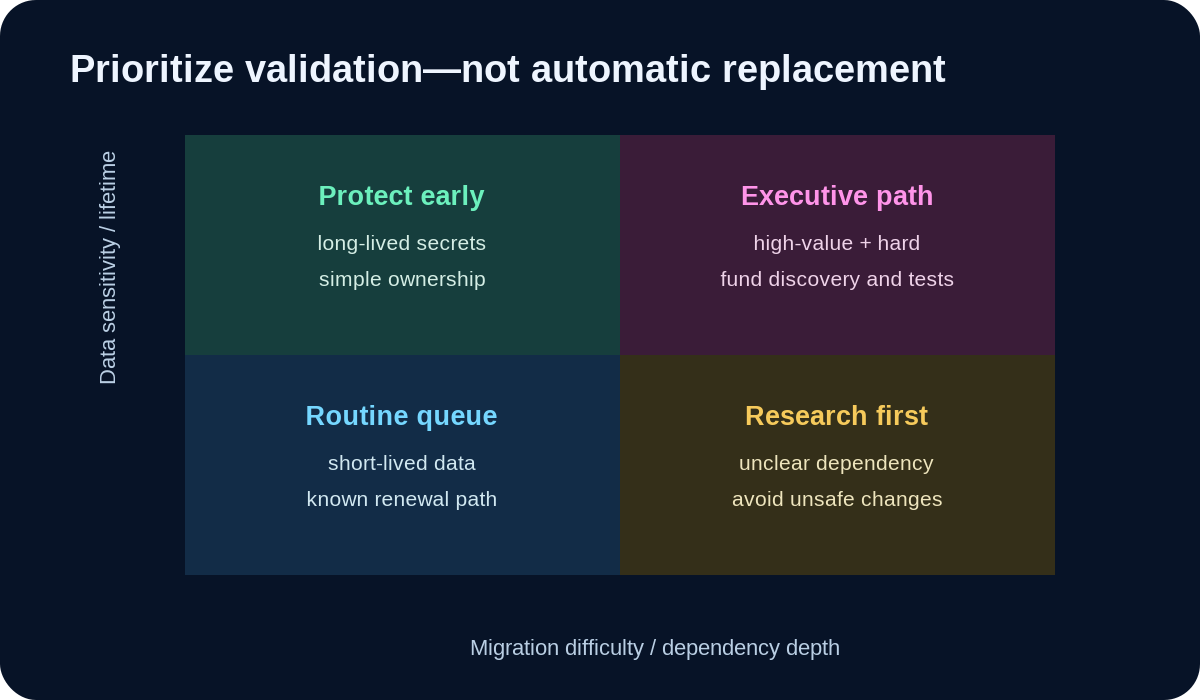
Prioritize records where sensitive data remains valuable for years, external exposure is high, cryptography is embedded in long-lived devices, or a supplier and rollback path are unclear. Public TLS is only one slice. Include private PKI, VPN and remote access, code and firmware signing, SSH, storage encryption, identity credentials, payment or medical-device dependencies and the libraries buried in applications.
Example prompt: “Rank records for human validation using data lifetime, exposure, business criticality, dependency depth, owner certainty and rollback readiness. Show the factors and missing evidence; do not assign a compliance conclusion.” The owner—not the model—accepts the priority and schedules discovery or a lab test.
Step 3: turn records into safe migration experiments
For each validated high-priority record, create a test card with owner, supported alternatives, client and vendor dependencies, staging environment, success criteria, rollback signal and evidence to retain. Follow the applicable NIST standards and vendor support statements; do not let a language model invent algorithm compatibility.
Run changes in an isolated lab or staging path first. Capture handshakes, signatures, performance, error behavior and rollback. Promote only through normal change control. Track records with direct evidence, owner-confirmed records, unresolved dependencies, lab-test pass rate and overdue validation tasks. Avoid a single completeness percentage unless the denominator and collection coverage are defensible.

Limitations and topic-selection signal
AI cannot see undiscovered hardware, proprietary firmware, dormant keys or cryptography hidden behind vendor abstractions. Scanner output can be stale, and source code can show capability rather than runtime use. Treat inventory as a living evidence set, protect sensitive architecture data, use approved enterprise controls and preserve a manual review path.
Focused Firecrawl research on November 24 returned NIST's October 27 final guidance, FedScoop's November 23 migration article and DigiCert's November 19 supplier-readiness prediction among prominent results. The primary guidance is older than seven days but remains within 30 days and is the authoritative context. These results show current attention around the inventory problem; they do not establish traffic, ranking, universal requirements or complete adoption.
Put the insight into practice.
Deep Security helps organizations assess risk, validate controls, and build a practical plan to strengthen their defenses.
Talk with Deep Security