

Build a verifiable PHP2Shell patch inventory across servers and containers. Use AI to normalize approved evidence, prioritize exposed workloads and track validation.
Why PHP2Shell turns inventory quality into an emergency control
On October 21, 2026, the PHP project released PHP 8.5.12, 8.4.27, 8.3.36 and 8.2.35 for two critical vulnerabilities, CVE-2026-109618 and CVE-2026-109619. Wiz named the issue PHP2Shell and described remote-code-execution paths affecting supported PHP branches. OpenAI said its researcher coordinated disclosure, while Reuters reported broad defensive urgency ahead of the release.
The complete remediation is an updated build. A web-server rule or configuration change can reduce exposure in a specific architecture, but it does not make a vulnerable PHP runtime safe. PHP 8.1 and older community branches are end of life; an operating-system or commercial LTS vendor may provide a backport with a different package version, so compare against that vendor’s advisory rather than the upstream number alone.
Focused Firecrawl searches on October 22 surfaced the official PHP notice, Wiz and OpenAI research, and same-day Reuters coverage among prominent results. That is a strong freshness and attention signal, not proof of search volume, exploit prevalence or this article’s future ranking.
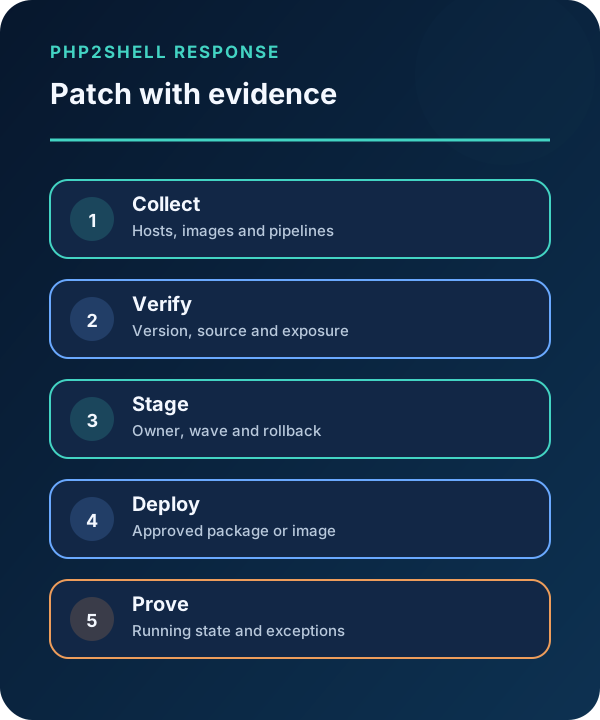
1. Collect authoritative runtime evidence
Target web servers, container images, build pipelines, serverless layers, developer runners and managed platforms that may execute PHP. Export host and image inventories from approved configuration, endpoint, cloud, registry and software-composition systems. Include asset owner, environment, internet exposure, package source, runtime version, image digest, listening service and collection time.
Use the project’s published version checker or an equivalent read-only command only in an authorized environment. Do not paste credentials, customer data or command output containing secrets into a public model. If the estate is large, collect structured JSON or CSV and retain the unmodified export beside the working copy.
The first deliverable is an evidence register with one row per runtime instance. Deduplicate only after confirming host, container digest and deployment identity; two identical version strings may represent different owners, exposures and rollback paths.

2. Let AI normalize, then verify every row
An approved assistant can standardize package names, extract version fields, group identical image digests and flag missing owners. Suggested prompt: “Using only the supplied asset exports and vendor advisories, produce a table with asset, owner, environment, PHP source, observed version, collection time, external exposure, fixed-version basis and evidence reference. Mark contradictions or missing facts as unknown. Do not infer that an asset is vulnerable, patched or reachable.”
Review the output against the source exports. AI can mistake an application dependency for the active interpreter, collapse distro epochs or treat an image tag as an immutable digest. A running-process or deployed-image observation is stronger than a repository manifest that may not match production.
Expected output: a reviewer-approved inventory with source pointers and an explicit unknown queue. The unknown queue is operational work, not a low-risk category.
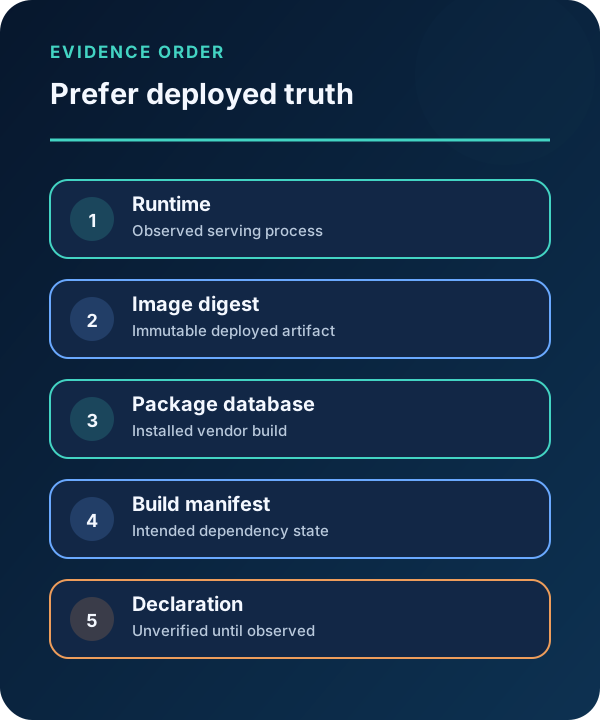
3. Build safe patch waves and rollback points
Prioritize externally reachable, production and privileged workloads, but do not ignore internal runtimes. Assign each row to a change owner and a fixed-version basis: upstream PHP release or a named vendor backport advisory. Record the maintenance window, dependency test, backup or immutable rollback artifact, health check and abort condition.
Patch a representative nonproduction instance first. Rebuild container images from an updated base, pin the resulting digest and redeploy rather than editing a running container. For hosts, use the approved package channel. Avoid unreviewed emergency scripts that search and modify an entire fleet.
A practical wave plan might separate public web tiers, internal services, build agents and dormant images. The assistant may draft the grouping, but owners approve scope and change order.

4. Prove the deployed state after change
Recollect the same evidence after each wave. Verify the running interpreter or deployed digest, service health and expected application path; a successful package command does not prove the serving process restarted on the new build. Re-scan with the approved tool and reconcile exceptions.
Suggested closeout prompt: “Compare the before and after evidence by immutable asset identifier. List version changes, unchanged rows, missing post-change observations and conflicting records. Do not label a row remediated unless the approved fixed-version basis and deployed-state evidence both match.”
Preserve the change record, advisory used, approver, before-and-after evidence, validation result and remaining exceptions. Do not claim exploitation was absent merely because no alert fired.
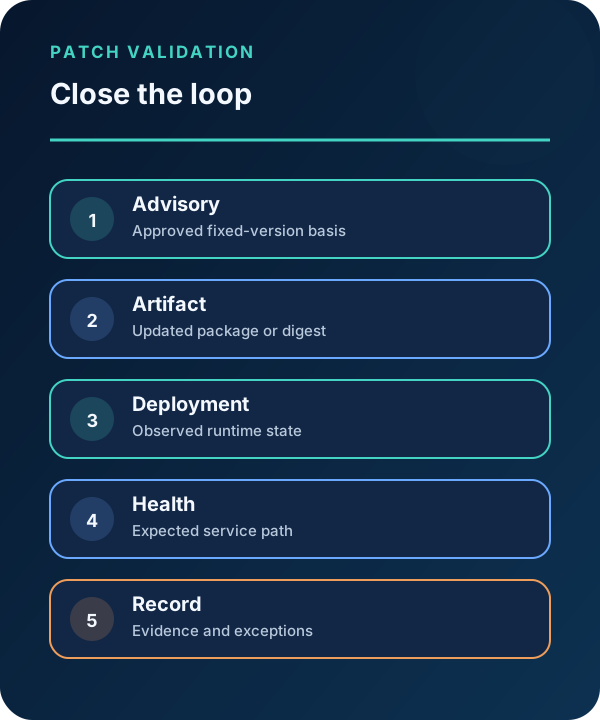
Response checklist and realistic limits
AI can shorten reconciliation work and expose gaps, but it cannot see an uncollected host, determine reachability from an incomplete network map or validate a vendor backport without the vendor advisory. Keep exploitation investigation separate from patch status, and escalate suspected compromise through the incident-response process.
- Inventory hosts, containers, registries and build systems with collection times.
- Use the correct upstream or vendor-backport fixed-version basis.
- Validate the running state and retain exceptions after every patch wave.
Put the insight into practice.
Deep Security helps organizations assess risk, validate controls, and build a practical plan to strengthen their defenses.
Talk with Deep Security