

A practical workflow for correlating Microsoft’s November 2026 advisories with local assets, exploit evidence and change controls before a human approves patch rollout.
Why patch prioritization has urgent current attention
Microsoft’s November 10 security release produced unusually large independent coverage. Dark Reading reported 1,093 addressed vulnerabilities, 63 rated critical and one actively exploited zero-day, CVE-2026-124194. Other outlets counted 1,094 depending on inclusion rules, which is itself a warning against treating a headline total as an asset-level decision.
Microsoft’s advisory says CVE-2026-124194 is an Outlook spoofing vulnerability released November 10. The described scenario requires network connectivity and user interaction and can disclose an NTLMv2 hash after a user opens a malicious Office file; Microsoft says the Preview Pane is not the attack vector for that CVE. Deep Security did not test the vulnerability, Microsoft’s updates or the workflow below.
Audience, tools and operating boundary
This pattern fits vulnerability managers, Windows administrators, managed service providers, desktop engineering and change advisory teams. A pilot needs Microsoft Security Update Guide records, an accurate asset and software inventory, exposure and business-criticality data, change windows, patch tooling, test results, an approved model and read-only retrieval.
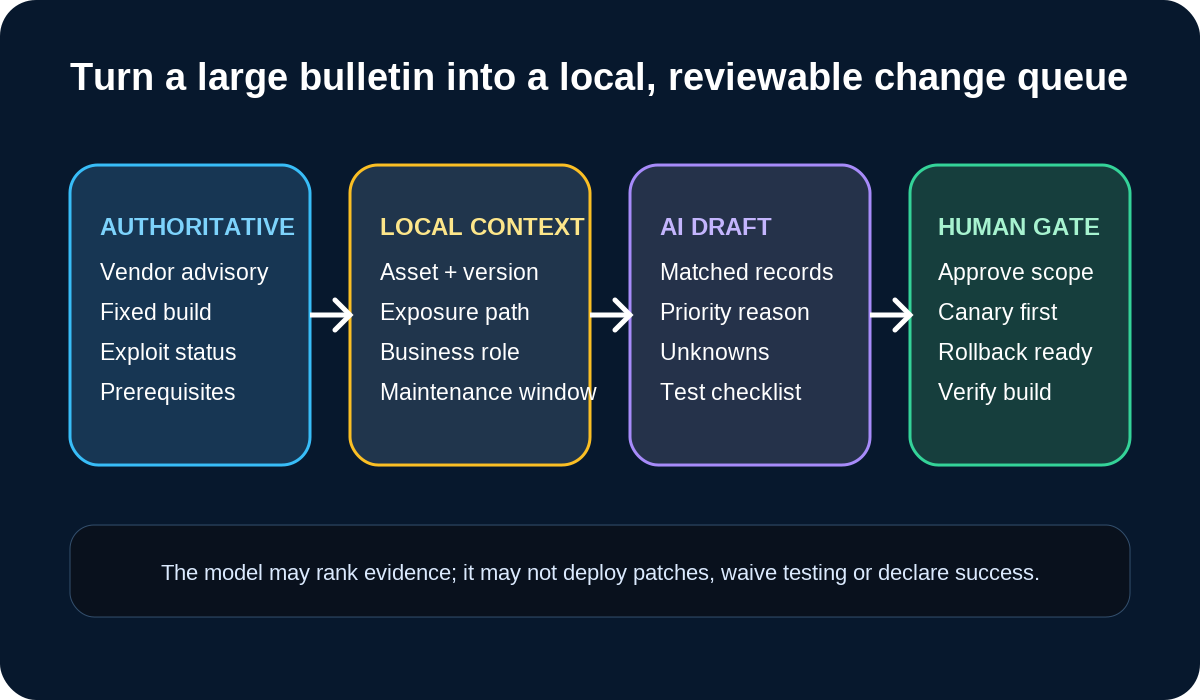
The assistant may normalize advisories, propose asset matches, show missing versions and draft a priority rationale. It may not declare an asset affected, deploy a patch, suppress a finding, waive application testing, accept downtime, choose a rollback or close the change. A vendor CVSS score is one input—not a substitute for reachability, exploit status and business consequence.

- Authoritative source: vendor advisory, fixed build and documented prerequisites.
- Local source: asset identity, installed version, internet exposure, business role and owner.
- AI role: correlate records and explain a proposed order with citations and uncertainty.
- Human role: validate applicability, approve change, observe rollout and verify recovery.
Step 1: normalize authoritative and local evidence
Create one record per advisory-product-version tuple with CVE, vendor URL, release and revision dates, product, affected range, fixed version, impact, exploit status, prerequisites and workaround. Keep the vendor text linked, not paraphrased into an unlabeled note. Preserve discrepancies among sources rather than averaging them away.
Join that record to a local asset only through stable product and version identifiers. Add asset owner, business service, exposure path, last-seen time, backup state, maintenance window and rollback method. If inventory is stale or version matching is ambiguous, the output must say unknown and route the asset for validation.
Step 2: ask for a cited local queue, not a global ranking
A useful prompt limits the advisory revision, asset snapshot and decision horizon. It asks the model to show why each asset is in or out of scope, evidence against the match and the lowest-risk verification before change. Run numerical scoring and policy gates outside the model.
Example prompt: “Using Microsoft advisory records V-200 through V-880 and inventory snapshot A-4100 through A-4780, draft a review queue for the next 48 hours. For each asset, cite the advisory, affected-version match, exposure, business role, exploit evidence, owner, test dependency and rollback record. Separate confirmed, possible and not-applicable matches. List contradictions and unknowns. Do not deploy, suppress, waive testing or describe an update as installed.”
- Expected output: a small cited change queue and an explicit validation backlog.
- Reject a match without both an authoritative version rule and a local version record.
- Treat active exploitation as urgency evidence, not proof that every asset is reachable.
- Verify the installed build after deployment; a generic ‘patched’ flag is insufficient.
Step 3: let humans resolve the priority matrix
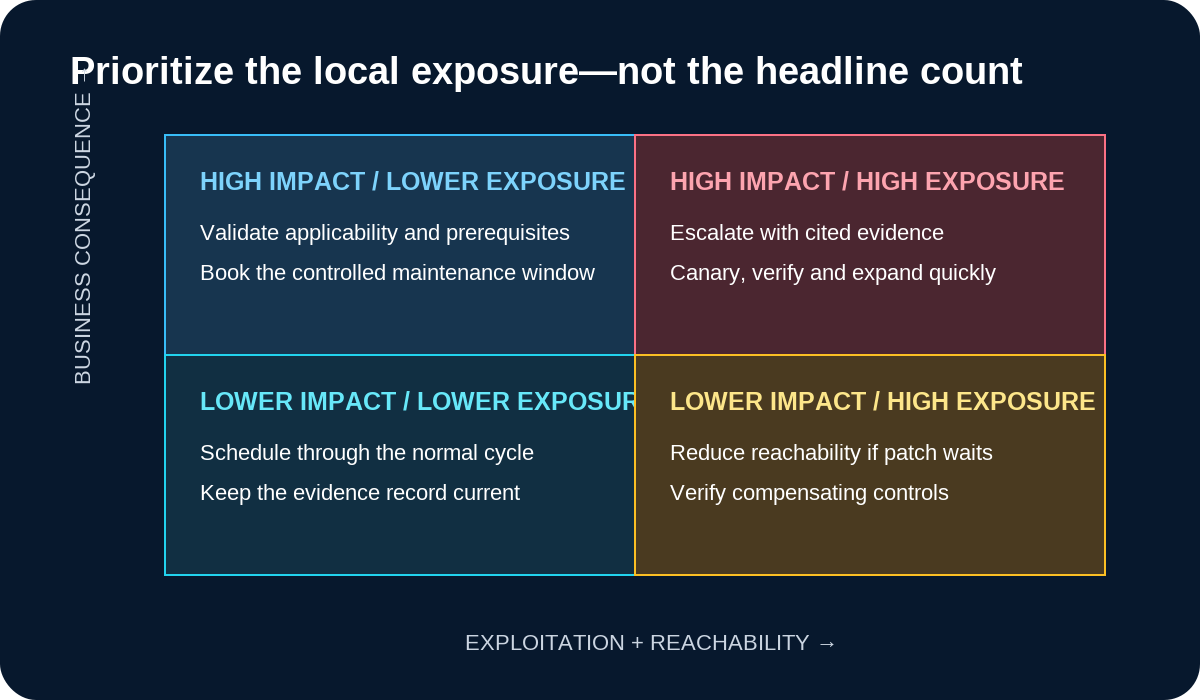
Review confirmed applicability on two axes: exploitation and reachability, then business consequence. An internet-facing, reachable, actively exploited condition with a safe fix usually moves ahead of a high headline score on an isolated or absent component. Document exceptions and compensating controls with an owner and expiration date.
The matrix should not output a magic number. It should make assumptions visible to the change team and show which evidence would move a record between quadrants.
Step 4: require a canary and rollback review
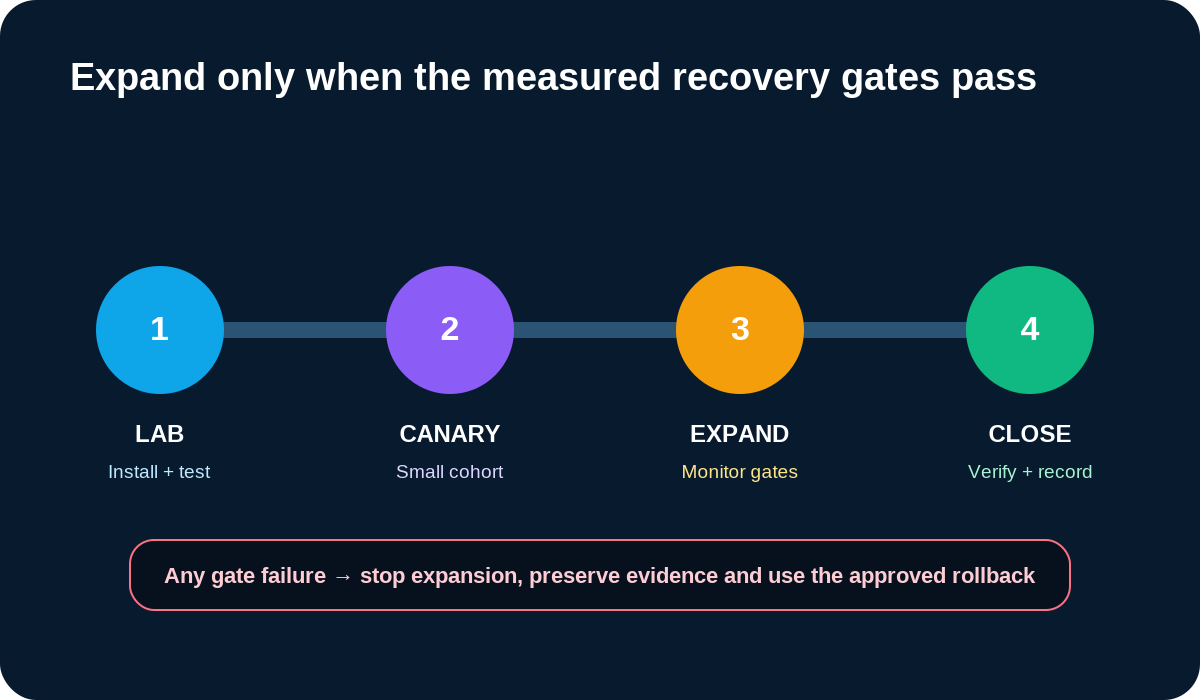
Test the exact update against a representative application and identity path. Confirm backup or recovery readiness, expected restart, monitoring signals and a rollback owner. Start with a small canary cohort that can tolerate the change and is large enough to expose application or policy conflicts.
The assistant can draft the checklist and compare recorded results with expected fields. Deterministic monitoring and a human change owner decide whether to expand. If a gate fails, stop expansion, preserve logs and execute the approved rollback process.

Step 5: close with installed-build and service evidence
After deployment, verify installed versions, application health, authentication, monitoring coverage and business transactions. Record failures and devices that missed the window. Reconcile the vulnerability scanner only after inventory and vendor evidence agree; do not ask the model to suppress a finding because the change ticket says complete.
Keep the final advisory revision, approved scope, canary results, expansion timestamps, exceptions, rollback events and reviewer. This becomes the evidence for the next monthly cycle and exposes where inventory quality—not model capability—limited the decision.
Realistic limitations and why this topic was selected
An AI assistant cannot repair stale inventory, validate hidden dependencies, reproduce a vendor’s exploit analysis or guarantee rollback. It can overmatch product names, miss supersedence, overweight a severity label and turn an advisory summary into false certainty. Authoritative records, staged testing, change control and measurable recovery gates remain essential.
A focused Firecrawl search on November 14 for “Microsoft November 2026 Patch Tuesday 1093 CVEs November 10 2026 coverage” returned current coverage from Splashtop, Cybersecurity News, Security Boulevard, Dark Reading, TechRepublic and The Record, with direct links to Microsoft advisories. That result concentration is an attention signal, not proof of search volume, Google rank or site traffic.
Put the insight into practice.
Deep Security helps organizations assess risk, validate controls, and build a practical plan to strengthen their defenses.
Talk with Deep Security