

A practical AI-assisted workflow for correlating outage-lure email, click and identity evidence while people approve quarantine, reset and session-revocation actions.
Why outage lures need evidence discipline
Microsoft Threat Intelligence disclosed on November 16 that it observed a coordinated, high-volume campaign on November 13 using fake Microsoft 365 service-health messages. The lure claimed held email would be deleted within 24 hours and sent recipients through tracking links to a non-Microsoft destination. Microsoft assessed likely credential phishing, but said its available evidence did not confirm credential capture, malware delivery or post-compromise activity.
Field Effect separately reported outage-themed credential phishing and support scams after the November 12 Microsoft 365 disruption. That combination creates a practical workload for small-office IT teams, managed service providers and security operations: group related messages quickly, identify who interacted, and take only the containment action the evidence supports.

Build the packet from approved telemetry
This workflow needs an email-security export, message-trace or search results, safe URL-analysis output, click or proxy telemetry, identity sign-in logs and your existing case system. Use a model approved for the data classification. Redact message bodies and user details that are not required, and never submit live credentials, session tokens or sensitive mailbox contents to a public chat service.
Create one immutable evidence folder per campaign. Store original records, hashes or source IDs, collection time and the analyst who collected them. Give the model read-only copies and require every claim to cite an evidence ID. The model may organize and compare; it may not quarantine mail, reset credentials, revoke sessions, alter inbox rules or contact users.
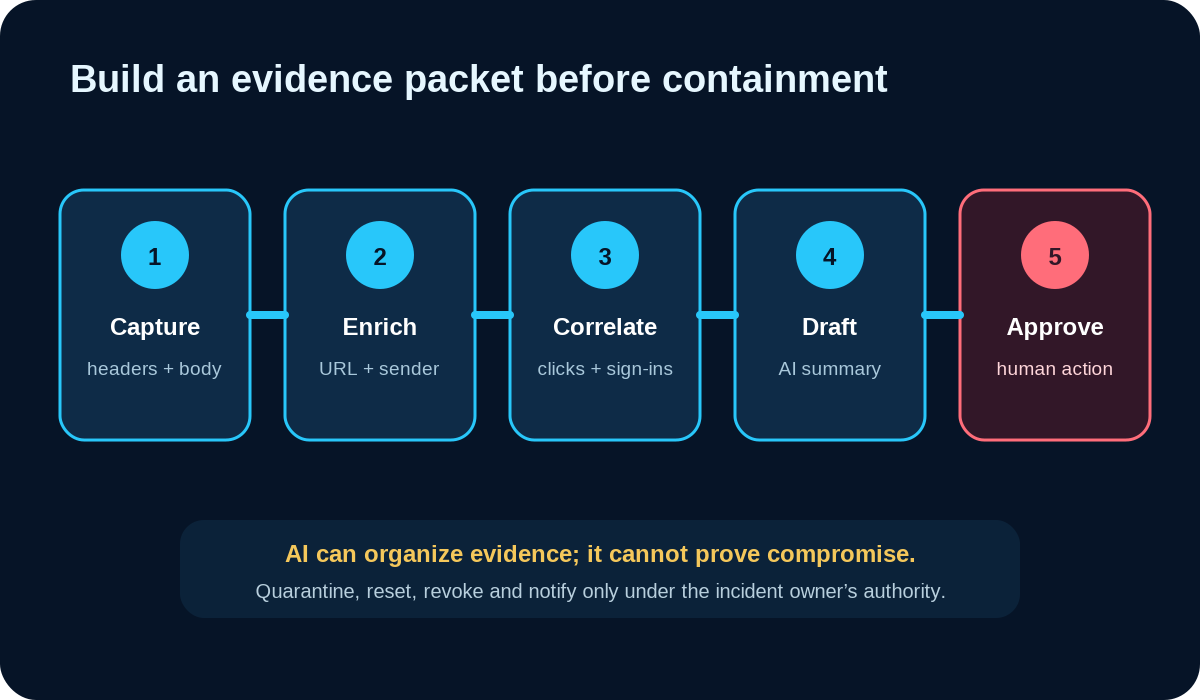
- Message evidence: sender domain, return path, subject pattern, authentication results and delivery scope.
- Interaction evidence: click time, redirect chain, destination reached and browser or proxy observations.
- Identity evidence: sign-ins, token use, MFA events, inbox-rule changes and unusual cloud activity.
- Decision record: observed facts, uncertainty, approved action, owner and completion evidence.
Step 1: correlate the campaign without inventing a verdict
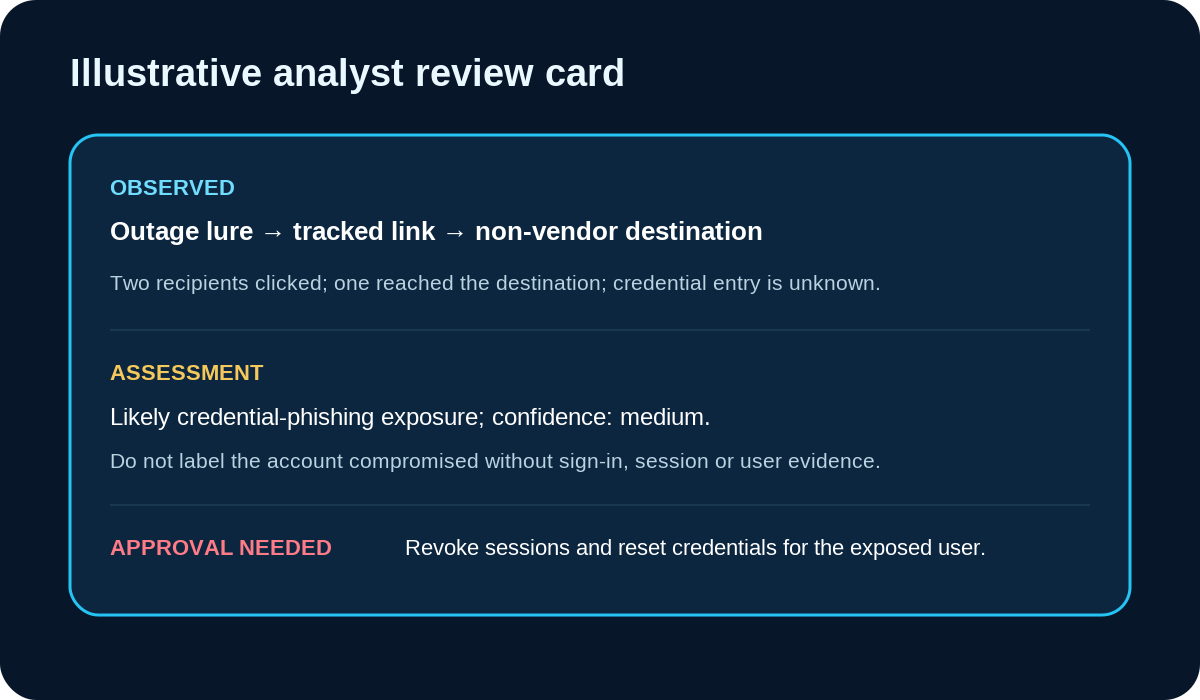
Start with the indicators and patterns in the primary research, then add only observations from your own environment. Example prompt: “Group these authorized message, URL, click and sign-in records by likely campaign. For each user, list observed facts with evidence IDs, missing evidence and confidence. Use ‘no evidence found’ rather than ‘safe.’ Do not claim credential theft or compromise unless the supplied records directly show it.”
The expected output is a campaign table and one review card per potentially exposed user. It is illustrative, not a tested detection result. An analyst should reopen the original message and telemetry, correct false joins and confirm that timestamps and identities refer to the same event.
Step 2: apply the smallest verified response
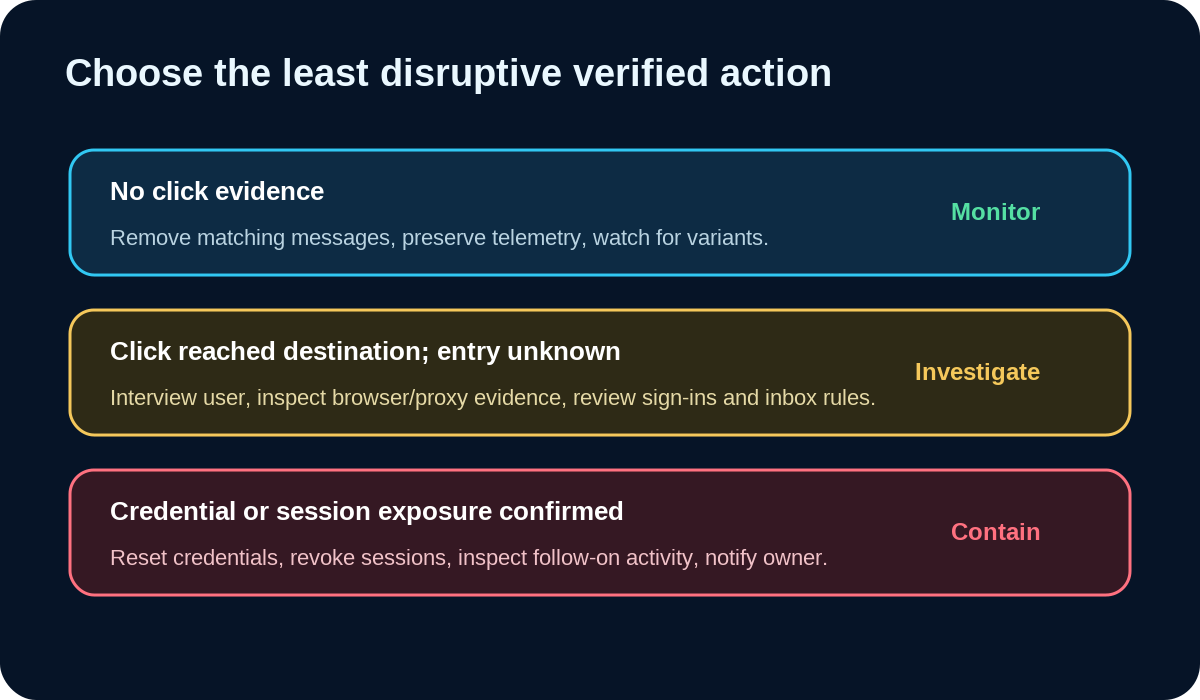
If no click evidence exists, remove matching messages, preserve telemetry and monitor for variants. If a user reached the destination but credential entry is unknown, interview the user, inspect browser or proxy evidence, and review sign-ins, sessions and inbox rules. If credential or session exposure is confirmed, follow the approved account-recovery procedure, including credential reset and session revocation.
Microsoft's updated phishing investigation playbook follows the same sequence: identify the message, scope impact, assess interaction, look for follow-on activity, contain and recover. Use your licensed tools and documented permissions; the workflow can also be performed with other mail, web and identity platforms that expose equivalent evidence.
Step 3: make the human handoff inspectable
Ask the model for a short handoff: campaign summary, affected users, cited evidence, unresolved questions, proposed action and the specific approval needed. The analyst edits the packet, records corrections and assigns an owner. Automations should accept only structured, allowlisted fields after approval; a persuasive narrative must never trigger account changes.
Retain the model version, prompt, evidence IDs and final human decision under the organization's incident-retention policy. Measure packet completion time, citation reopen rate, reviewer corrections, false joins and time from approval to completed containment. These process measures show whether the workflow helps; they do not prove that the model detected every phish.

Limitations and topic-selection signal
Email and identity logs can be delayed or incomplete. Redirects can change after collection, users may misremember interactions, and AI can merge unrelated records or overstate confidence. Preserve originals, isolate URL analysis, require citations, keep a manual path and treat absence of evidence as an open question—not proof of safety.
Focused Firecrawl research on November 24 placed Microsoft's November 16 campaign disclosure first, its November 4 investigation playbook prominently, and recent independent outage-lure coverage in the same result set. That is a current search-result and multi-source attention signal, not proof of search volume, ranking, adoption or DeepSecurity.io traffic.
Put the insight into practice.
Deep Security helps organizations assess risk, validate controls, and build a practical plan to strengthen their defenses.
Talk with Deep Security