

A practical MSP workflow for using AI to correlate N-central advisories, fleet inventory and compromise evidence while containment and recovery remain human-owned.
Why N-central fleet investigation has current attention
N-able published a November 11 update urging on-premises N-central customers to move to 2026.4 HF2 and keep servers inaccessible from the internet. The company says its hosted servers were updated and that it had seen scanning tied to public vulnerability information but no compromise of its hosted servers. It also said further work and hotfixes were underway.
The independent picture continued moving. Tenable’s FAQ, published November 11 and updated November 13, describes 33 alleged vulnerabilities, public exploit claims after HF2 and reports of cryptocurrency miners on exposed servers. Aviatrix’s November 13 analysis attributes a 21-server compromise set to researchers and describes a chain involving CVE-2026-90436 plus local privilege escalation, with 19 observed systems reporting the HF2 build. These are independent reports and claims, not a substitute for N-able guidance or local forensics. Deep Security did not test the exploits, inspect those servers or validate the workflow below.

Audience, tools and operating boundary
This pattern fits managed service providers, N-central administrators, incident responders, vulnerability managers and client-service owners. A pilot needs the current N-able release guidance, an authoritative server inventory, exposure and configuration data, identity and audit logs, process and network telemetry, case management, an approved model and read-only retrieval.
The assistant may normalize claims, map versions and prerequisites, align observations, identify missing evidence and draft a cited review packet. It may not run exploit code, isolate a server, delete a process, rotate an account, reconnect a client, declare compromise, promise safety or close the incident. Investigation should occur under the organization’s authorization, evidence-preservation and client-notification procedures.
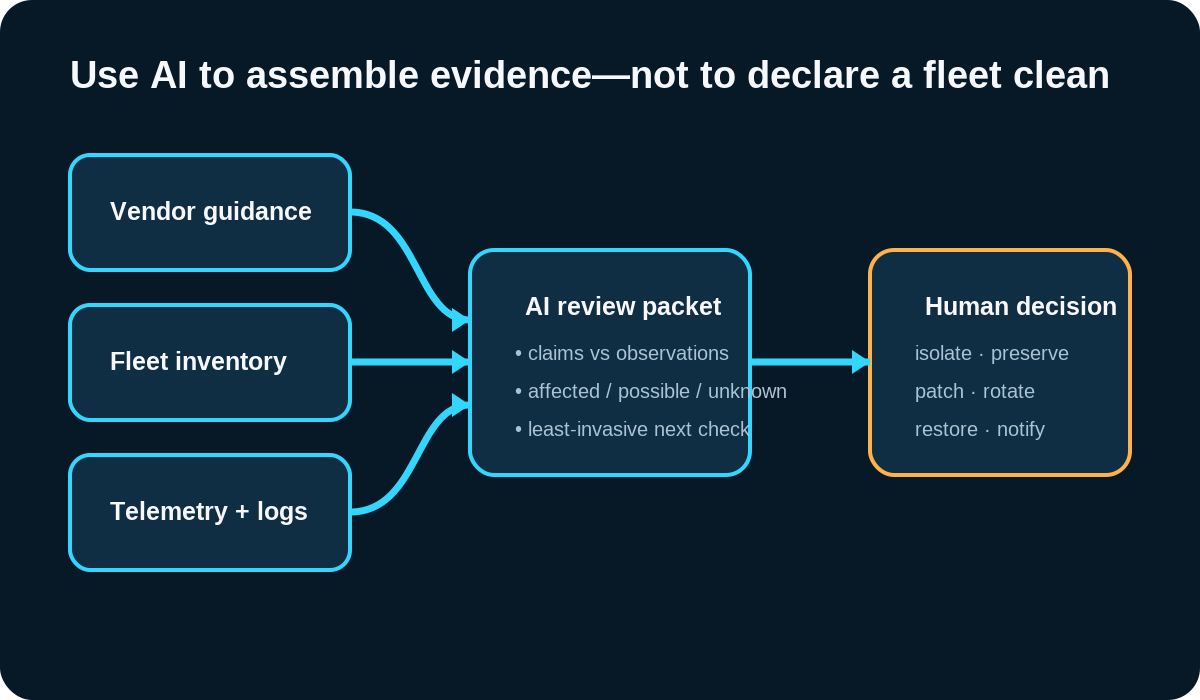
- Authoritative inputs: N-able release guidance, server build, configuration and support instructions.
- Local inputs: exposure path, enabled APIs, accounts, processes, network flows and integrity evidence.
- AI role: compare public claims with local observations and show uncertainty.
- Human role: contain, preserve, remediate, communicate and restore.
Step 1: freeze the evidence window and fleet snapshot
Capture server ID, deployment type, region, owner, build, patch time, internet reachability, reverse proxy and firewall path, enabled legacy interfaces, administrative identities, client count and last-known-good checkpoint. Preserve collection time and source for every field. A version string alone does not prove what code is running or whether compromise preceded the patch.
Record vendor and researcher claims separately with publication time, prerequisite, affected build, claimed effect and source URL. Do not execute public proof-of-concept code in production. If safe validation requires active testing, move it into an isolated, authorized lab with a written stop condition.
Step 2: build an evidence matrix
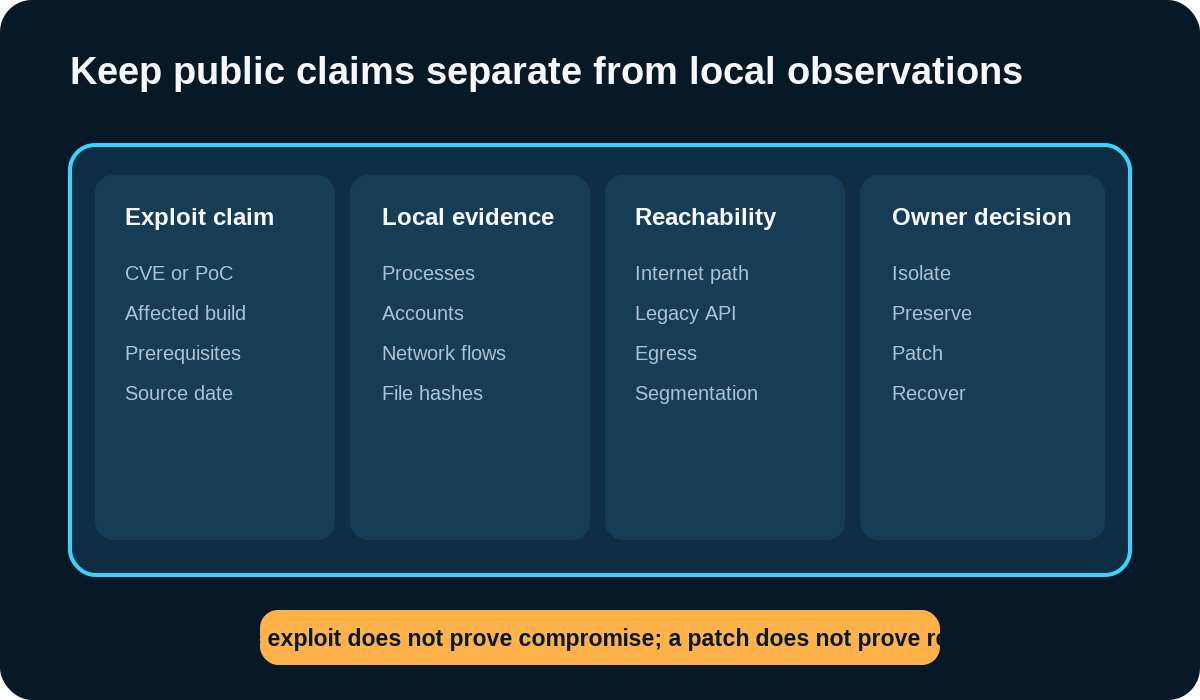
For each server, separate four columns: public exploit claim, local observation, reachability or prerequisite, and owner decision. Local observations may include unexpected processes, cryptocurrency-mining behavior, new accounts, suspicious outbound connections, altered services, persistence, file hashes and authentication anomalies. Preserve raw evidence outside the model.
Require explicit states—confirmed observation, absent observation, query failed, not collected or not applicable. “No alert” is not the same as “no compromise.” A deterministic check should reject a record whose build, collection time or owner is missing.
Step 3: request a cited fleet review
Provide a bounded server set, current vendor records and approved read-only telemetry. Ask for observations before hypotheses, evidence against each classification and the least-invasive next check. Use code or queries—not the model—to compute hashes, compare version values and evaluate policy gates.
Example prompt: “For N-central incident NC-415, use only vendor records V-10 through V-24, fleet snapshot F-800 through F-842 and read-only evidence E-300 through E-590. Return confirmed observations, possible exposure, evidence against compromise, missing collection, reachability prerequisites and the next read-only check for each server. Cite an ID and timestamp for every factual line. Do not run exploit code, isolate or reconnect systems, delete files, rotate credentials, contact clients or call a server clean.”
- Expected output: a review queue with evidence links and unresolved collection gaps.
- Reject a compromise label without a local observation and an accountable reviewer.
- Reject a clean label; use verified checks with a stated evidence window instead.
- Keep client impact and notification decisions with incident leadership and counsel.
Step 4: contain while preserving evidence
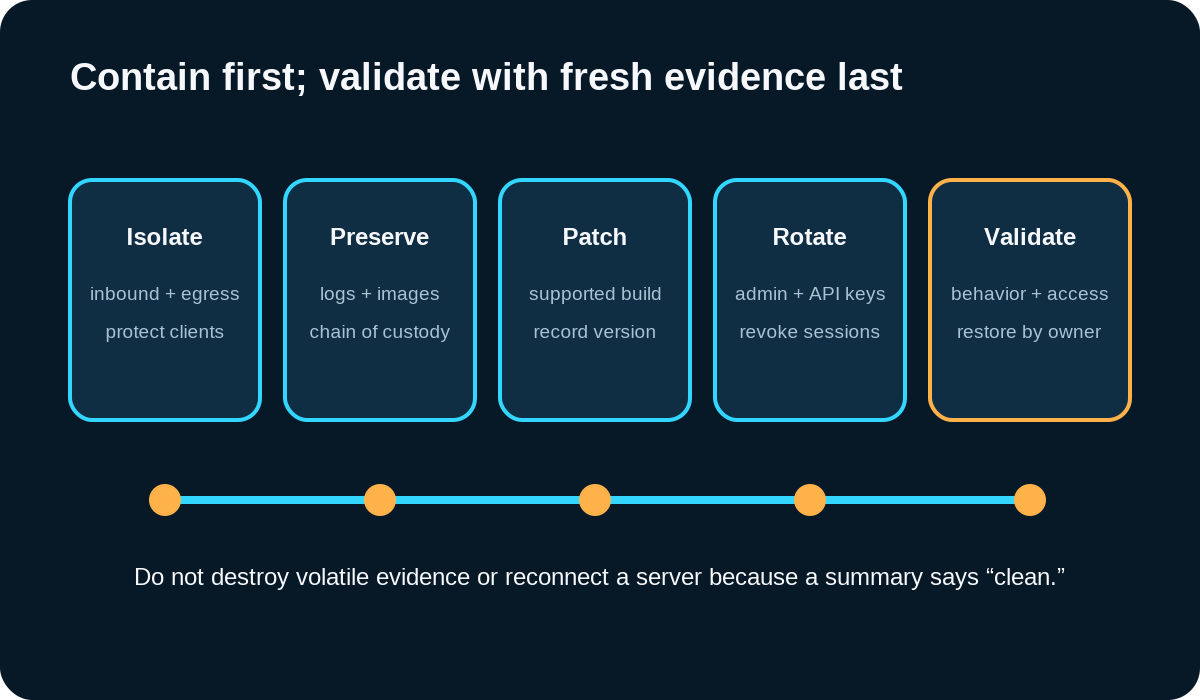
If a human reviewer identifies credible compromise evidence, follow the approved containment plan: restrict inbound and outbound paths, protect downstream clients, preserve volatile data and disk evidence, and establish an alternate administration channel. Avoid destructive cleanup before the evidence and business impact are understood.
The assistant can draft a containment checklist tied to observed facts. It cannot judge whether an action will disrupt client management, backups or monitoring. Record each action, approver, time, target, result and rollback option.

Step 5: patch, rotate and validate in order
Follow current N-able support guidance for the supported build, but treat patching as one recovery step. After evidence preservation, rotate administrative and API credentials from a trusted system, review newly created accounts and sessions, validate client trust paths, and rebuild or restore when required by the incident plan.
Define recovery checks before reconnecting: expected services and hashes, authorized accounts, clean outbound behavior, restricted internet exposure, successful client communication, monitoring coverage and an owner-approved observation period. A green console or installed hotfix is not sufficient closure evidence.
Realistic limitations and why this topic was selected
AI cannot determine whether an unlogged command ran, prove a public exploit works in your exact configuration, recover overwritten evidence or guarantee that a patched server is trustworthy. It can merge incompatible exploit claims, hallucinate indicators, reveal client details or overvalue a version match. Qualified incident response, current vendor instructions, isolation, evidence preservation and deterministic validation remain necessary.
Focused Firecrawl searches on November 15 for “4EverAble2Shell November 14 2026 vulnerability vendor advisory” and “N-able N-central security advisory CVE-2026-90436 Hotfix 2 November 2026” surfaced recent SOCRadar and Aviatrix analysis, N-able’s November 11 response and Tenable’s November 11 FAQ updated November 13. Multiple dated independent results plus the primary vendor response establish current attention; search placement does not prove traffic, Google rank, exploitation prevalence or DeepSecurity.io performance.
Put the insight into practice.
Deep Security helps organizations assess risk, validate controls, and build a practical plan to strengthen their defenses.
Talk with Deep Security