

A source-linked workflow for correlating AI-model usage, IAM, cost and network signals to investigate LLMjacking without automatic containment.
Why LLMjacking deserves a dedicated workflow
Google Threat Intelligence Group’s November 16 update says Mandiant responded to multiple 2026 incidents in which attackers used compromised cloud environments to consume model or GPU resources. The primary report describes credential theft, session hijacking, internal reconnaissance, unauthorized service accounts, role changes, quota increases, short-lived identity rotation and large volumes of model requests. The underlying mechanics are familiar cloud compromise; the new operational problem is that AI services add fast-moving usage, quota and cost evidence.
Help Net Security’s November 17 coverage and other fresh independent reports amplified the same research. Current attention is therefore broader than one announcement. For cloud and security teams, the useful question is how to correlate those signals quickly without letting an anomaly model revoke legitimate production access.

Collect four signal families read-only
This workflow fits cloud security, FinOps, SOC and platform teams running managed model APIs, model gateways or GPU workloads. Export a bounded window of identity audit logs, model invocation records, billing and quota events, and network or proxy telemetry. Include approved deployment, owner and maintenance records so legitimate bursts can be distinguished from unexplained activity.
Use a separate investigation role with read-only access. Minimize prompts and payload content; request metadata such as principal, model, region, client, source network, request count and timestamp. Never feed model inputs, customer data or secrets into a second model unless policy explicitly permits it.
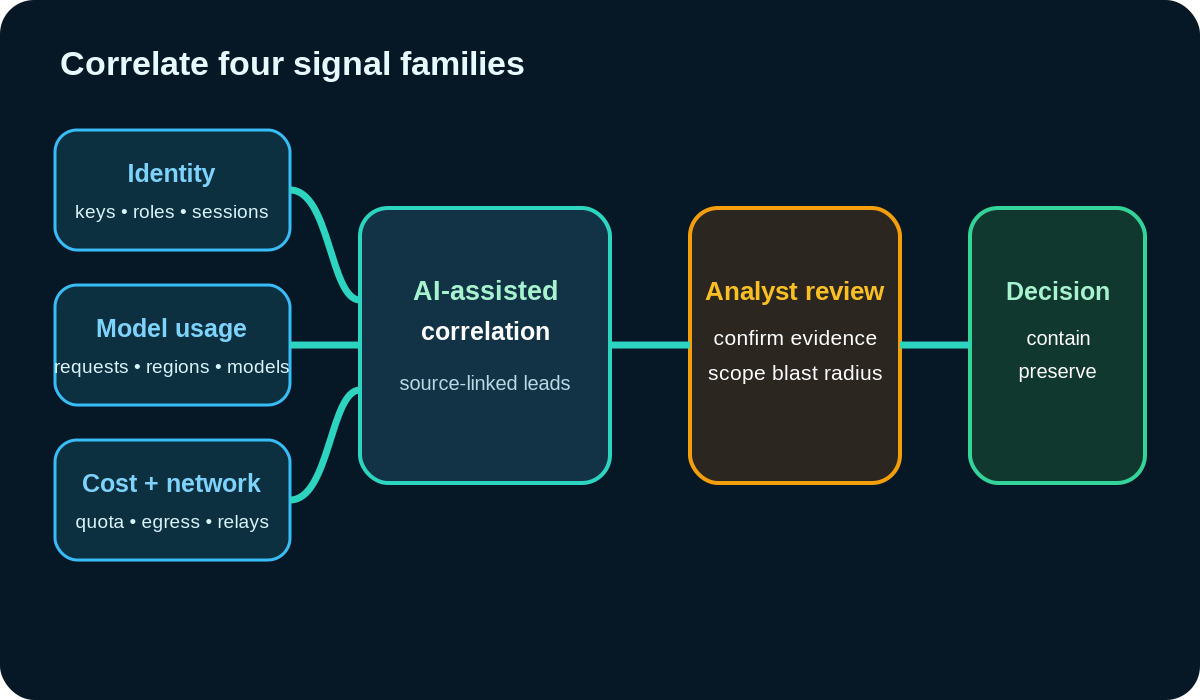
- Identity: keys, sessions, service accounts, role bindings and token events.
- Model: provider, model, region, client, request roots and rate-limit behavior.
- Cost: subscription changes, quota requests, compute provisioning and spend anomalies.
- Network: egress destinations, relay infrastructure, unusual user agents and source locations.
Step 1: ask for a cited anomaly packet
Start with an alert, account and time window. Example prompt: “Using only evidence bundle LLMJ-17, group model activity by principal, region, model, client and 15-minute interval. Correlate it with authentication, role, service-account, subscription, quota and network events. Cite each source record; distinguish observed, inferred and unknown; show the strongest legitimate explanation and the smallest read-only check that separates it from abuse. Do not attribute an actor or change access.”
Expected output is a list of unusual principals and request patterns, relevant identity changes, cost or quota context, conflicting evidence and next read-only queries. It is an illustrative workflow, not a tested detection benchmark. The AI should never convert a billing spike alone into a compromise verdict.
Step 2: verify ownership and blast radius
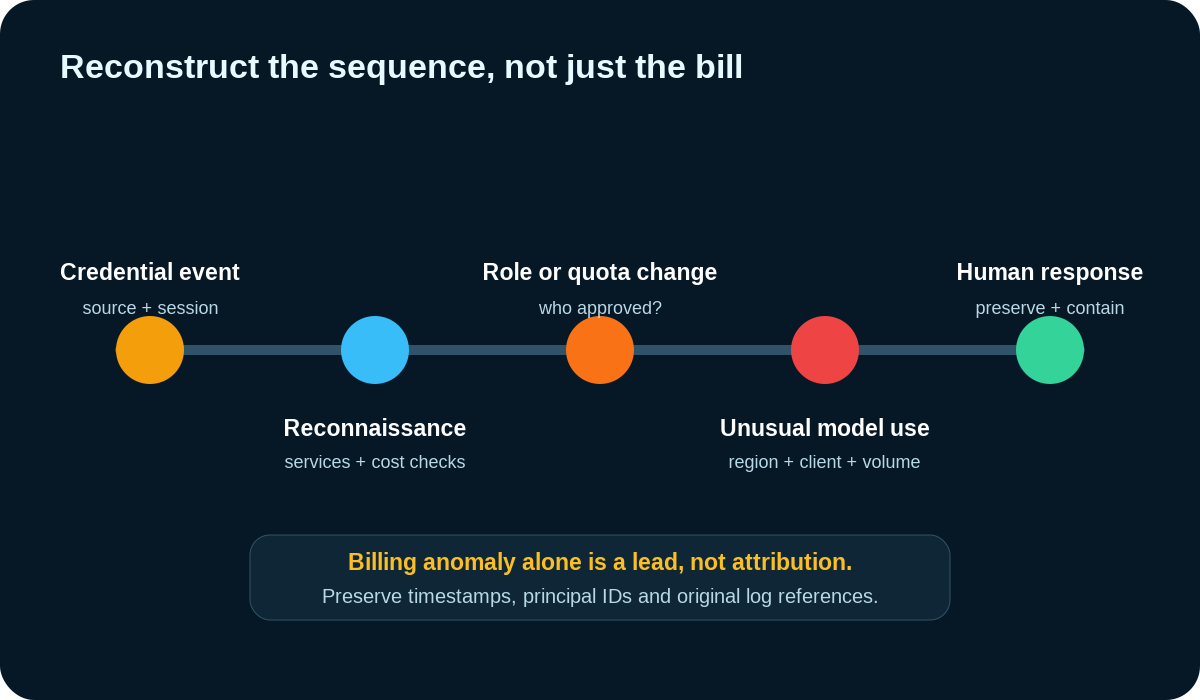
An analyst opens the original audit records and confirms the principal, credential age, last expected use, deployment owner and change ticket. Enumerate every environment where the same secret, session or role can act. Check for new service accounts, attached administrative policies, newly enabled model services, GPU instances, quota requests and relay infrastructure.
Challenge the leading hypothesis: could a load test, batch job, failover, developer experiment or provider retry explain the activity? Ask the model to list evidence that would disprove abuse. Keep attribution separate from containment; the first goal is to establish which access is unauthorized and what can be changed safely.

Step 3: preserve, approve and contain
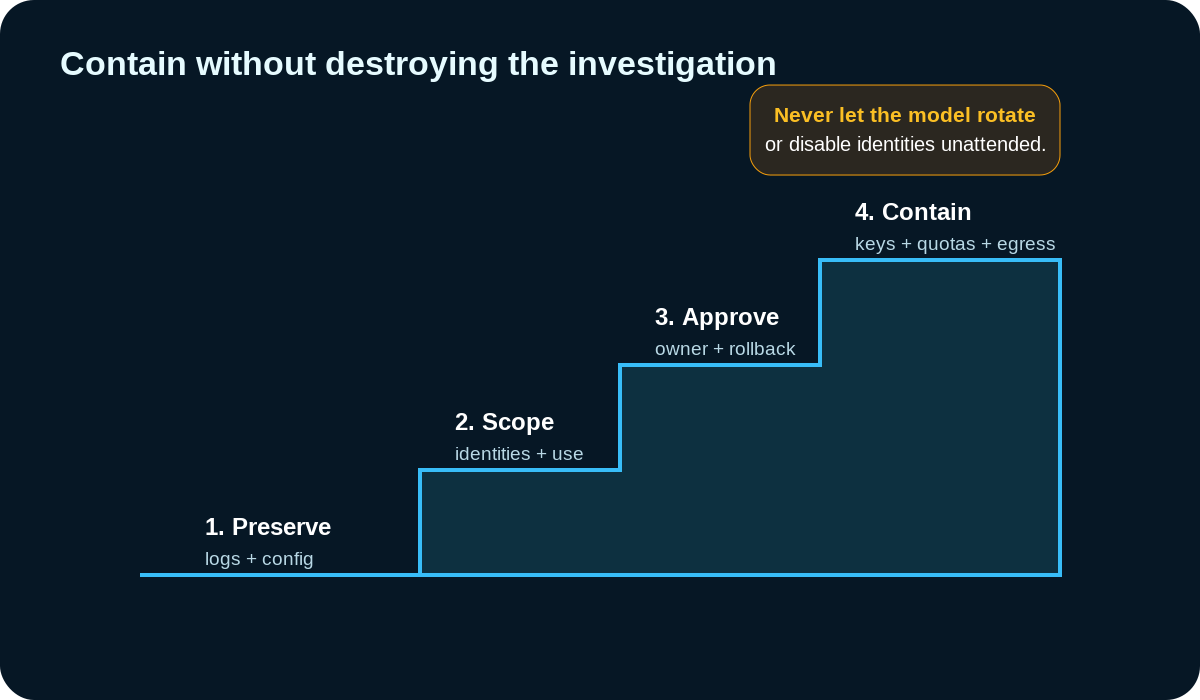
Before changes, preserve logs, policies, service-account details, configuration and representative request metadata according to the incident plan. Then bind approval to a specific action: rotate one credential, revoke one session, disable one unauthorized principal, reduce one quota, block one relay destination or isolate one workload. Name the owner, expected effect, monitoring and rollback.
After containment, watch model requests, authentication failures, new identities, spend and business health. Attackers may rotate credentials or move to compute workloads. The model may summarize the post-action evidence, but only authorized cloud and security owners should close the incident or restore access.
Limitations and topic-selection signal
Usage baselines can be wrong when projects launch, models retry or billing data lags. Shared keys, incomplete gateway logs and cross-account roles can blur ownership. An AI correlator can miss a quiet attacker, overreact to legitimate research or expose prompt content. Pair anomaly review with hard controls: secret scanning, short-lived credentials, least privilege, quota budgets, egress policy and an incident runbook.
A focused Firecrawl search on November 21 returned Google’s November 16 primary report first, a separate detailed LLMjacking analysis, and multiple current independent security articles. That cluster establishes fresh attention and direct relevance to cloud administration and security operations; it does not establish traffic, search rank, universal loss levels or the performance of this workflow.
Put the insight into practice.
Deep Security helps organizations assess risk, validate controls, and build a practical plan to strengthen their defenses.
Talk with Deep Security