

A reproducible, human-reviewed workflow for using AI to organize logs, prompts, tool calls and approvals into an evidence-backed incident handoff.
The practical problem: AI incidents cross more evidence boundaries
A conventional application incident already spreads evidence across identity, cloud, endpoint and ticketing systems. An AI-enabled workflow adds prompts, retrieved context, model and policy versions, tool calls, approvals and the downstream systems an agent touched. When those records live with different owners, a fluent timeline can arrive faster than a defensible one.
NIST published IR 8621 on November 2 after a workshop with more than 400 participants. The final report describes attacks against AI systems as well as harms caused by misuse, malfunction or unintended actions. It identifies monitoring, evidence collection, information sharing and clearer responsibilities as areas for future work. It is a workshop report, not a binding incident-response standard, and it does not certify the workflow below.
This use case is for SOC leads, AI platform owners, cloud responders and counsel who need a first-pass evidence packet. The required tools are an approved model, read-only exports from the systems in scope, a case repository with retention controls, and a named reviewer. Do not paste secrets, personal data or regulated records into a model that is not approved for that data.
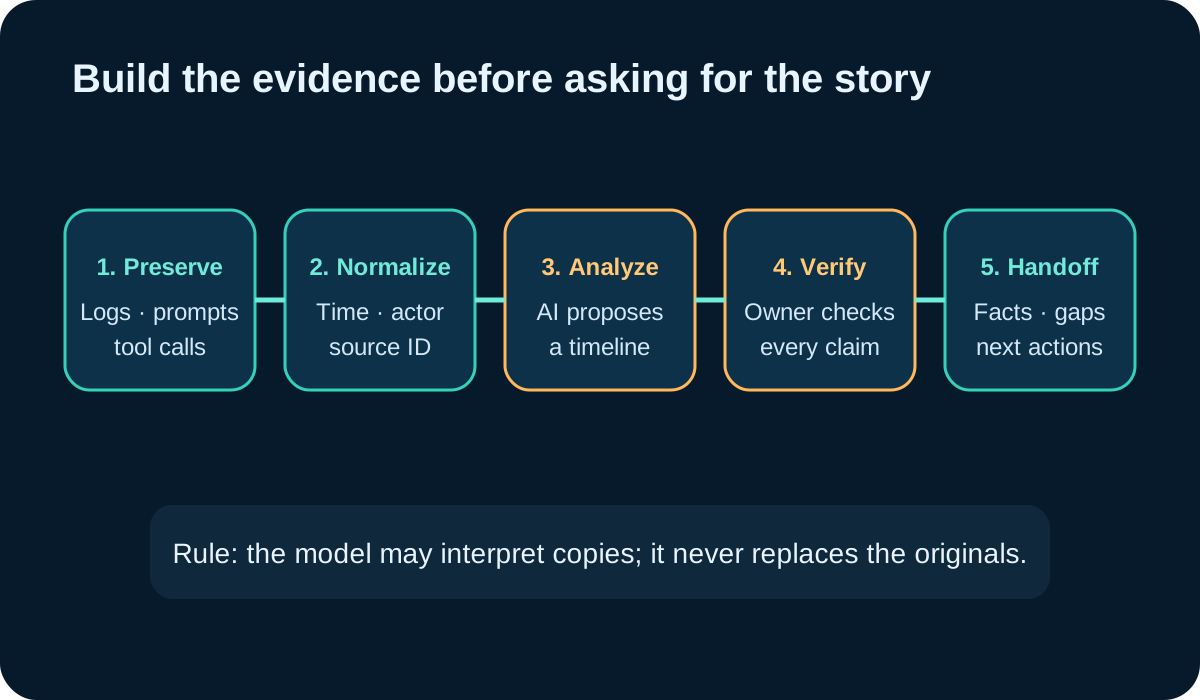
Step 1: freeze scope and preserve originals
Write the incident question before collecting data: systems, identities, time window, suspected action and decision owner. Export the smallest useful set of records, retain the untouched originals, and record collection time, source system, exporter and hash where your process supports it. Normalize copies into a simple event shape: timestamp, actor, action, target, result, source ID and source link.
Keep model inputs separate from source files. Redact only under an approved rule, and preserve a mapping when investigators must reconnect a redacted identifier to the original. If a system lacks logs, add an explicit evidence-gap row; silence is not proof that an action did not occur.

- Collect model request and response records, retrieval references, tool-call logs and approval events.
- Collect identity, endpoint, network and cloud audit records for the same window.
- Record clock source and known time skew before sorting events.
- Assign an owner and retention rule to each evidence class.
Step 2: ask for a cited evidence register, not a verdict
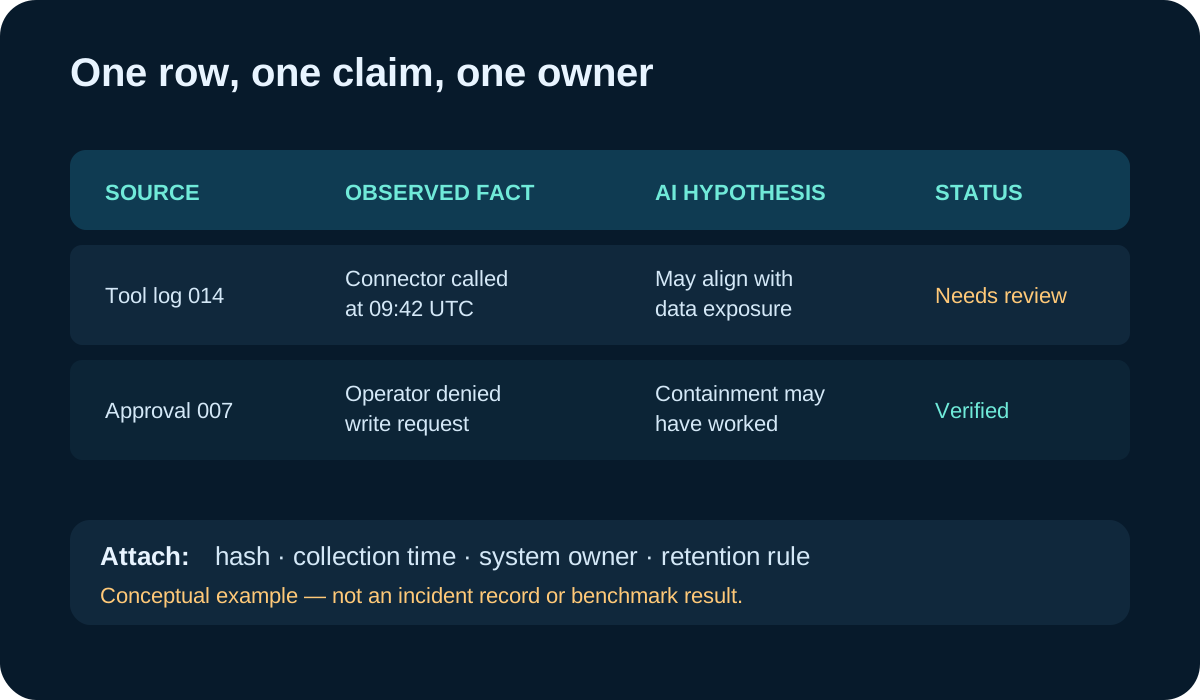
Give the model a fixed output schema and forbid unsupported inference. A useful prompt is: ‘Using only the supplied records, create one row per material event with UTC time, actor, action, target, outcome, source ID, confidence and open question. Separate observed facts from hypotheses. Quote no secrets. If a field is missing, write unknown. Do not decide intent, impact or root cause.’
Run a second pass for contradictions: ‘List every claim that depends on a single source, every timestamp conflict, and every hypothesis that lacks a confirming record. Return the exact source IDs needed for review.’ The expected output is a compact evidence register and a gap list. It is illustrative until the case owner checks the referenced records.
Step 3: rehearse the cross-company handoff
IR 8621 highlights coordination across model developers, deployers and users. Practice that boundary before a real event. Give each party a role card: what it operates, what evidence it can preserve, who can authorize release, and how another responder reaches it after hours.
Have the model draft two versions from the verified register: an internal technical brief and a partner request that names only the missing artifacts, time range and secure transfer route. A human must review contractual, privacy and privilege implications. The model should never choose what another organization is permitted to disclose.

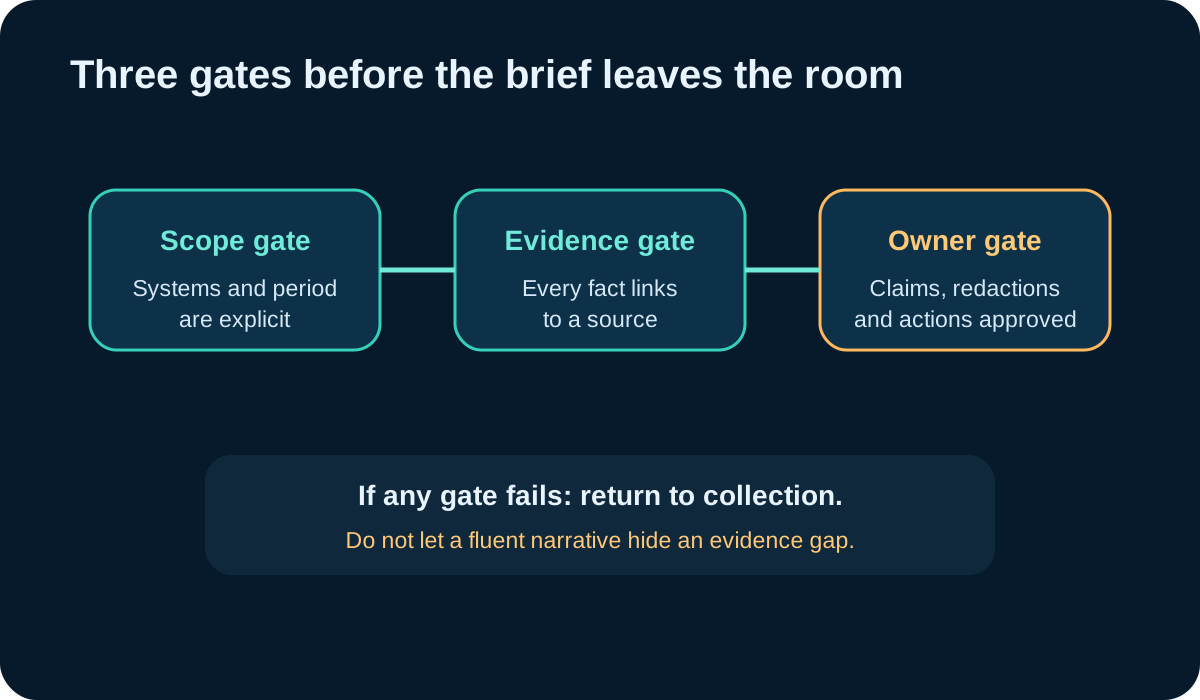
Step 4: apply three handoff gates
Before distribution, require scope, evidence and owner gates. Scope confirms the systems and period. Evidence confirms that each factual sentence points to an inspected record and labels uncertainty. Owner approval covers claims, redactions, recipients and next actions.
A useful completion packet contains the preserved-evidence index, verified timeline, evidence gaps, decisions and approvals, containment state, recovery criteria and a list of notifications considered. Store the model version and prompt with the case so the drafting process can be reproduced.
What this workflow can and cannot establish
This workflow can reduce clerical sorting and expose conflicts across large record sets. It cannot prove intent, recover missing telemetry, validate a source it cannot access, or replace forensic acquisition, legal review or product expertise. Prompt injection can also be present inside tickets, logs or retrieved content; treat all collected text as untrusted data and disable model tools during analysis.
NIST IR 8621 records stakeholder perspectives and future-work areas; it is not a mandate and does not claim that this AI-assisted procedure has been tested. Pilot it with synthetic records, score citation accuracy and missed gaps, and stop if the model invents sources or obscures uncertainty. For alert-level work, compare the related evidence-backed SOC triage guide.
Put the insight into practice.
Deep Security helps organizations assess risk, validate controls, and build a practical plan to strengthen their defenses.
Talk with Deep Security