

A practical workflow for using frontier AI to review authorized source snapshots, route cited vulnerability leads to code owners, correct severity and retest fixes.
What the ENISA and CERT-EU experiment actually showed
A November 2026 ENISA report, supported by CERT-EU, describes an experiment across 27 codebases—25 open source and two expected to become open source. The models reviewed source code only; they received no production-deployment context and tested no live applications. They produced 220 potential issues that were shared with code owners.
At publication, owners had assessed 88 findings and confirmed 95% of that reviewed subset as true positives. Four CVE identifiers had been assigned. The report explicitly limits that result to the subset with owner feedback and notes that assessment was still ongoing. It also found a tendency to overrate severity. Treat the numbers as this experiment's status, not an expected accuracy rate for another model, repository or organization.

Define an authorized, isolated review lane
This workflow fits application-security teams, open-source maintainers and internal platform groups that have owner permission to review source. Select a small snapshot with a named owner and disclosure path. Run the model in an isolated environment with no production credentials, no ability to publish findings and no live target access. Feed it architecture notes only when the owner approves them.
Keep general code-quality suggestions out of the security queue. Require each candidate to name the file, line or data flow, the assumed attacker capability, missing deployment context and a minimal safe validation idea. Deduplicate against existing SAST, dependency and issue-tracker results before asking owners to spend time.
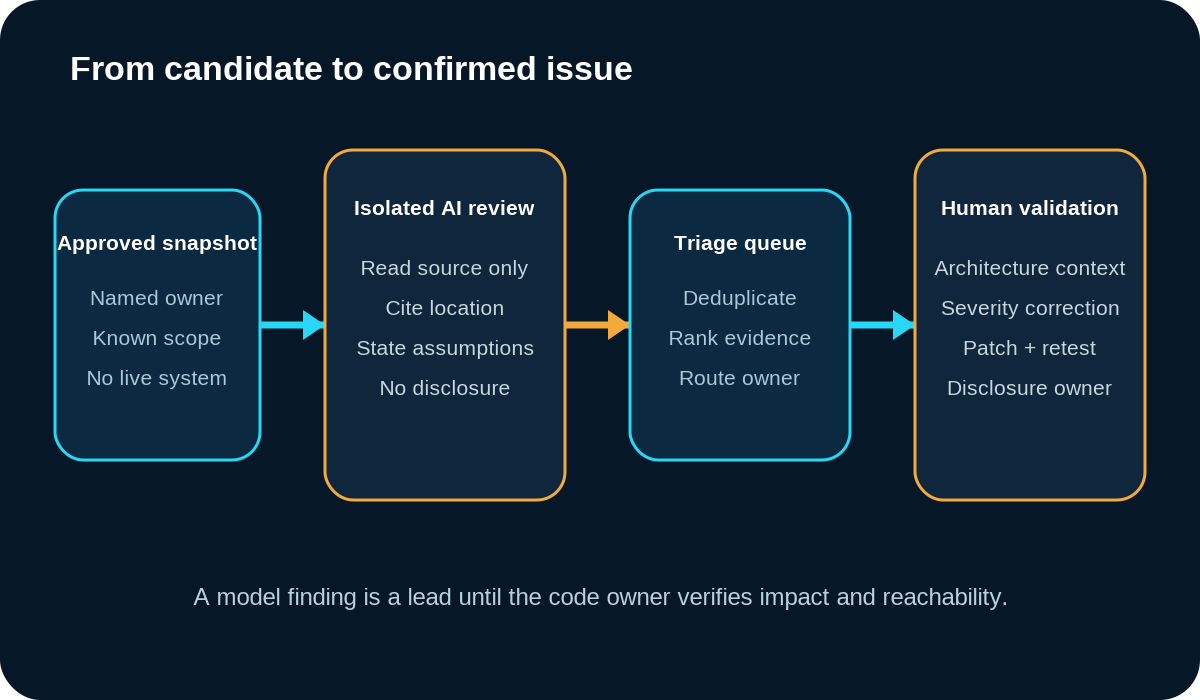
- Allow: read the approved snapshot, cite evidence and draft a bounded candidate finding.
- Ask: request missing architecture or configuration context from the code owner.
- Deny: probe a live service, retrieve secrets, publish a disclosure or assign final severity.
- Record: model version, prompt, source revision, candidate, owner decision and retest.
Step 1: generate a cited candidate, not a verdict
Example prompt: “Review snapshot SHA-47 for remotely reachable security defects in the request-processing path. For each candidate, cite file and line, trace untrusted input to the sensitive operation, list required configuration and attacker capability, state missing context and propose a non-destructive validation. Do not assign a CVE, contact a maintainer, claim exploitability or inspect anything outside this snapshot.”
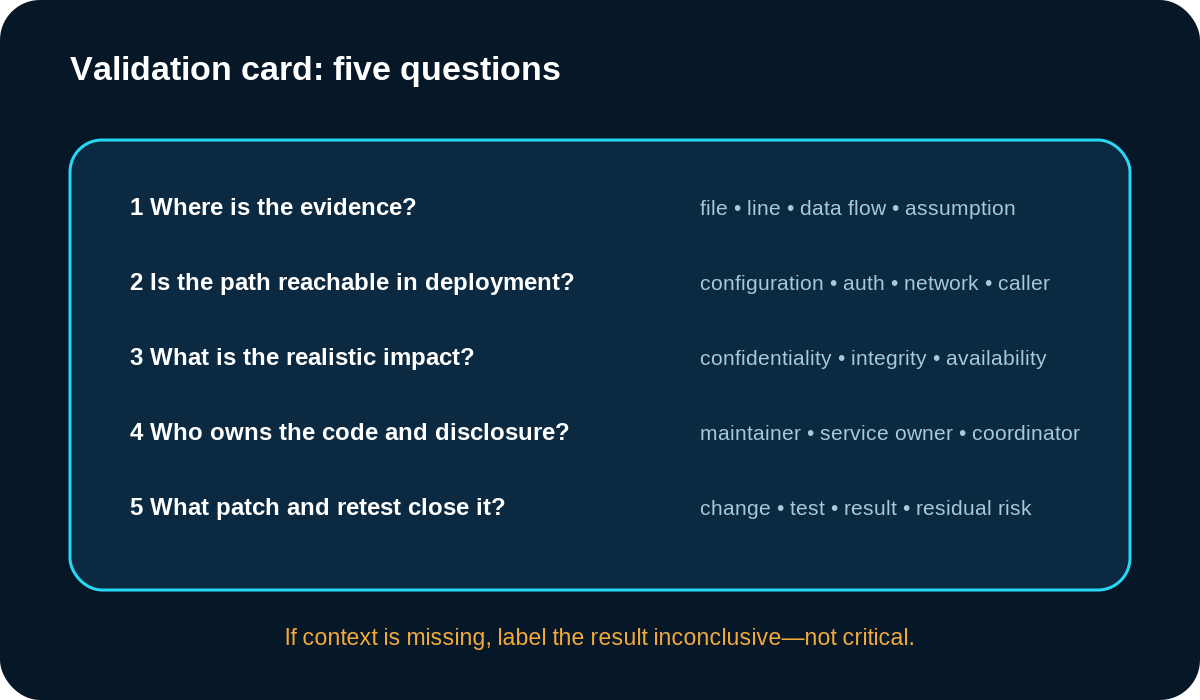
Expected output is a short candidate card with evidence and assumptions. It is an illustrative format, not a tested result. Reject cards that lack a source location, describe only style, repeat an existing scanner finding without new evidence or depend on a configuration the repository does not use.
Step 2: let the code owner correct context and severity
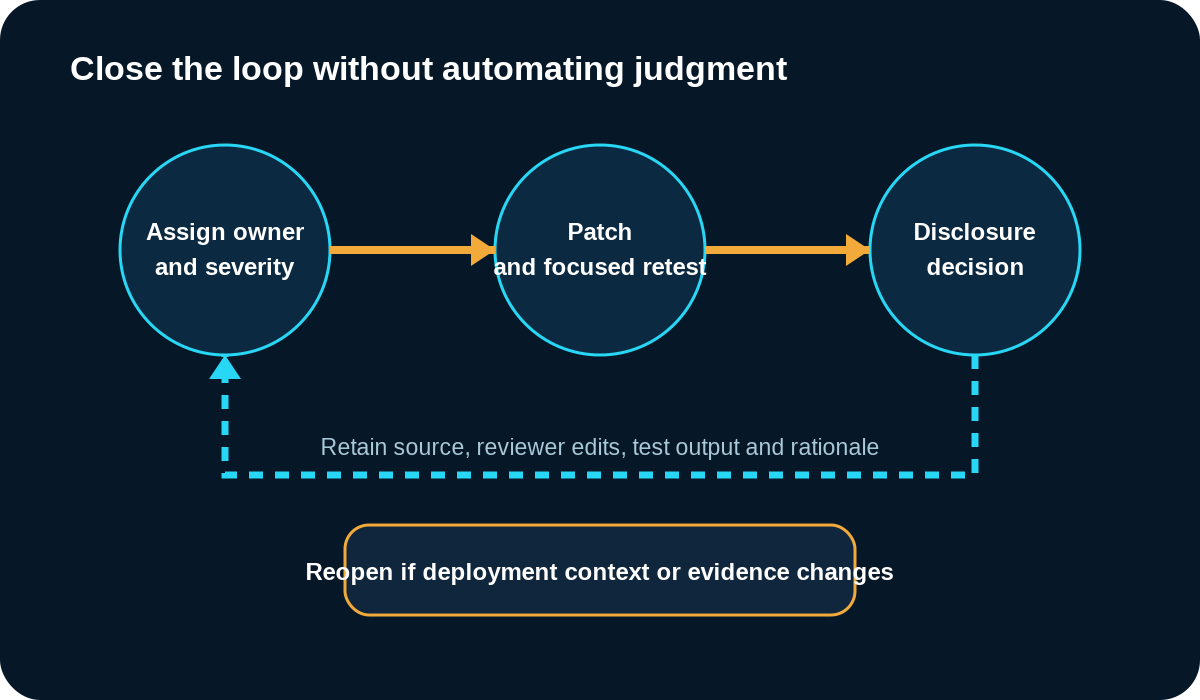
The code owner checks the cited path against build flags, authentication, callers, deployment topology and existing mitigations. A security reviewer then decides whether the issue is reachable and meaningful. Preserve both the model's original severity and the human revision; ENISA's experiment shows why that correction step matters.
If validation needs execution, use a disposable environment and a safe, authorized test case. Do not copy exploit attempts into production or expand the target set. Route ambiguous cases to a specialist rather than asking the same model to defend its first answer.

Step 3: patch, retest and retain the decision record
For a confirmed issue, assign an owner, write the smallest safe fix and add a focused regression test. Re-run the model only as a second reader; the owner and security reviewer inspect the actual diff and test output. Follow the project's established coordinated-disclosure process, including embargo and maintainer preferences.
Measure owner-confirmed candidates, duplicates, severity changes, inconclusive cases, reviewer time and reopen rates. Do not optimize for the largest finding count. A smaller queue with reproducible evidence is more useful than a dramatic list that overwhelms maintainers.
Limitations and topic-selection signal
A model can miss multi-service behavior, hallucinate a path, expose proprietary source to an unapproved provider or generate unsafe validation steps. Source-only review also lacks production configuration and business impact. Use approved models and retention settings, isolated execution, narrow scope, owner validation and a stop path. This workflow is not a penetration test or an assurance claim.
Focused Firecrawl research on November 23 returned ENISA's report first, multiple current independent summaries and November 17–18 coverage of the AI-assisted Java4Shell discovery and remediation urgency. That cluster shows fresh public attention to AI-assisted vulnerability discovery; it does not prove model performance, adoption, traffic or search ranking.
Put the insight into practice.
Deep Security helps organizations assess risk, validate controls, and build a practical plan to strengthen their defenses.
Talk with Deep Security