

Create an isolated test gate for AI-generated infrastructure and cloud code using synthetic credentials, policy checks, deterministic tests and human approval.
Why code generation shifted the bottleneck to verification
LocalStack’s State of AI in Cloud Development 2026 report, released October 20, surveyed 309 developers and managers at North American enterprises with more than 1,000 employees. Respondents estimated that nearly 40% of AI-generated code never reaches production; 79% said agents receive cloud-environment access at least occasionally even though 97% cited concerns. These are commissioned survey responses, not telemetry from every development team.
The practical problem is familiar: an agent can produce Terraform, serverless handlers or deployment configuration faster than a team can safely validate it. Direct access to a shared staging account introduces credentials, cost, quota, drift and blast radius before basic behavior has been proven.
Firecrawl searches on October 23 surfaced the official report, its October 20 release coverage and recent independent discussion of LocalStack’s Azure public preview. That supports current interest in isolated cloud testing; it does not prove the survey figures apply to your team or that one emulator provides full cloud parity.
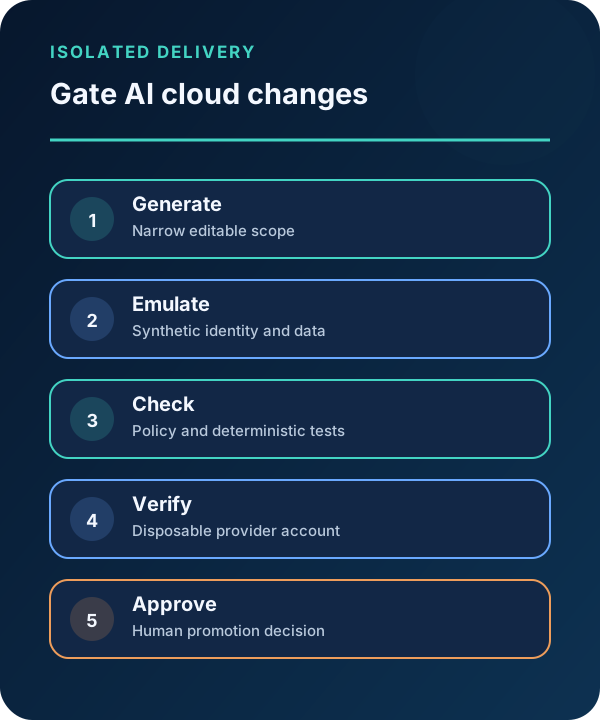
1. Build a disposable laboratory with synthetic identity
Choose one representative workload, such as an event-triggered function writing to object storage. Run its dependencies in a local emulator, containerized test environment or disposable sandbox account. Use fake records and synthetic credentials that cannot authenticate to production.
Pin the emulator, provider and test images. Commit the environment definition, seed data and teardown script with the workload. LocalStack is one option for supported AWS services, and its Azure product entered public preview in October 2026 with a limited service list; evaluate the published support matrix rather than assuming parity. Equivalent emulators or provider-native disposable accounts may fit other stacks.
The laboratory’s contract should name allowed endpoints, blocked networks, data classification, maximum cost, time-to-live and cleanup owner. Test the deny path before giving it to an agent.

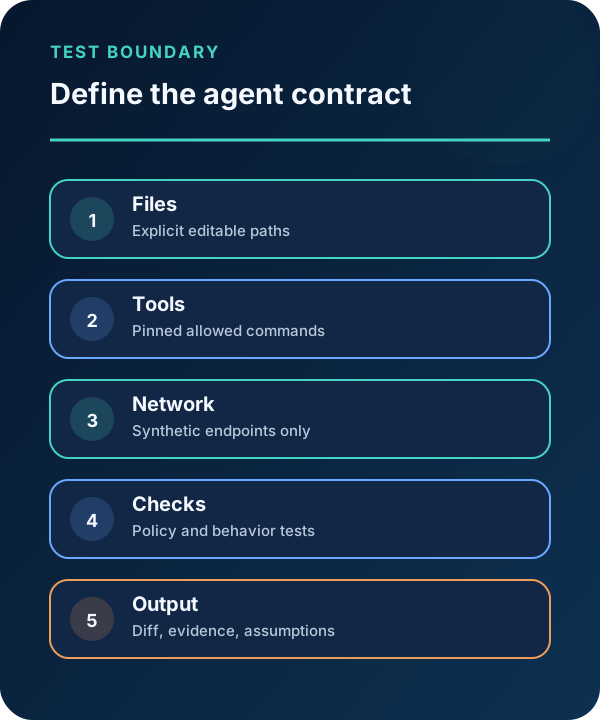
2. Give the agent a narrow test contract
Define the input files it may edit, commands it may request, local endpoints it may reach and tests it must run. Suggested prompt: “Modify only the supplied infrastructure and handler files to satisfy the test contract. Use the synthetic endpoint and credentials defined in the fixture. Do not add external network calls, production identifiers or new providers. Return the proposed diff, test output and any assumption you could not verify.”
Run formatting, static analysis, secret detection, IaC policy checks, unit tests and integration tests in a fresh sandbox. Capture tool versions and the full command result. A model-written explanation is not a substitute for the machine-readable result.
Expected output: a small diff, deterministic test record, policy findings and an explicit assumption list. Reject undeclared dependencies, unpinned downloads or attempts to bypass a failing check.
3. Make failure useful and reproducible
Seed tests for missing permissions, duplicate events, retry behavior, malformed payloads, network loss and quota-like limits. Ask the assistant to summarize failures with exact evidence references: “For each failed check, cite the test case and observed output, distinguish code defects from environment limitations and propose the smallest reviewable change. Do not weaken a policy or assertion.”
Reviewers should be able to reset the laboratory and reproduce the same failure. If the emulator does not implement a service behavior, label that limitation and move the case to a disposable provider account rather than deleting the test.
This step produces a failure ledger: observed behavior, expected behavior, environment, owner and disposition. It prevents a green local result from hiding untested provider semantics.

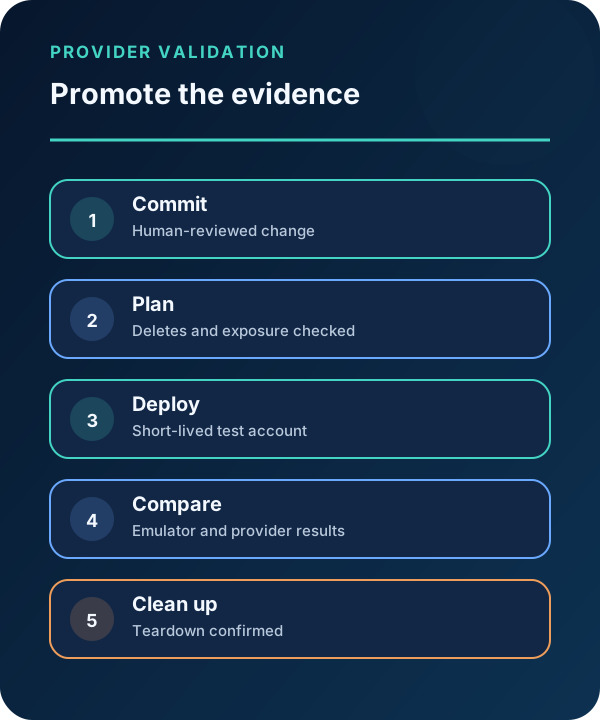
4. Promote the evidence, then verify in a bounded cloud account
A human reviewer inspects the diff, test record, policy findings and known emulator gaps. Only an approved commit is deployed to a short-lived development account with least-privilege credentials, budget controls and no production data. Re-run the contract against the real provider and compare results.
Require a plan output for infrastructure changes and inspect deletes, replacements, public exposure, identity changes and cross-account references. Promotion to shared staging or production follows the normal change process; the agent does not receive the promotion credential.
Record the commit, artifact digest, lab results, provider verification, approver and unresolved differences. Tear down the disposable account resources and confirm cleanup.
Gate checklist and realistic limits
An isolated gate reduces credential exposure and makes failures cheaper, but it cannot reproduce every managed-service edge case, regional control or production dependency. Measure its value using review time, escaped defects and reproducibility—not code volume alone.
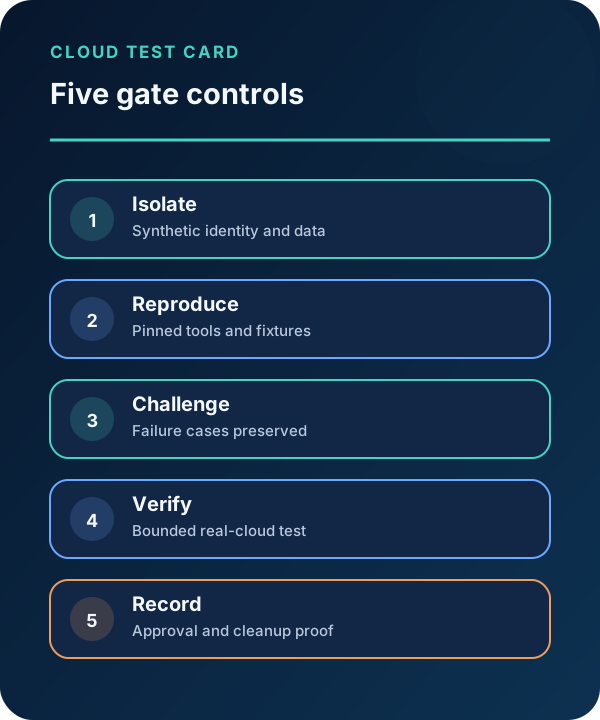
- Use synthetic identity, data and endpoints with enforced egress limits.
- Preserve diffs, tool versions, test results and known emulator gaps.
- Verify approved changes in a disposable real-cloud environment before promotion.
Put the insight into practice.
Deep Security helps organizations assess risk, validate controls, and build a practical plan to strengthen their defenses.
Talk with Deep Security