

A practical workflow for combining camera, telemetry, location and policy evidence with AI while keeping driver contact and safety escalation human-owned.
A current real-world pattern: multimodal fleet operations
AWS published a November 9 architecture account of Novus Hi-Tech’s FleetGPT, a deployed fleet-operations system that brings together video evidence, telemetry, driver history and policy documents for natural-language investigation and intervention workflows. An AWS case study says human teams remain the validation layer and stay involved for higher-risk cases. Superpower Daily covered the implementation on November 9 and explicitly cautioned that the reported gains are company claims rather than independently verified results.
AWS and Novus report a 46% annual reduction in road-behavior violations and a 55% reduction in drowsiness alerts per 1,000 km in one large dangerous-goods logistics program, plus faster warning validation. Those figures describe the cited deployment and measurement context. Deep Security did not test FleetGPT, and the results do not establish causation, transferability, pricing or expected performance for another fleet.
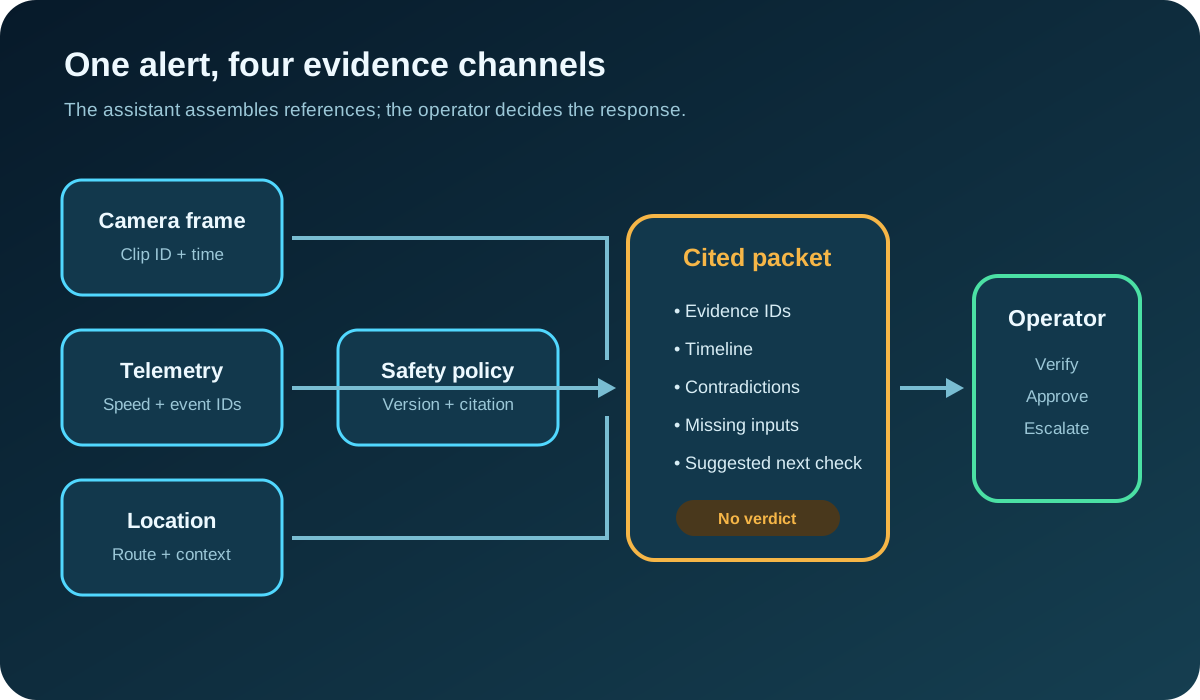
Audience, tools and safe boundary
This workflow is for authorized fleet operations, safety, IoT, security and data teams that already collect vehicle events. You need time-synchronized camera or event clips, vehicle telemetry, GPS or route context, driver and vehicle identity from an authoritative source, current operating procedures, an incident queue and an approved multimodal AI service. The Novus implementation uses AWS services including Bedrock, Aurora, DynamoDB, S3 and managed compute, but the control pattern does not require that stack.
Minimize privacy exposure. Use event windows rather than continuous footage, replace names and plate numbers with stable IDs, exclude cabin audio unless it is lawful and necessary, and restrict model retention and training. Separate the evidence workspace from systems that can call a driver, alter a route, discipline an employee or control a vehicle.

- System of record: original event media, telemetry and operator disposition.
- AI role: align timestamps, summarize relevant evidence, cite policy and surface contradictions.
- Human role: verify the event, select the response, contact people and escalate safety risk.
- Stop condition: identity conflict, stale telemetry, missing critical media or unclear safety impact.
Step 1: define an event packet and clock contract
Create one immutable event ID and record the vehicle ID, driver assignment source, device ID, event type, device clock, ingestion clock, time-zone offset, clip start and end, telemetry window, route segment, policy version and evidence hashes. Document acceptable clock drift. Without this contract, the assistant can confidently join events that did not happen together.
For the first pilot, choose one narrow alert type and a noncritical response path. Build known-positive, false-positive, missing-video, stale-sensor and identity-mismatch cases. Define what must be present before the system may even recommend contact.
Step 2: prompt for evidence, contradictions and the next check
Give the assistant only the bounded packet and the specific policy version. Require it to separate observed facts, model interpretations and unknowns. Any statement about behavior should cite a clip frame or telemetry sample. The output should identify missing evidence and the safest next verification, not decide fault or intent.
Example prompt: “For event EVT-2041, align the supplied camera frames, telemetry, route context and policy version P-17. Return observed facts with evidence IDs, timing conflicts, missing inputs, policy passages, alternative explanations and the next human check. Do not identify a person, infer intent, assign fault, contact anyone or recommend vehicle control. If the driver or vehicle ID conflicts, stop and mark human review required.”
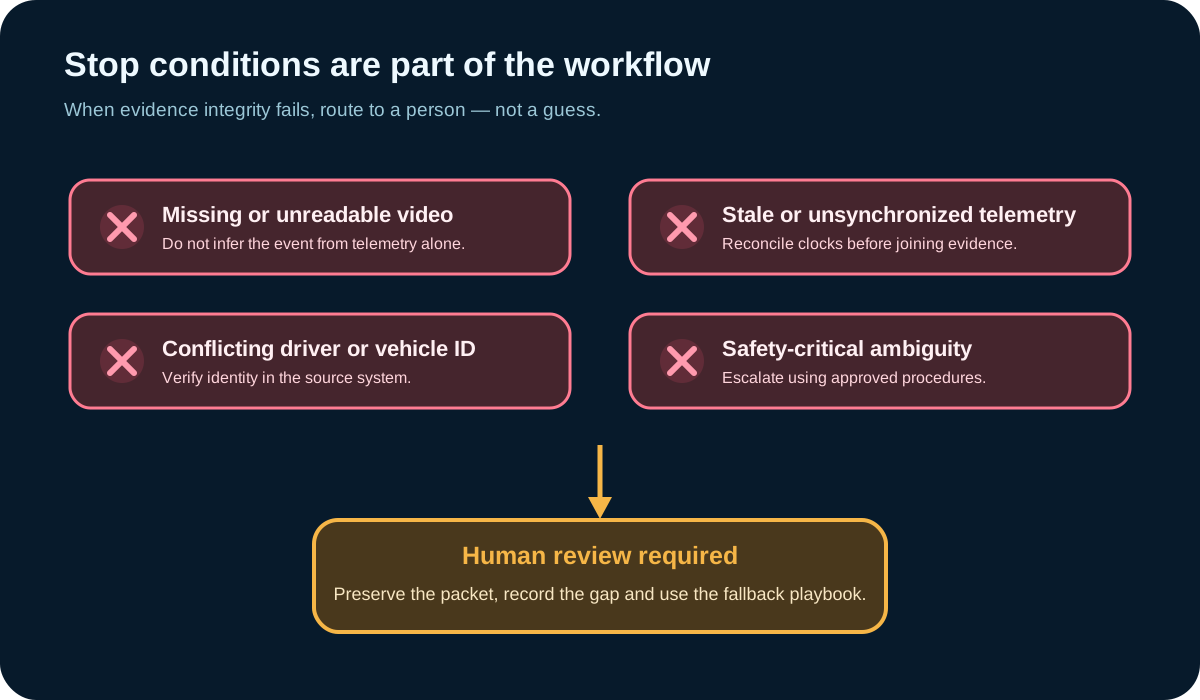
- Expected output: a cited event packet, not an autonomous safety verdict.
- Display the source clip and telemetry beside the summary.
- Make unknown and conflicting fields visually prominent.
- Measure missed stop conditions and unsupported claims during evaluation.
Step 3: put a human gate before contact or escalation
The operator should inspect the cited clip, telemetry window and policy before choosing a response. For routine, verified events, the workflow may prepare an approved contact script in the driver’s supported language. The operator approves the destination, content and timing. Higher-risk or ambiguous cases follow the organization’s existing emergency, supervisory and legal procedures.
Record who approved the response, which evidence they viewed, what was communicated, whether it was acknowledged and the follow-up disposition. AI-generated language should not conceal that a message is automated where disclosure is required, and it should never replace emergency services or trained safety personnel.
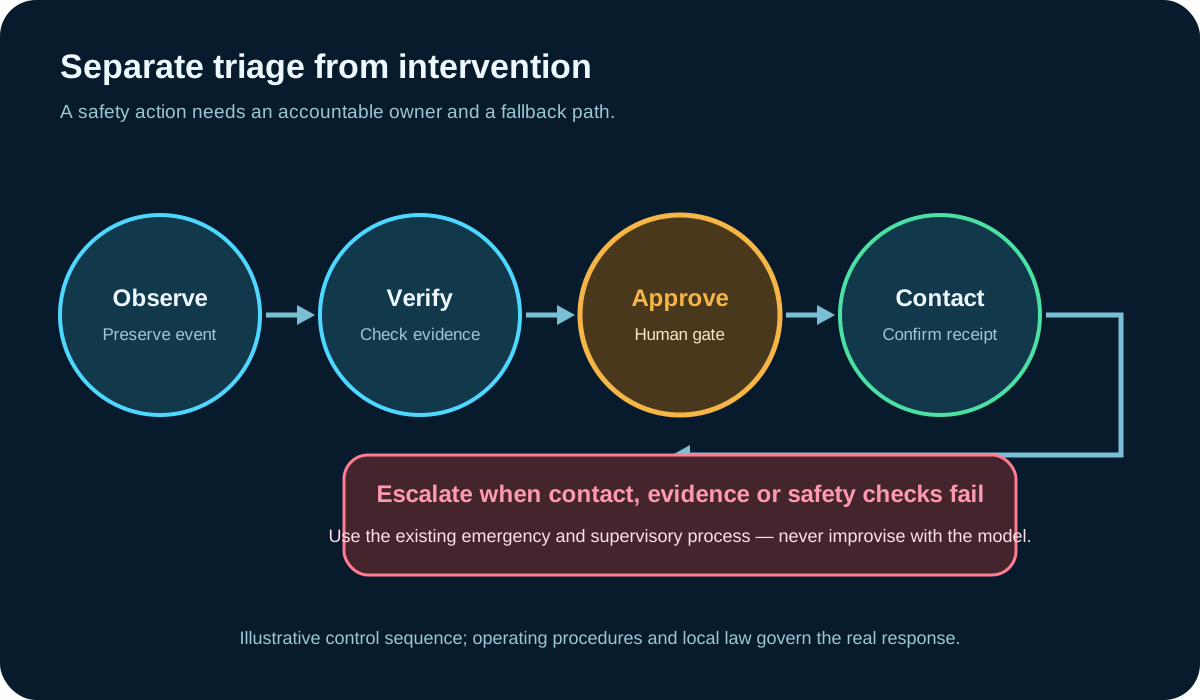
Step 4: test the handoff, privacy and failure paths
Run shadow mode first. Compare the assistant’s packet with experienced operator review and measure citation accuracy, clock-alignment errors, false escalation, missed escalation, identity mismatch handling and time to disposition. Include degraded cameras, duplicated events, network delay, policy version conflicts and unavailable translation. A useful pilot should fail visibly and safely.
Before production, test access revocation, retention deletion, supervisor escalation, driver callback, model outage and manual processing. Review whether the workflow creates worker-surveillance, labor, discrimination or biometric risks in the relevant jurisdiction. Operational speed is not a substitute for proportionality and due process.

Realistic limitations
A model cannot see beyond the supplied sensors, prove who was driving, determine intent, guarantee a translation is culturally or legally appropriate, or know whether immediate physical intervention is safe. Camera perspective, sensor calibration, weather, network delay and incomplete policy can all distort the packet. Automated contact may distract a driver or amplify a false alarm.
Keep the system advisory until each alert class, language, vehicle type and escalation path is validated. Safety outcomes should be reviewed over time with independent operational data, not inferred from a fluent summary or transferred from a vendor case study.
Why this topic was selected
A focused Firecrawl search on November 10 for “Novus Hi-Tech FleetGPT agentic AI fleet analytics November 9 2026” returned the November 9 AWS architecture post first, an AWS customer case study and same-day independent coverage that clearly labels the metrics as company-reported. The result set shows current attention to a real deployment; it does not establish search volume, Google ranking or broad market adoption. The practical gap was an evidence and safety-gate design that readers can reproduce without copying the vendor architecture.
Put the insight into practice.
Deep Security helps organizations assess risk, validate controls, and build a practical plan to strengthen their defenses.
Talk with Deep Security