
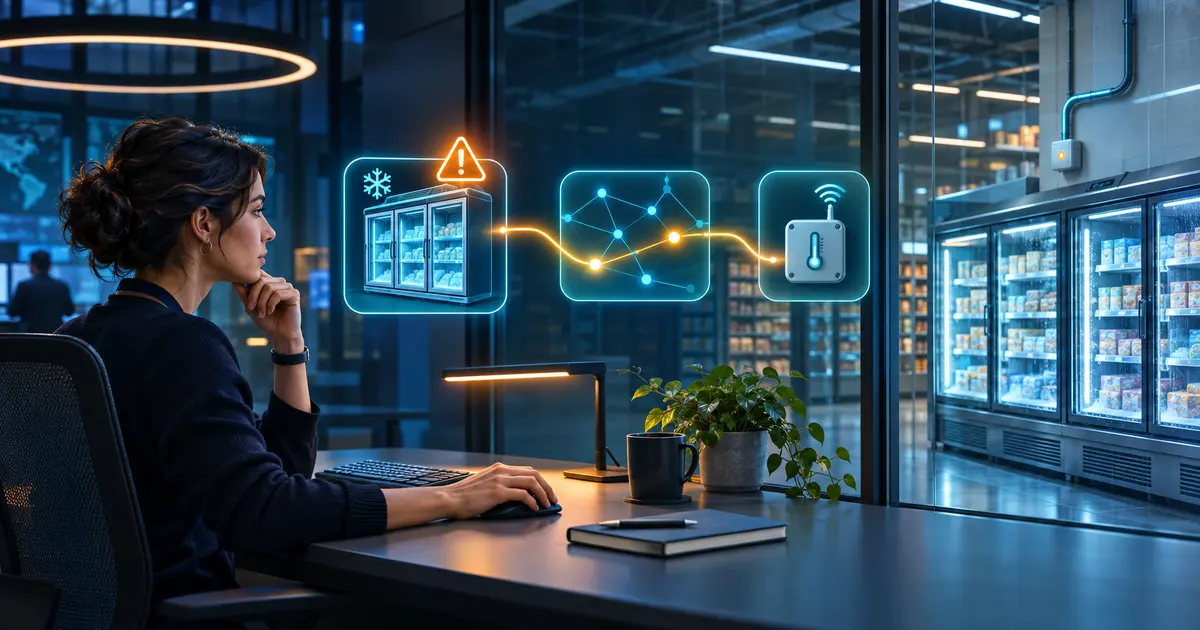
Correlate controller events, network telemetry and independent temperature readings into a human-reviewed cold-chain incident packet without letting AI control equipment.
Why connected refrigeration needs a safer triage pattern
Reuters reported on November 2, with an update on November 3, that cyberattacks disrupted connected fridges and freezers across multiple European countries and forced some stores to discard food. Reuters could not establish who was responsible or whether the incidents were linked. A Belgian cybersecurity official separately warned that AI may make attacks easier, but that is not evidence that AI caused these events.
IoT Business News described network-level visibility and AI-assisted anomaly detection as useful controls on November 3, while also noting that monitoring does not replace secure remote access and can struggle when an attacker abuses a legitimate channel or credential. Darktrace's October 21 vendor research provides older context on exposed industrial controllers, weak credentials and outdated firmware; it does not establish the attack path in the November incidents.
For grocery operators, cold-storage facilities, facilities teams and managed security providers, the immediate problem is not autonomous remediation. It is turning noisy cyber and physical telemetry into a fast, evidence-linked packet that a qualified person can act on.
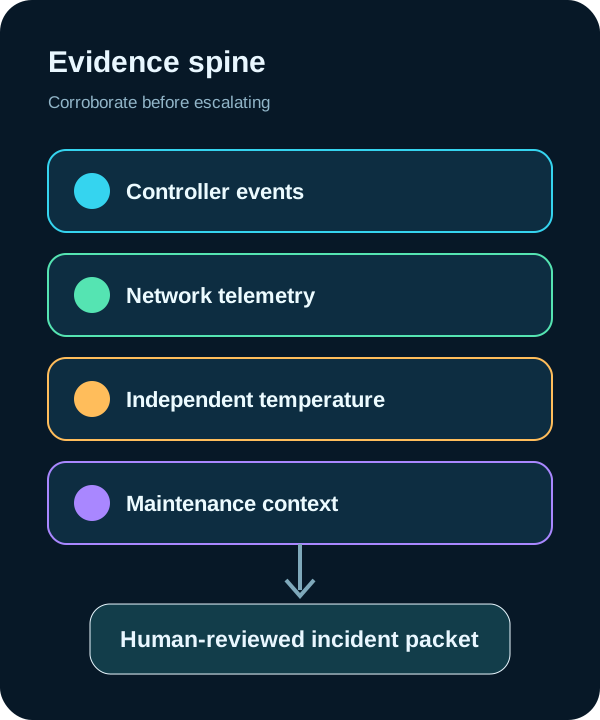
- Problem: separate controller, network and physical-sensor signals can hide a dangerous change.
- Tools: controller audit export, network telemetry, an independent calibrated sensor, maintenance calendar and an approved AI workspace.
- Output: a prioritized anomaly card with source pointers, explicit unknowns and named human owners.
Collect four evidence streams before prompting
Export controller events with device ID, site, timestamp, old and new values, initiating account and remote-management channel. Add firewall, VPN, DNS and flow records that can show where the session came from and what else the controller contacted. Preserve the originals in the authorized evidence store and give the model redacted copies or stable pointers.
Use an independent temperature probe or building-management reading that does not share the same controller path. Add door-open, power, defrost and compressor-cycle context where available. Finally, attach the approved maintenance window, work order and vendor contact so legitimate service activity is visible.
Normalize timestamps and units before analysis. If clocks drift, record the offset. Do not upload store credentials, customer information, refrigeration recipes or raw vendor configuration to an unapproved model.
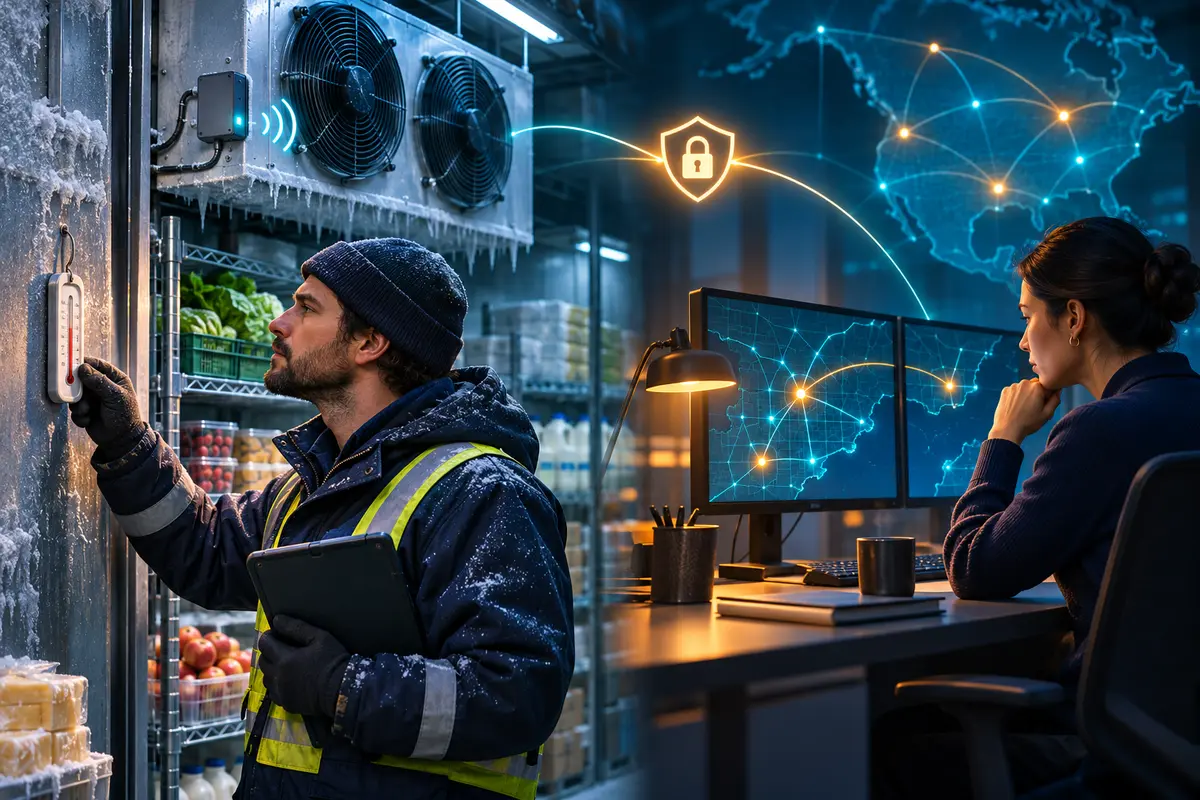
- Cyber: remote login, configuration write, firmware event and unusual destination.
- Physical: independent temperature, door, power and compressor state.
- Context: maintenance ticket, approved technician, expected schedule and safe operating range.
Ask AI for comparison, not control
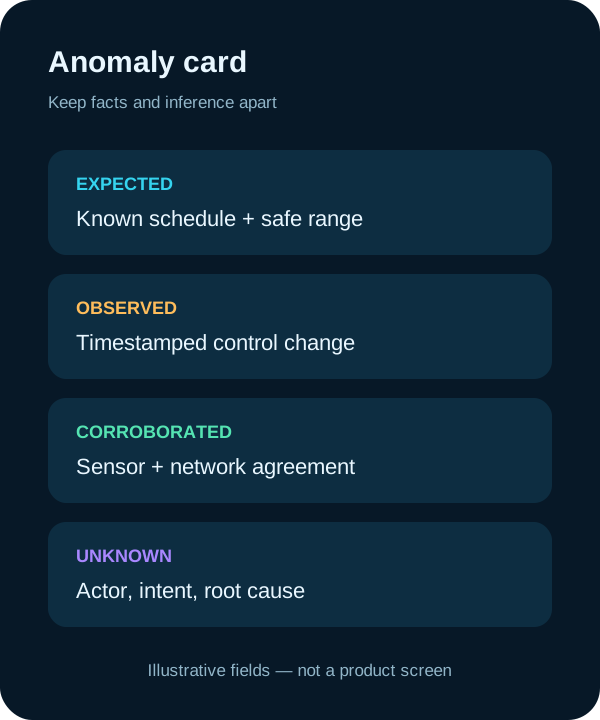
Create one row per event with a source pointer and a label of observed, inferred or unknown. Then ask the model to group events by site and equipment, compare them with the authorized change window and identify contradictions between controller state and independent readings.
Example prompt: “Using only the supplied rows, build an anomaly card for each device. Cite the row IDs behind every claim. Separate observed facts, inferences and unknowns. Compare with the maintenance window and independent sensor. Do not recommend changing setpoints, running defrost, isolating equipment or disposing of food. Return missing evidence and the human role that should review it.”
The expected output is an illustrative incident packet: a timeline, affected-device list, corroboration status, confidence rationale, missing evidence and routing owner. It is not a safety certification or root-cause finding.
Route anomalies through a three-owner gate
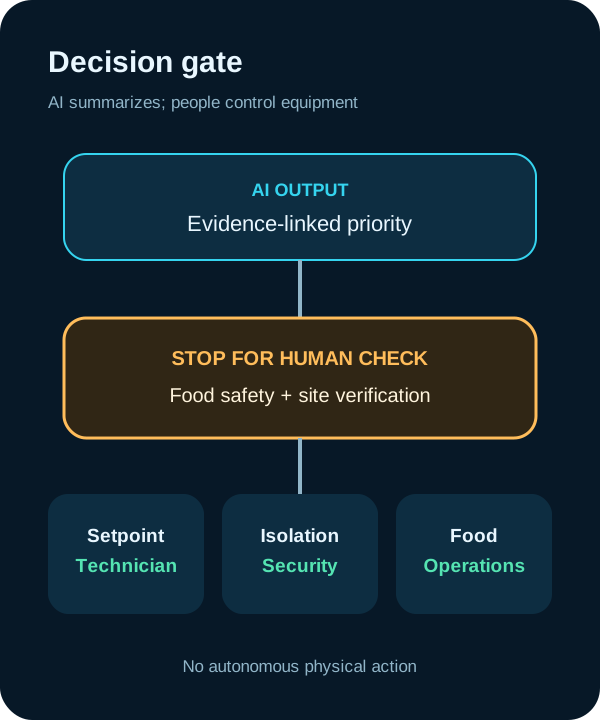
A facilities technician confirms the physical state and whether the controller display matches an independent instrument. A security owner validates identity, remote-access and network evidence. A food-safety or operations owner decides product handling under the organization's procedures.
AI can rank cases using documented factors such as simultaneous sites, privileged configuration writes, controller-to-sensor disagreement and activity outside a work order. The ranking should always show why a case moved up; an unexplained score is not a defensible escalation.
Never connect the assistant directly to setpoint, defrost, compressor or isolation controls. If a fast containment path is required, pre-authorize a human-run procedure with rollback and site communication.
Pilot on historical and simulated events
Start with redacted historical alerts and a tabletop dataset, not a live control loop. Include benign maintenance, sensor failure, clock drift, a legitimate remote login, an unauthorized change and a controller-to-sensor mismatch. Verify that every summary claim points back to an input row.
Track time to assemble the case packet, uncited claims, missed seeded conditions, duplicate cases and analyst overrides. Set acceptance thresholds before the pilot. Deep Security did not run this workflow against the reported European incidents, so no measured improvement is claimed here.
Expand only after facilities, security and food-safety owners agree that the output is comprehensible and the assistant cannot cause a physical action.

Limitations and failure modes
A compromised controller and a compromised upstream sensor can agree on the same false state. Encrypted or vendor-proprietary traffic may reveal only metadata. Valid credentials can make malicious activity look routine, and a temperature excursion can still be mechanical rather than cyber-related.
Model output can overstate causality, omit a quiet device or merge two sites with similar identifiers. Require citations, immutable source records and analyst review. Use deterministic safety alarms and existing food-safety procedures independently of the AI workflow.
Treat current attention as verified by the November 2–3 Reuters report and same-day industry coverage, not as evidence of search volume, widespread compromise or the performance of any AI product.
Put the insight into practice.
Deep Security helps organizations assess risk, validate controls, and build a practical plan to strengthen their defenses.
Talk with Deep Security