

A practical read-only AI agent workflow for fraud and financial-crime review with scoped identity, immutable evidence, human approval and a tested kill switch.
Why financial AI agents need a hard transaction boundary
Reuters reported on November 23 that several large and midsize US banks are tightening controls around internal AI agents. The banks described explicit credentials and permissions, activity monitoring, backup processes and controls intended to keep agents inside approved workflows. Reuters also identified loan processing, fraud detection and financial-crime review as current banking use cases. These are reported practices, not proof that any one control prevents failure.
The Bank Policy Institute separately argued on November 20 that consumer-facing agents should not yet access financial accounts over unapproved channels, citing mistaken payments, wrong-objective behavior and prompt injection. For DeepSecurity.io readers, the reusable pattern is narrower: use an internal agent to prepare a cited investigation packet, while transaction authority, account changes and case disposition remain outside the agent's toolset.

Build a read-only case contract
This workflow fits fraud operations, anti-money-laundering investigators, security teams and regulated business operations that already have a case-management process. Start with a service identity for the agent, least-privilege access to approved case exports and a tool allowlist. The agent may read records, compare evidence and draft questions. It may not initiate a payment, change an account, alter source records, close a case or contact a customer.
The OCC's November bulletin says examiners may use a supervisory framework proportionate to the nature, consequences, autonomy and complexity of a bank's use case. It also says the guide does not establish new supervisory expectations or enforceable requirements. Treat it as current risk context, not a checklist or legal conclusion.
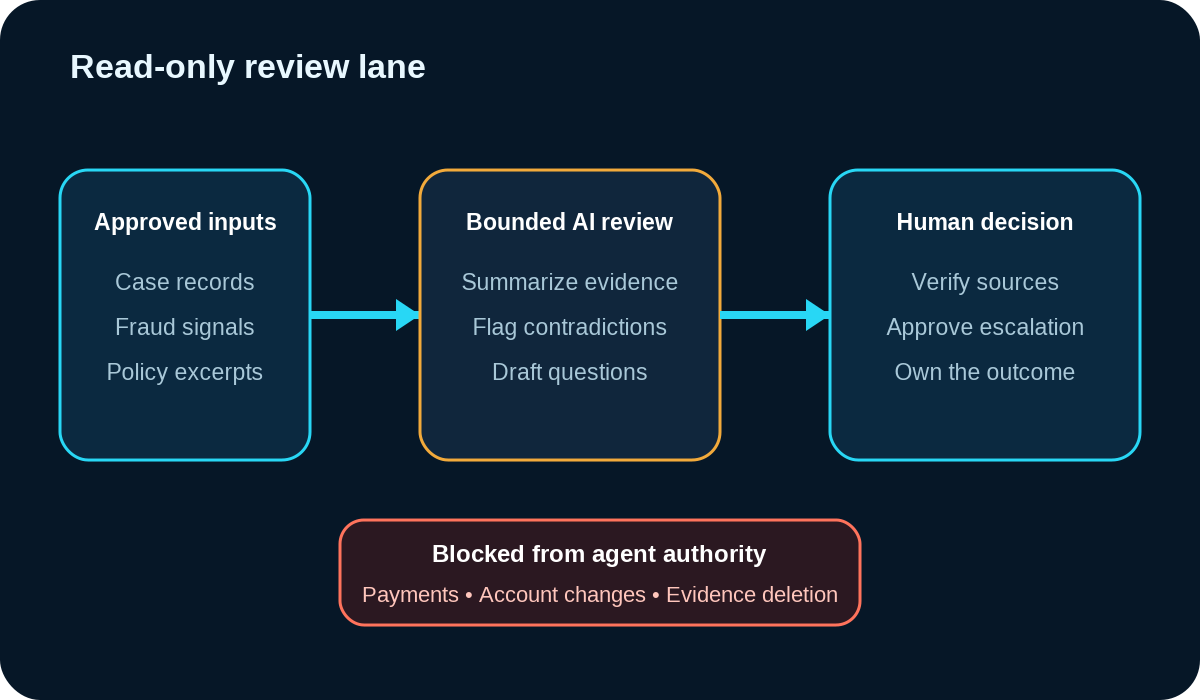
- Identity: one attributable service identity, short-lived credentials and no shared human token.
- Scope: one case, approved data fields, fixed retention and explicit tool endpoints.
- Evidence: source IDs, timestamps, uncertainty labels and an append-only action log.
- Decision: a named investigator verifies the packet and records the disposition.
Step 1: ask for claims that reopen at the source
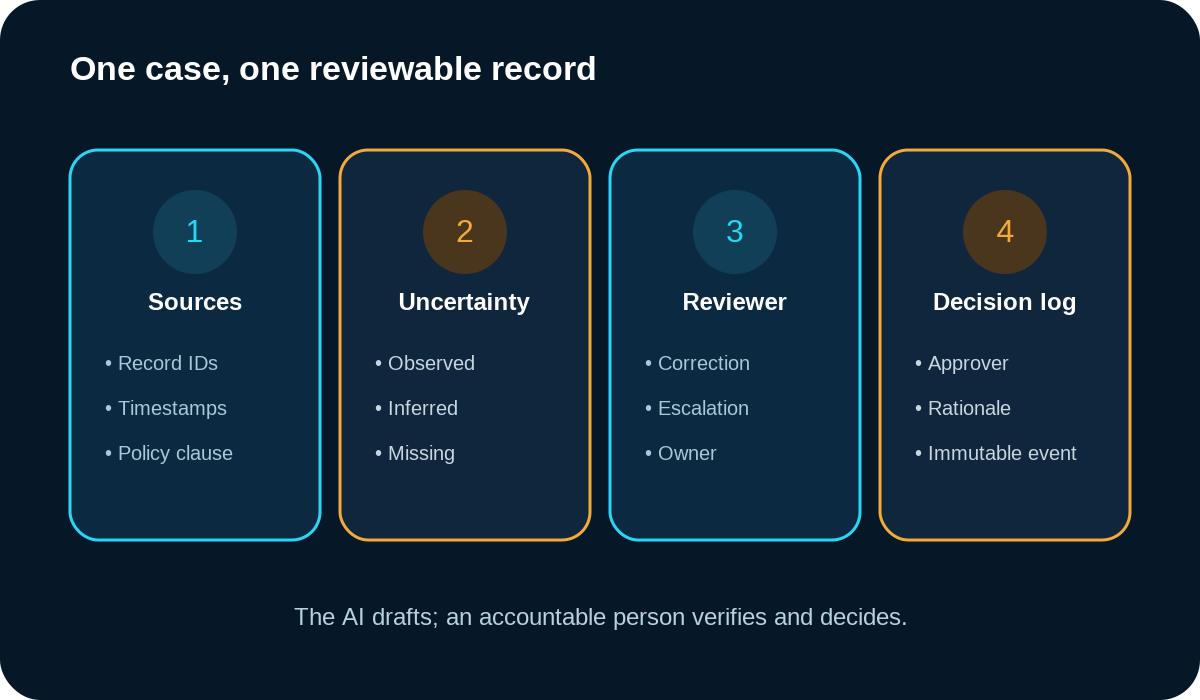
Export only the fields needed for the review and replace unnecessary customer identifiers with stable case references. Example prompt: “For case FC-204, build a chronology from the approved records. For every claim, cite record ID and timestamp; label observed, inferred or missing; list contradictions and the smallest follow-up question. Do not recommend a transaction, change risk status, contact anyone or close the case.”
The expected output is a compact chronology, an evidence table and a question list. That is an illustrative format, not a tested accuracy result. The investigator opens each cited record, corrects model errors and decides whether additional authorized data is necessary.
Step 2: separate review tools from transaction systems
Enforce the boundary in infrastructure, not only in the prompt. Put the agent behind an API gateway that exposes read-only case methods. Deny payment, account-maintenance, messaging and deletion routes at the service identity and network layers. Validate tool parameters, rate-limit requests and record the agent version, prompt, tool call and response metadata in an immutable audit store.
If a reviewer needs to freeze an account, escalate a case or contact a customer, the system should create a human task with the supporting evidence. The authorized employee then performs the action through the existing application. A persuasive agent explanation is never approval.

Step 3: rehearse the kill switch and manual fallback
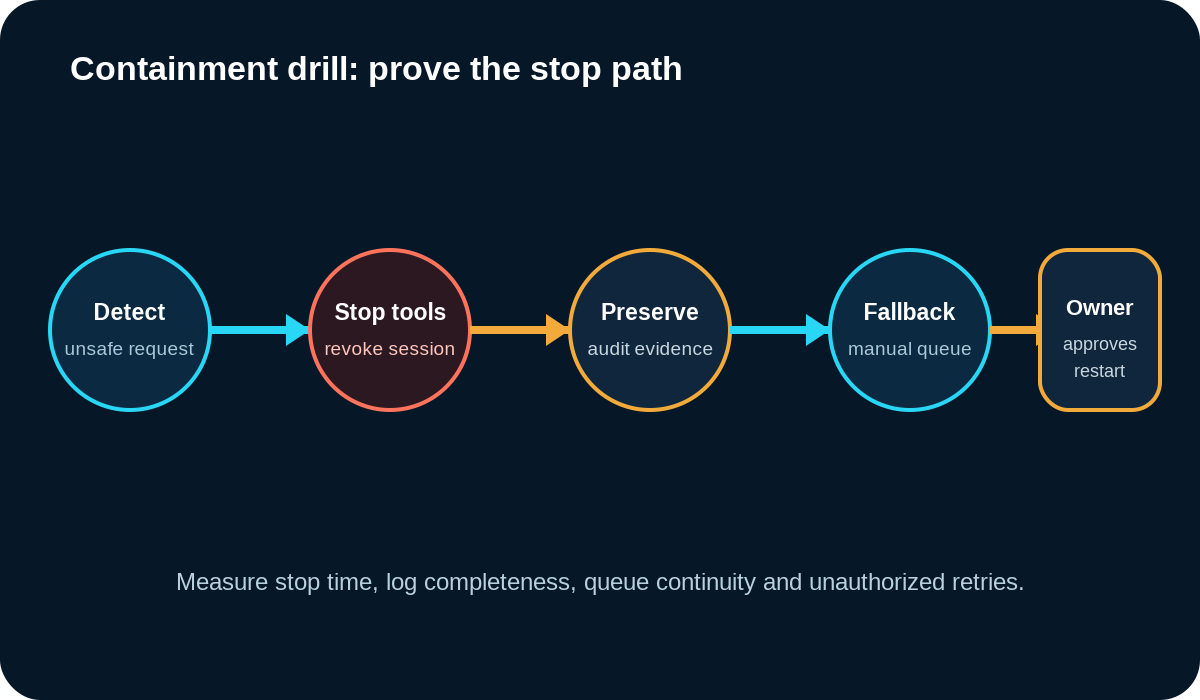
Run a tabletop test before production: present a prompt-injection string inside an approved record, request an out-of-scope action and revoke the agent session during a busy queue. Confirm that tools stop, credentials expire, logs remain available and investigators can continue from the manual case queue. Do not use real customer transactions for the drill.
Track unauthorized tool attempts, reviewer corrections, missing citations, stop time, log completeness and manual-queue recovery. Those measures reveal control quality; they do not establish model safety. Restart only after the service owner and risk owner understand the trigger and approve the new boundary.
Limitations and topic-selection signal
Models can omit records, overconnect unrelated events, accept hostile instructions inside evidence or leak sensitive data to an unapproved service. Case exports can also be incomplete. Keep the agent inside approved enterprise controls, minimize data, require source reopening, monitor for anomalous tool use and preserve a manual path. This workflow supports investigation; it does not determine fraud, satisfy a regulatory duty or authorize a transaction.
Focused Firecrawl research on November 23 returned Reuters' same-day report, the November 20 Bank Policy Institute analysis and the OCC's current supervisory bulletin among prominent results. That combination shows fresh public attention and a concrete operational problem; it does not prove search volume, adoption, DeepSecurity.io traffic or ranking.
Put the insight into practice.
Deep Security helps organizations assess risk, validate controls, and build a practical plan to strengthen their defenses.
Talk with Deep Security