

A practical, vendor-neutral workflow for combining transaction, identity, device and email evidence with AI while keeping holds and payment decisions human-controlled.
Why cyber-signal fraud review is timely
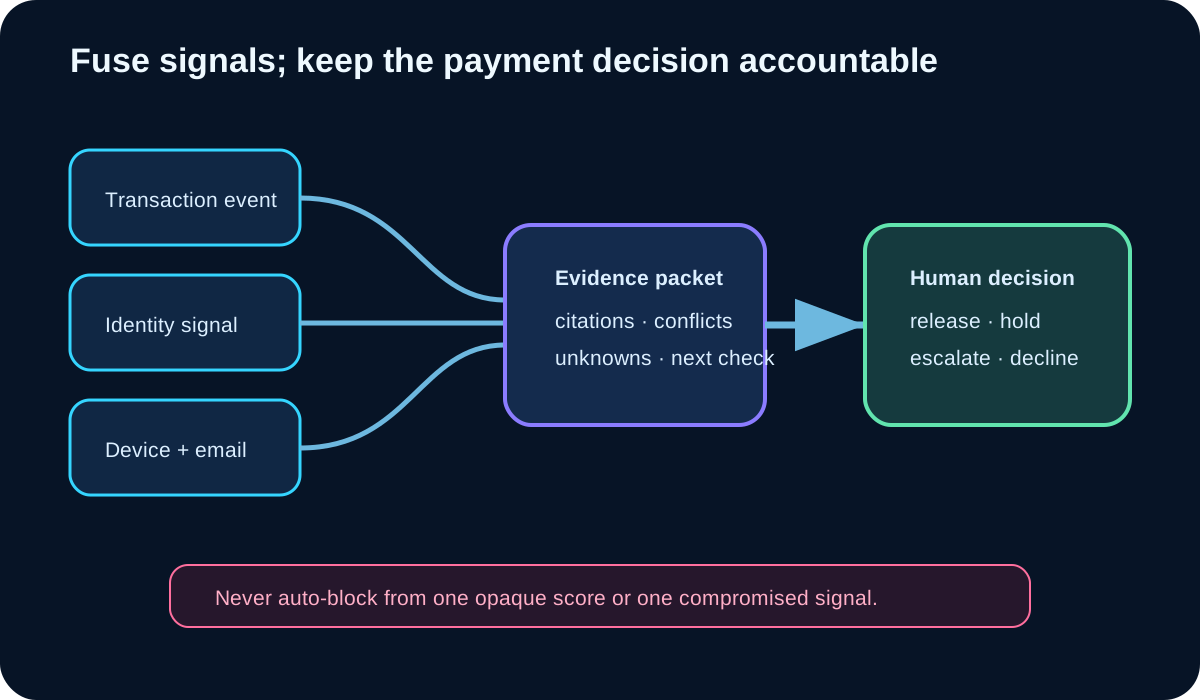
Seceon announced aiFraudGuard360 on November 10, positioning it as a way for financial institutions to combine transaction activity with signals from identity, endpoints and email security. The company says the system can help identify suspicious logins, compromised devices, remote-control activity and related accounts before funds move, and that engagements begin with a proof of concept using an institution’s own data.
Security Boulevard, ITTech Pulse and other outlets carried same-day coverage. Much of that attention traces back to the vendor release, so it is a current-interest signal rather than independent validation. The reviewed pages name no production customer, publish no price and provide no independently measured fraud-reduction result. This article therefore focuses on a vendor-neutral, evidence-first pilot rather than repeating product claims.
Audience, tools and safe operating boundary
This pattern fits fraud operations, security operations, payments, identity, risk and compliance teams. You need authoritative transaction events, authentication and identity logs, device-risk signals, email-security alerts, customer-contact records, current fraud policy, an incident queue and an approved AI service. Start with tokenized historical data and synthetic test cases.
Keep card numbers, bank details, credentials, message content and direct identifiers out of a general-purpose model. Replace them with stable IDs, enforce tenant and purpose boundaries, minimize retention and log every input and output. Separate the evidence workspace from systems that can hold, release, reverse or decline a transaction.

- System of record: payment platform, identity provider and security telemetry.
- AI role: correlate evidence, expose conflicts and draft the next verification step.
- Human role: contact the customer, apply policy and approve a hold or release.
- Stop condition: stale identity, missing transaction state, conflicting customer evidence or unsupported model claim.
Step 1: define an evidence contract
For each source, document owner, event ID, clock, freshness, allowed fields, data classification and reliability. A transaction event should include state and amount bucket, not unnecessary full account details. An identity event should name the authentication method, device ID, session ID and risk reason. Email or endpoint alerts should carry their originating evidence IDs and timestamps.
Write decision policy outside the model. Define which combinations require manual review, what evidence permits customer contact, who may place a hold, maximum hold duration, escalation route and appeal or recovery path. The assistant should not invent those thresholds from old cases.
Step 2: run a staged proof of concept
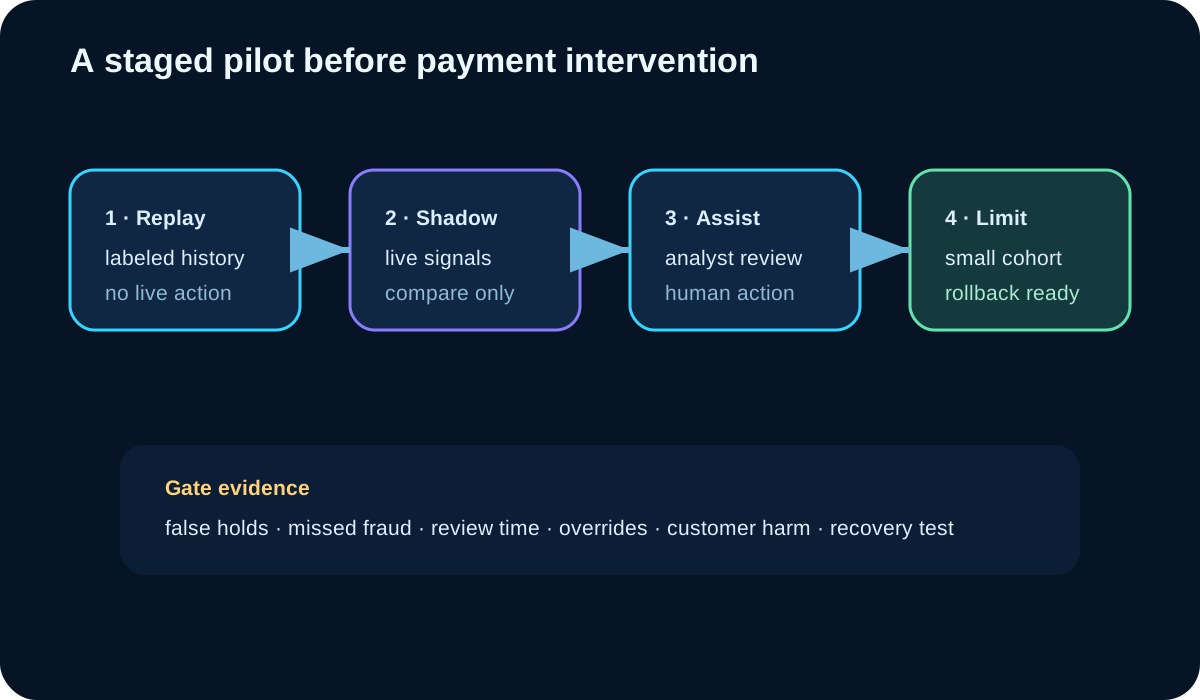
Begin with labeled historical events and known outcomes. Replay them without live action, then move to shadow mode beside the existing process. Compare the proposed evidence packet with analyst decisions, and review false holds, missed fraud, unsupported claims, review time, overrides and customer harm. Only then consider a small assisted-review cohort.
Seceon says its architecture supports on-premises, local-cloud and hybrid deployment and is intended to work alongside existing financial systems. Those are vendor claims, not proof of fit for a specific institution. Validate integration, data residency, latency, failover, evidence export and model governance in the proof of concept.
Step 3: prompt for facts, conflicts and the next check
Give the assistant one bounded case with tokenized identifiers and the applicable policy version. Require separate fields for observed facts, risk signals, contradictions, unknowns, policy references and recommended next verification. The output should never be a bare fraud score.
Example prompt: “For case TX-2041, correlate the attached transaction, identity, device and email-security events. Return observed facts with evidence IDs, signal freshness, contradictions, unknowns, relevant policy clauses and the least harmful next human check. Do not reveal identifiers, infer criminal intent, contact the customer, place a hold, release funds or treat one risk score as proof.”

- Expected output: a cited evidence packet and review queue.
- Reject any field without source and timestamp.
- Show the analyst the underlying evidence beside the summary.
- Treat compromised telemetry as an incident, not merely a low-confidence signal.
Step 4: record the human decision
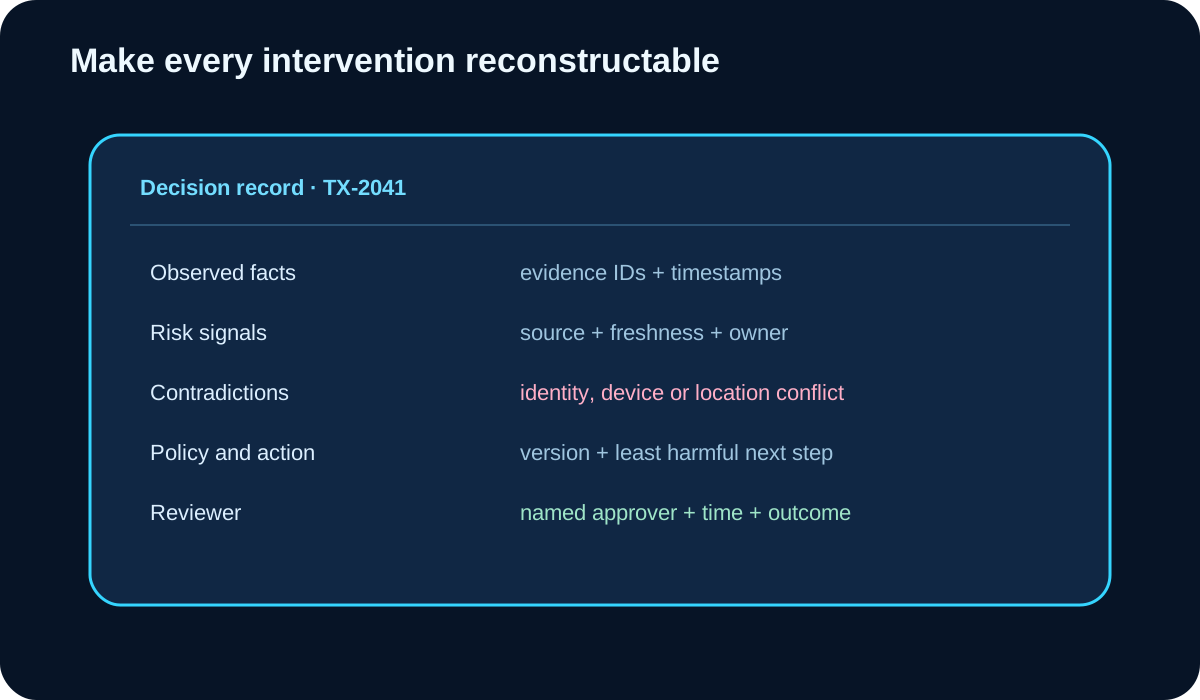
The reviewer checks the cited evidence, applies policy and chooses release, hold, customer verification, escalation or decline. Record the evidence viewed, policy version, reviewer, time, action, reason and eventual outcome. If the analyst overrides the assistant, capture why; that is evaluation evidence, not a silent correction.
A decision record should also preserve recovery. Document how a mistaken hold is lifted, how the customer is contacted safely, and how a false signal is corrected at its source. A fast block is not a successful result if the institution cannot explain or reverse it.
Realistic limitations
AI cannot prove that a transaction is fraudulent, know who is behind a device, guarantee a customer-contact channel is safe or replace regulatory and payment controls. Attackers may poison identity or device signals, and correlated systems can share the same error. Historical labels also reflect past policy and analyst bias.
This article did not test aiFraudGuard360 or any bank system. The product capabilities, nine-agent architecture and deployment options are vendor claims. Pricing, named-customer outcomes and independently measured performance were not available on the reviewed public pages. Buyers should require their own proof of concept, data-protection review and rollback evidence.
Why this topic was selected
A focused Firecrawl search on November 11 for “Seceon aiFraudGuard360 November 10 2026 launch independent coverage” returned Seceon’s dated announcement first, current third-party coverage and the product page in the leading results. A broader November 10 search also returned Security Boulevard coverage in the news results. This shows fresh public attention to cyber-signal-assisted fraud prevention; it does not prove search volume, Google ranking, adoption or product effectiveness. The information gap was a safe pilot design that prevents an opaque model score from becoming a payment action.
Put the insight into practice.
Deep Security helps organizations assess risk, validate controls, and build a practical plan to strengthen their defenses.
Talk with Deep Security