

A practical, human-gated workflow for using AI to assemble equipment logs, manuals and ticket history into a cited diagnostic packet without authorizing repairs.
Why equipment-support evidence is a timely AI use case
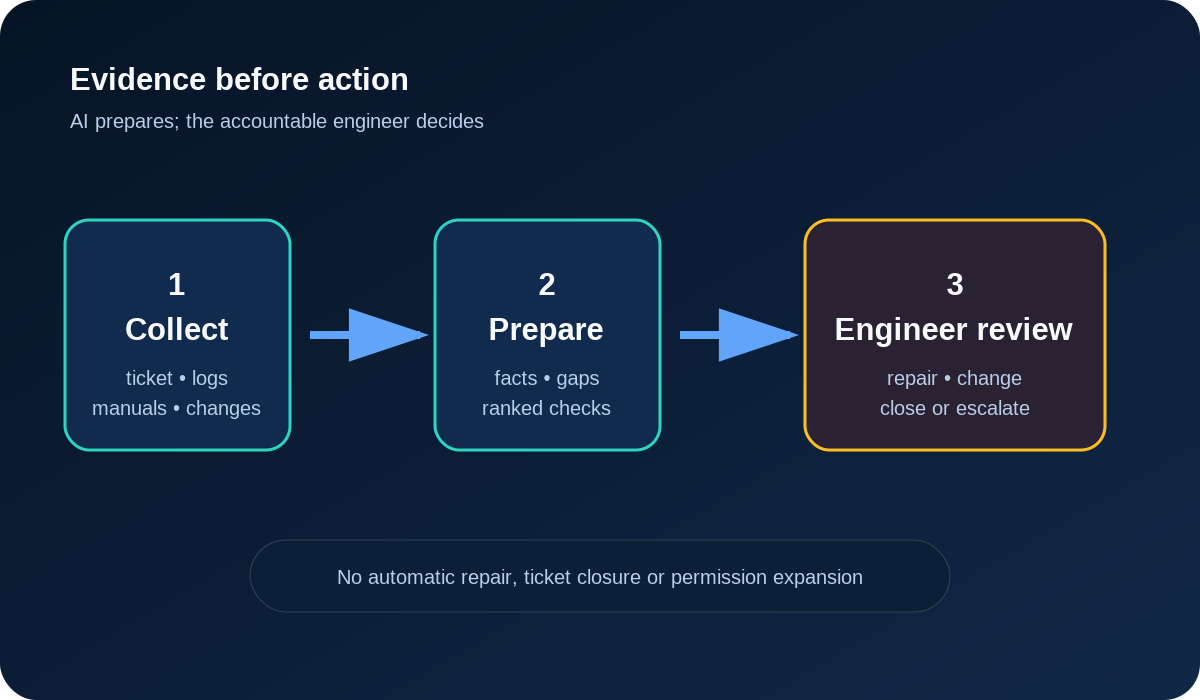
AWS published a November 12 case study describing SWARM, an agentic system Natera built for laboratory operations support. The company says more than 65 daily support tickets had arrived across three Jira queues. SWARM uses a background diagnostics agent and a real-time collaboration agent to assemble information from operational data, manuals and earlier tickets before an engineer begins work.
Natera and AWS report that first response fell from an average 17.4 hours to about eight minutes and that the system generated diagnostics for 96.2% of tickets. Independent same-day coverage correctly notes that coverage is not diagnostic accuracy and that the results were not independently evaluated. The system prepares a troubleshooting report; people still inspect and repair equipment. Deep Security did not test SWARM, Natera’s environment or Amazon Bedrock AgentCore.
Audience, tools and a safe operating boundary
This pattern fits laboratory operations, manufacturing support, facilities teams, managed IT services and any equipment desk where staff repeatedly correlate tickets, logs, manuals and recent changes. A pilot needs an authoritative ticket system, asset inventory, versioned manuals, approved telemetry, an identity broker, a retrieval layer, audit logging and an organization-approved model or agent runtime.
Start with one equipment family and one non-safety-critical ticket class. The assistant may retrieve approved records, align timestamps, identify missing evidence and draft a report. It may not control hardware, change calibration, order parts, close tickets, reveal patient or customer data, contact a vendor or broaden its own permissions. Natera says patient-identifiable information is excluded from its searchable index and model; your implementation needs its own data classification and enforcement.

- System of record: ticketing, asset management, telemetry and controlled document storage.
- AI role: assemble cited facts, ranked hypotheses, conflicts and next read-only checks.
- Human role: validate the diagnosis, enforce safety procedures, approve repair and close the ticket.
- Stop condition: missing manual, stale asset version, sensitive data, unsupported claim or requested write action.
Step 1: make the evidence contract more important than the prompt
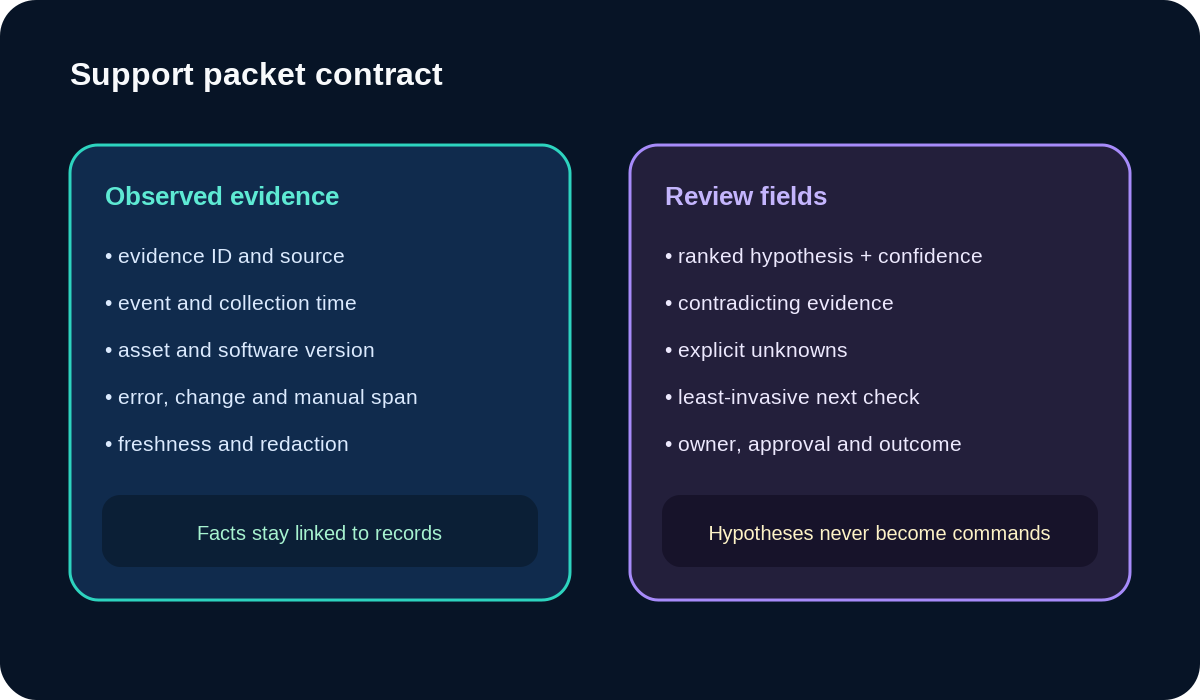
Normalize each record into source, evidence ID, asset ID, software or firmware version, event time, collection time, observed fact, document revision, sensitivity and retention class. Keep the full record in the authoritative system and give the model only the minimum excerpt. An absent log, missing manual or failed query must remain unknown rather than being converted into a confident diagnosis.
Use short-lived identity, least-privilege roles, private network paths and a secrets manager around retrieval. The AWS case says Natera used OIDC and temporary AWS credentials, IAM roles, VPC endpoints and Secrets Manager rotation. Those are design examples, not proof that a copied architecture will satisfy your risk model. Log every retrieval, tool argument, result hash, model run and reviewer.
Step 2: request a cited diagnostic packet
Provide a bounded ticket window, current asset identity, approved manuals and narrow read-only tools. Ask for observations before interpretations and require contradictions and unknowns beside each hypothesis. Calculate safety limits and maintenance rules outside the model.
Example prompt: “For ticket LAB-184, use only records EQ-220 through EQ-268 and the approved read-only retrieval tools. Return a cited timeline, observed facts, up to three possible causes, evidence against each cause, missing records, and the least-invasive next check. Cite an evidence ID and timestamp for every factual line. Do not control equipment, invent a manual step, reveal restricted data, order parts, contact a vendor, close the ticket or describe a repair as completed.”
- Expected output: a compact packet with evidence links, not an autonomous work order.
- Reject any fact without an evidence ID and any instruction without a current manual revision.
- Show original records beside the summary during engineer review.
- Route conflicting safety instructions to the equipment owner.
Step 3: evaluate missing knowledge before changing the model
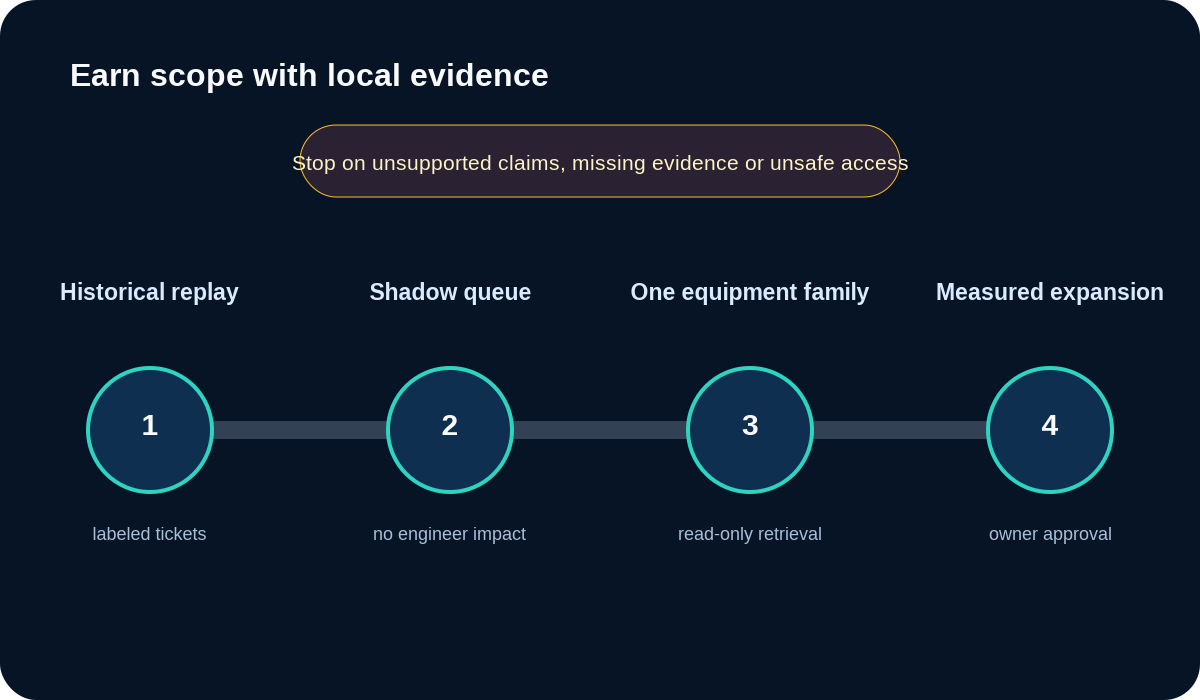
Replay resolved tickets and measure evidence recall, unsupported claims, wrong asset matches, unsafe suggestions and reviewer correction time. Natera’s case says adding missing vendor manuals improved accuracy for one instrument family from 71% to 75% without a model change. That company-reported example is a reminder to inspect knowledge quality before tuning prompts or models.
Then run in shadow mode beside the established desk. Test stale manuals, duplicate tickets, clock drift, conflicting technician notes, partial outages, poisoned document text and unavailable tools. A safe rollback disables the assistant and returns staff to the current runbook; it does not ask the same system to repair itself.
Step 4: make the engineer handoff operational
The final packet should name the ticket, asset and version, evidence window, observations, competing hypotheses, confidence basis, contradictions, missing records, proposed verification, safety boundary and responsible owner. The engineer must be able to reject the packet or request one more bounded query without copying prose into an instrument console.
After a human-approved repair, collect fresh telemetry and compare it with a predefined recovery condition. Record who performed the work, which procedure revision was used and what changed. The assistant may summarize the after-state; only the accountable owner should declare the equipment restored or the ticket closed.

Realistic limitations
A polished packet cannot compensate for an undocumented asset, incomplete telemetry or a wrong manual. The assistant can confuse similar instruments, overvalue frequent past fixes, expose sensitive operational data or make unsafe steps sound routine. Retrieval controls reduce risk but do not validate physical safety, regulatory requirements or repair quality.
The reviewed sources do not publish independent benchmarks, full costs, false-diagnosis rates or complete security test results. The reported timing, coverage and accuracy changes belong to Natera’s environment. Treat them as a current implementation signal, not a transferable performance promise.
Why this topic was selected
A focused Firecrawl search on November 13 for “Natera SWARM lab operations AI Bedrock AgentCore November 2026” surfaced AWS’s November 12 primary case and same-day independent coverage. Both addressed a concrete support workload and the independent article highlighted the distinction between ticket coverage and diagnostic accuracy. That search placement is a current-attention signal, not proof of Google rank, search volume or DeepSecurity.io traffic.
Put the insight into practice.
Deep Security helps organizations assess risk, validate controls, and build a practical plan to strengthen their defenses.
Talk with Deep Security