

Use AI to organize an eMudhra trust review across browsers, servers, APIs, containers and mobile clients while keeping every verification path distinct.
Why one compromised CA branch becomes many operational questions
Mozilla reported that it received notice on October 17 that private keys associated with eight eMudhra intermediate certificates had been compromised. Mozilla said those keys could be used to issue fraudulent HTTPS certificates; an attacker would still need a position to intercept traffic to impersonate a site. Cloudflare published its response on October 20 and described affected trust paths across browsers, operating systems, proxies, origin connections, applications, containers and certificate-based authentication.
The incident does not mean every connection was intercepted. Cloudflare said its review had not identified active exploitation on its services, and independent coverage noted no evidence in Certificate Transparency logs before revocation. The practical problem is narrower: which of your clients and services still trust an affected chain, and which vendor update or configuration change proves that they no longer do?
Focused Firecrawl research on October 25 placed Cloudflare's analysis first, Mozilla's response prominently, and SecurityWeek's October 21 coverage among the leading results. That is a current-attention signal, not proof of search volume, exposure in a specific organization or DeepSecurity.io ranking.
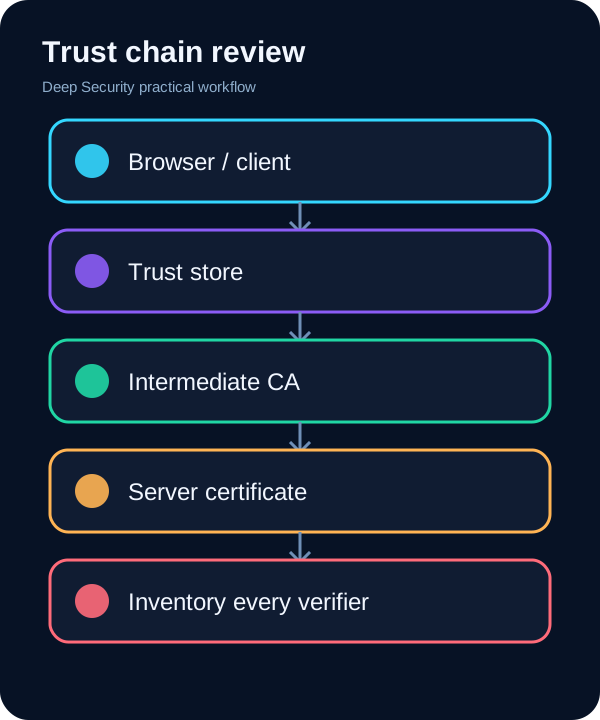
1. Build a verifier inventory before asking AI to summarize
Start with approved exports from endpoint management, browser management, mobile-device management, container registries, software composition analysis, API gateways, load balancers, proxies and application inventories. For each path record the asset owner, runtime, version, trust-store source, update channel, certificate-pinning behavior, mutual-TLS use and business service.
Use an approved assistant only on sanitized records. Example prompt: ‘Using only this inventory, group assets by verifier and trust-store source. Preserve every asset identifier. Mark missing runtime, version, owner or update evidence as unknown. Do not infer that a browser result covers a service, container or mobile application.’
The output should be a review queue, not a verdict. Validate versions and trust behavior with the endpoint, package manager, image manifest, runtime documentation or vendor-provided test. Never place private keys, live certificates containing sensitive identifiers, tokens or unredacted customer traffic in a prompt.
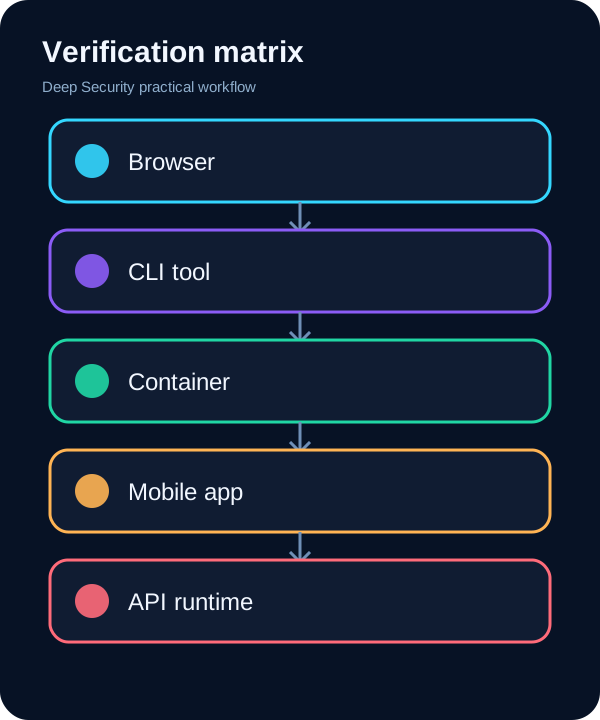
2. Test each real execution path independently
A desktop browser, curl, Java runtime, Python application, mobile client and container image can rely on different trust stores or update mechanisms. A green browser check therefore does not prove a background worker, VPN client or API integration is protected. Cloudflare explicitly warned that an SDK update may not change the underlying trust policy.
Run the applicable vendor test from the same network path and runtime the workload uses. Record command, version, timestamp, result and evidence location. If a client fails closed after an update, investigate the certificate chain and configuration; do not ‘fix’ the symptom by disabling certificate validation.
The expected result is a matrix of protected, vulnerable, not applicable and unknown. Unknown is a valid incident state. Assign it to an owner with a deadline instead of letting the assistant collapse missing evidence into an optimistic summary.

3. Apply authoritative updates and configuration changes
Mozilla said OneCRL blocked the affected intermediates for standard Firefox configurations and released Firefox 158.0.1 plus ESR updates for custom configurations. Its October 21 update added Firefox for Android 158.0.2 after some clients did not immediately apply the bundled blocklist at startup. Mozilla also referenced NSS 3.131.1 for applications using its trust store.
Cloudflare listed product-specific actions, including updating Cloudflare Tunnel to 2026.10.2, reviewing mutual-TLS trust stores and uploaded CAs, checking origin certificates and validating container and application dependencies. Those are source-specific examples, not a universal patch list; follow the vendor responsible for each verifier.
Change through normal approval and rollback procedures. Preserve the before-state, package or policy change, deployment evidence and after-test. An assistant may format the change record, but it should not select production exceptions or operate certificate controls.
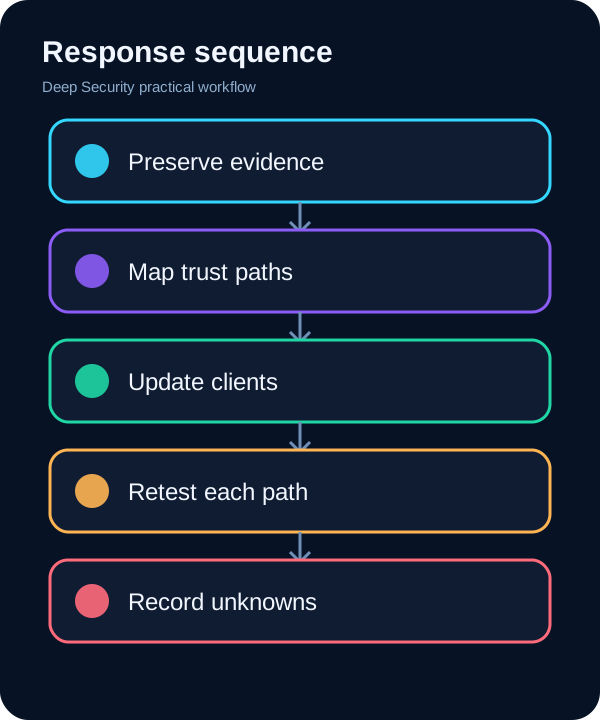
4. Hunt carefully without inventing interception
Review proxy, DNS, TLS inspection, endpoint and application logs for anomalies tied to the affected period and your actual assets. Look for unexpected certificate chains, issuer changes, validation errors, unusual network intermediaries or applications that disabled verification. Use source timestamps and normalized fields so the assistant cannot silently merge different events.
Suggested prompt: ‘Create a timeline from these sanitized records. Cite the exact record ID for every event. Separate certificate-validation failures, configuration changes and network anomalies. Mark any claim of interception unsupported unless the record contains the observed chain or equivalent authoritative evidence.’
A suspicious error is not proof of a forged certificate. Escalate with packet capture, certificate artifacts, endpoint telemetry or provider evidence where available. Keep the investigation scoped to owned systems and approved logs.
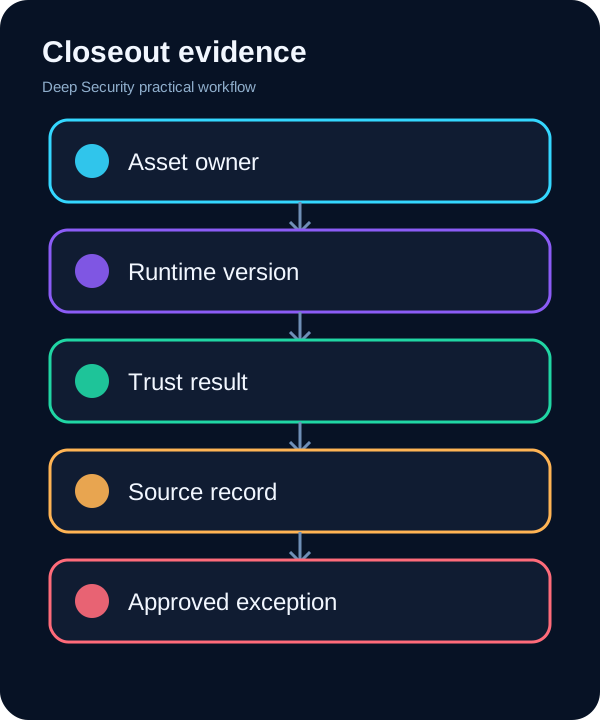
5. Close by verifier, not by announcement
Set a closure rule for every inventoried path: owner identified, update or compensating control applied, real runtime retested, logs reviewed for the defined period, exception approved and monitoring retained. Re-run tests after base-image rebuilds, mobile updates and appliance maintenance.
Have a second reviewer sample the highest-impact paths and every exception. Compare the assistant's matrix with raw inventory counts so omitted rows are visible. Keep unresolved third-party or embedded clients open until their maintainer supplies an authoritative fix or the connection is isolated.
The lasting output is a reusable certificate-trust register connected to patch and asset management. That makes the next CA incident a reconciliation problem instead of a scramble to guess which browser check represents the business.

A compact handoff for operations
Give operations a one-page status with total paths, protected paths, open unknowns, owners, deadlines and evidence links. State explicitly that public reports did not establish exploitation in your environment and that AI organized supplied evidence rather than testing trust itself.
- Keep browser, runtime, container, mobile and appliance results separate.
- Never disable verification to make an error disappear.
- Retain unknowns and exceptions until an accountable reviewer closes them.
Put the insight into practice.
Deep Security helps organizations assess risk, validate controls, and build a practical plan to strengthen their defenses.
Talk with Deep Security