

Turn email alerts, user reports, headers, URL checks and identity telemetry into a cited incident packet without letting AI contain mailboxes or invent a verdict.
Why email triage has fresh operational attention
Palo Alto Networks described new Cortex Advanced Email Security capabilities on November 5: a Threat Inbox that combines detections and user reports, AI-generated investigation summaries, QR-code analysis, and rendering or vision analysis for visually deceptive messages. These are vendor claims about its product, not results tested by Deep Security.
The announcement arrived within a broader 2026 focus on AI-assisted phishing and visual evasion. Hoxhunt's 2026 report surfaced prominently in current searches and discusses AI indicators in reported phishing plus QR-code and other nontraditional lures. That report uses its own network and methodology, while the Palo Alto launch is release-led; together they establish active public attention to the workload, not traffic, adoption or guaranteed detection quality.
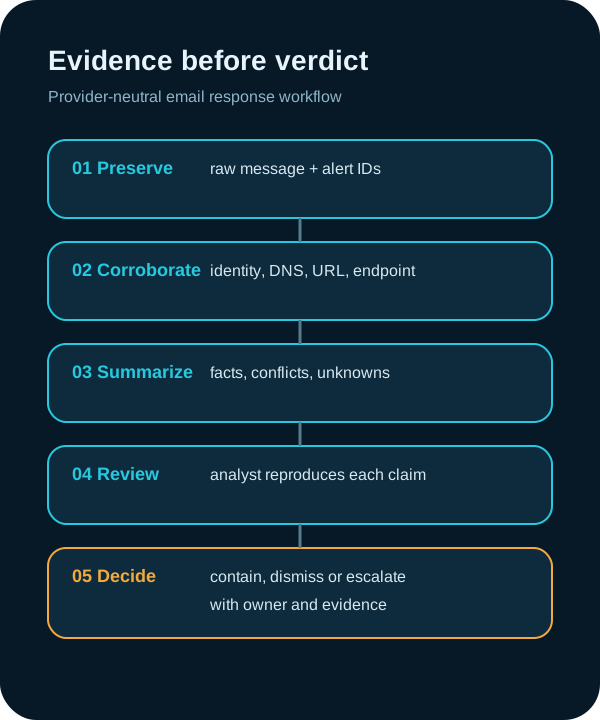
The practical use case is provider-neutral: combine a reported message, security-gateway alert, headers, URLs, attachments, identity activity and endpoint signals into one evidence packet that an analyst can reproduce. The model organizes the case; authoritative systems determine the facts.
- Problem: alerts and user reports arrive in different tools while visual lures hide context from text-only review.
- Audience: SOC analysts, Microsoft 365 or Google Workspace administrators, MSPs and incident responders.
- Output: a cited case packet with observed facts, corroboration, inference, unknowns, owner and next action.
Collect a minimal, read-only evidence bundle
Start with the original message or a forensically useful export, not a screenshot. Preserve message and alert IDs, normalized headers, sender and reply-to values, authentication results, recipient scope, body and attachment hashes, embedded URLs, QR-code destination when safely extracted, report time and collector. Keep the raw item in the mail or evidence system.
Add corroborating facts from authoritative sources: DNS and registration data, approved detonation results, secure-web-gateway events, identity sign-ins, mailbox rules, endpoint telemetry and related recipient reports. Record query time, time zone and evidence ID. Do not put live credentials, session cookies, personal mailbox content or unrestricted tenant tokens into an assistant.
Run the assistant in a separate read-only workspace. If links or attachments require inspection, use the organization's established sandbox and URL-analysis process. Never ask a general model to visit a suspicious destination from an analyst workstation.

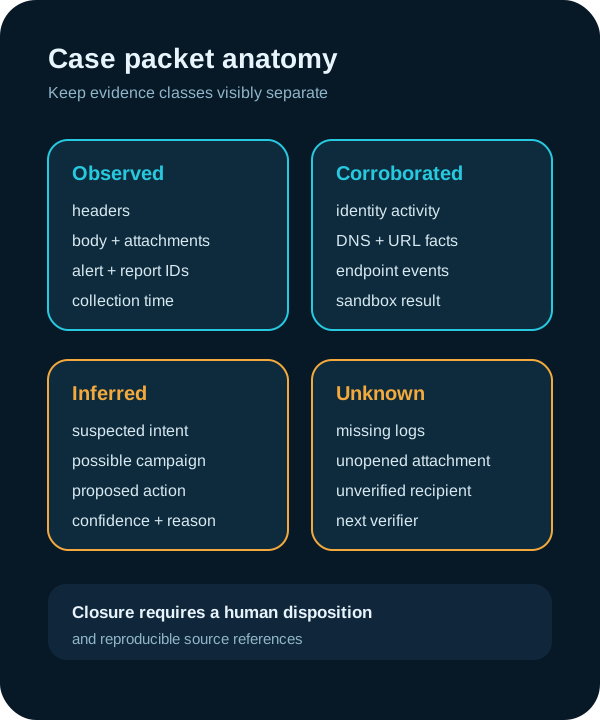
- Message facts: headers, body, hashes, URLs, QR destination and collection time.
- Corroboration: identity, endpoint, DNS, proxy, sandbox and recipient evidence.
- Boundaries: no live mailbox write access, no credential reset, no URL browsing and no automated purge.
Prompt for evidence classes, not a confident story
Give the model a closed schema that keeps observed, corroborated, inferred and unknown fields separate. Require a source ID for every fact and a confidence reason for every inference. A fluent narrative without traceable evidence is not an incident artifact.
Example prompt: “Using only the supplied evidence rows, create an email incident packet. Cite the source ID for every factual statement. Separate observed message facts, corroborating telemetry, inferences and unknowns. List affected recipients only when directly supported. Identify conflicts and the next safe verifier. Do not visit links, execute attachments, infer compromise from message content alone, purge mail, reset credentials or close the case.”
The expected output is a table plus a short analyst handoff: message identity, suspected technique, recipient scope, corroborating activity, unknowns, proposed containment options and the evidence required for each. It is an illustrative review aid, not a detection result or proof of compromise.
Treat QR codes and visual lures as separate evidence
A QR code is an image that may encode a URL, not proof that the destination is malicious. Preserve the original image, extraction method and decoded value, then route the value through the same approved reputation, redirect and sandbox checks used for other URLs. Record every redirect and observation time.
Visual rendering can help an analyst notice brand impersonation, urgency, mismatched domains and hidden instructions. It can also overinterpret layout or miss content that changes by device, geography or login state. Keep rendered observations separate from transport headers and identity telemetry.
If a recipient scanned the code, pivot to identity and endpoint evidence through the incident process. Do not assume that a scan caused a successful sign-in, token theft or malware execution.

Route the reviewed packet through a human gate
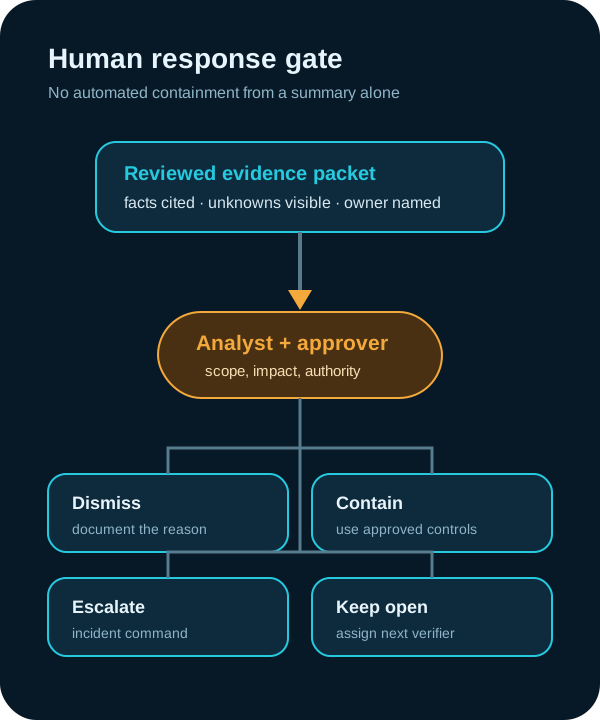
An analyst reproduces the packet against the source systems, then chooses the approved path: dismiss with evidence, keep open for collection, escalate to incident command, or contain through established mail, identity and endpoint controls. A second approver should review disruptive tenant-wide actions.
Verify results independently. A mail purge should have a provider audit event and post-action search; a credential reset should have an identity event and revoked-session check; an endpoint action should have a current device observation. Store who approved the action, why, when and what proves completion.
Measure evidence coverage, uncited statements, duplicate reports grouped correctly, time to a reproducible handoff, analyst overrides, missed recipient scope and unsafe action suggestions. Set thresholds from your own baseline; public sources reviewed here do not provide a universal target.
Limitations and safe boundaries
Email evidence can be incomplete or altered by forwarding, secure-link rewriting, mobile clients, privacy controls and retention. Reputation can change after collection, and absence of an alert does not prove absence of activity.
Models can invent header relationships, collapse conflicting timestamps, overstate brand impersonation or treat a decoded QR URL as malicious without corroboration. They may also expose sensitive content if the workspace is not governed.
This workflow does not replace an email-security gateway, sandbox, identity provider, endpoint telemetry, incident runbook or experienced responder. It improves the handoff only when every material statement remains traceable to authoritative evidence.
Put the insight into practice.
Deep Security helps organizations assess risk, validate controls, and build a practical plan to strengthen their defenses.
Talk with Deep Security