
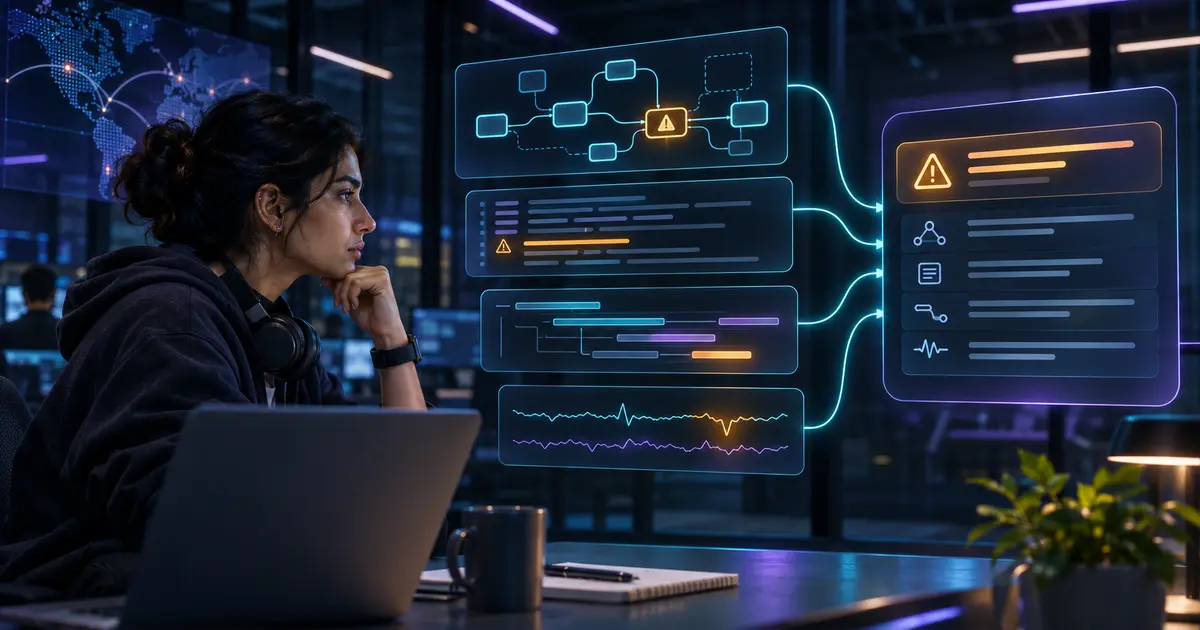
Build a cited AI-assisted DevOps incident brief from alerts, logs, traces and change context while keeping remediation under human control.
What Circle K's fresh case study makes practical
On November 2, AWS and a Circle K cloud engineer published a case study describing an Amazon Bedrock-based triage system that gathers context after a Grafana alert and sends a structured summary to Slack. Circle K reports that its mean triage time fell from 45–60 minutes to under 15 minutes, based on its internal incident-response metrics. That is a customer-reported result, not an independent benchmark or a result Deep Security reproduced.
The Agentic Digest independently highlighted the deployment on November 3 and drew the useful boundary: agents collect logs, service health and runbook context, while engineers decide what to do. Search placement and multiple recent mentions show current public attention; they do not prove search volume or that the same design will work in another environment.
For managed IT teams, cloud operators and software owners, the transferable use case is an evidence-first incident brief. The goal is not autonomous remediation. It is to reduce the time spent opening five tools while preserving the evidence and uncertainty a responder needs.
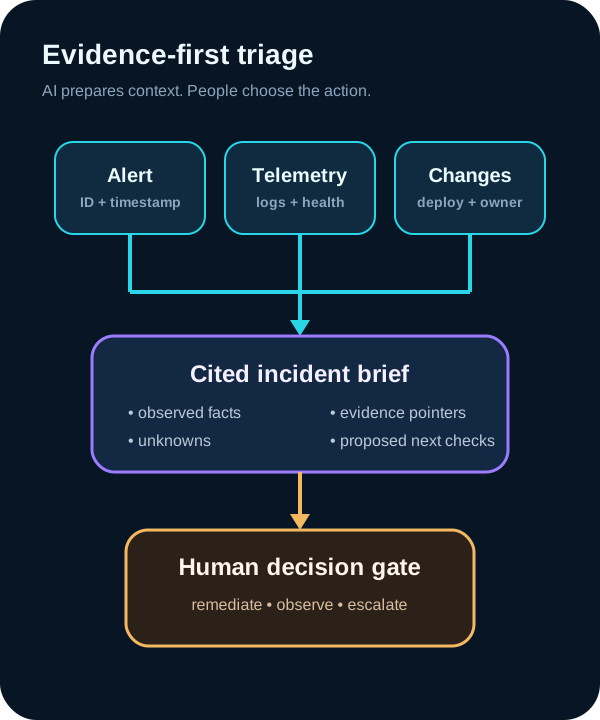
- Problem: an alert arrives without the deployment, ownership and telemetry context needed to act.
- Tools: alert webhook, read-only log/trace/health APIs, service catalog, change history, runbook store and an approved model endpoint.
- Output: a cited brief with observed facts, hypotheses, unknowns, next checks and a named owner.
Collect context through read-only connectors
Start with one alert family and one service. Capture the alert ID, first-seen time, affected resource, threshold and original payload. Then query a bounded window for application logs, traces, container or function health, recent deployments, configuration changes and the current service owner. Preserve raw records in the systems of record and pass the model stable pointers or minimized excerpts.
The Circle K design gathers CloudWatch logs, OpenSearch traces and ECS task status, and it also checks internal runbook context. Your equivalent may be Azure Monitor, Google Cloud Operations, Datadog, Splunk, Kubernetes events or a ticketing system. Keep the connector identity separate from the on-call engineer and deny write, restart, scaling, deployment and secret-read permissions.
Normalize timestamps, resource IDs and environment names before prompting. Record query bounds and truncation so a missing event is not silently treated as proof that nothing happened.

- Use an allowlist of data sources and fields.
- Redact credentials, customer payloads and regulated data before model access.
- Log every connector call and keep the original alert unchanged.
Ask for a brief that preserves uncertainty
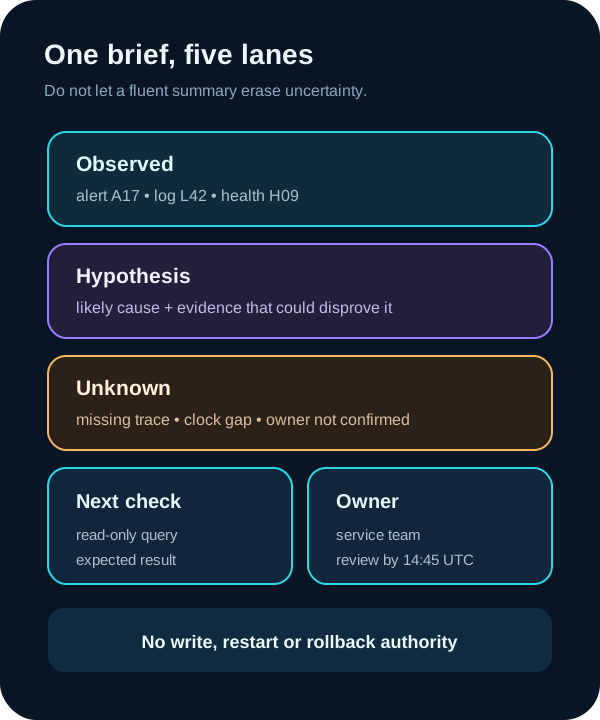
Give the model a strict schema rather than an open-ended request for root cause. Require every factual statement to cite an alert, query or document ID. Label each line observed, inferred or unknown, and ask what evidence would disprove the leading hypothesis.
Example prompt: “Using only the supplied evidence rows, produce an incident brief with: observed facts and source IDs; a ranked hypothesis list with supporting and contradicting evidence; missing data; two read-only next checks; affected service and owner; and an explicit confidence rationale. Do not call an API, restart a service, change capacity, roll back a deployment or claim root cause when evidence is incomplete.”
The expected output is an illustrative working brief, not a diagnosis. A responder should be able to open every source pointer and see which conclusion would change if a late log or deployment record arrives.
Stop at a human remediation gate
Route the brief to the named service owner and the on-call responder. They confirm the incident, decide whether to investigate, observe, escalate or execute an approved runbook, and record the reason. If a rollback or restart is selected, run it through the existing deployment or change-control path rather than through the model connector.
Use a second-person check for high-impact actions: one responder proposes the action and another confirms scope, rollback and customer impact. The assistant can surface the relevant runbook section, but it should not convert a suggestion into a production command.
Store the final human disposition beside the AI brief. That creates feedback for later evaluation without pretending the model's first hypothesis was correct.

Pilot with seeded incidents and explicit acceptance rules
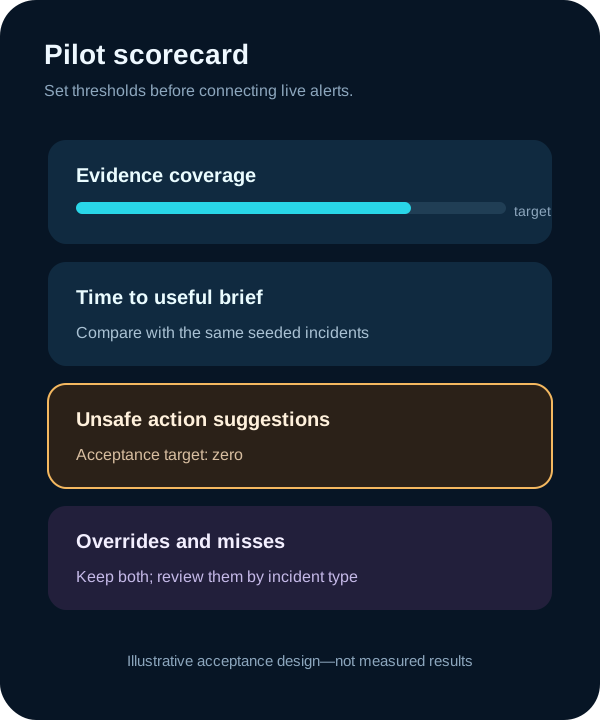
Replay redacted historical incidents and tabletop cases before attaching a live alert. Include a real outage, a noisy but harmless alert, a bad deployment, a dependency failure, missing telemetry, clock skew and a case where the leading hypothesis is wrong. Keep the correct evidence map hidden from the model and score the returned brief against it.
Measure time to a usable brief, evidence coverage, uncited claims, false root-cause certainty, missed contradictions and unsafe action suggestions. Track responder overrides by incident type. Set failure thresholds before the pilot; do not adopt Circle K's reported time as your target without measuring your own baseline.
Promote one alert family at a time. If the assistant cannot consistently expose missing evidence or stays accurate only when logs are short, narrow the source set or keep it in tabletop use.
Limitations and failure modes
A fluent summary can still miss a quiet dependency, merge two environments or mistake correlation for causation. Truncated logs, clock drift, sampling, encrypted traces and stale service ownership can all distort the brief. An attacker may also place misleading text in logs or tickets, so treat retrieved content as untrusted data and keep tool instructions outside it.
Model latency, token cost and regional model availability can make the workflow slower or more expensive during a broad incident. Design a deterministic fallback that gives responders direct links to the original tools when the assistant is unavailable.
This pattern is most useful for context assembly. It does not replace monitoring, incident command, runbooks, change control or an engineer who understands the service.
Put the insight into practice.
Deep Security helps organizations assess risk, validate controls, and build a practical plan to strengthen their defenses.
Talk with Deep Security