

A practical method for redesigning a customer-impacting process around AI agents while keeping security, privacy, compliance, approval and rollback controls intact.
Why governed agentic workflow redesign has current attention
SiliconANGLE reported on November 14 that AT&T has nearly 500 agentic workflows in production and plans to expand that number. The article attributes its figures—including about 45 billion AI tokens per day and more than one million monthly transactions—to AT&T executive Luke Corbin. It describes a fiber-order change process in which agents removed portions of a manual ticket-retrieval and record-update loop. These are company claims reported by an independent outlet, not results Deep Security tested.
The useful lesson is the operating model, not the scale claim. SiliconANGLE says customer-impacting workflows pass through AT&T’s Business Agent Foundry for security, privacy and compliance review, begin with human oversight and are continuously monitored. AT&T’s November 2025 primary description of Ask AT&T Workflows adds that actions are logged and handoffs enforce data isolation, retention policy and role-based access. That older page supplies product context; the current-attention signal is the November 14 coverage.

Audience, tools and the impact boundary
This pattern fits operations leaders, service owners, IT administrators, security architects, privacy teams and internal automation groups redesigning customer support, provisioning, order changes or network-service work. A pilot needs an authoritative process owner, current process evidence, system and data inventories, a case-management tool, an approved model, read-only retrieval, a policy engine or deterministic rules, logging and a safe test environment.
A personal assistant that drafts or summarizes is not the same risk class as a workflow that changes a customer record or service. The assistant may map events, propose a next step and prepare a review packet. It may not change production state, message a customer, waive a control, decide compliance, expose regulated data or approve its own output.
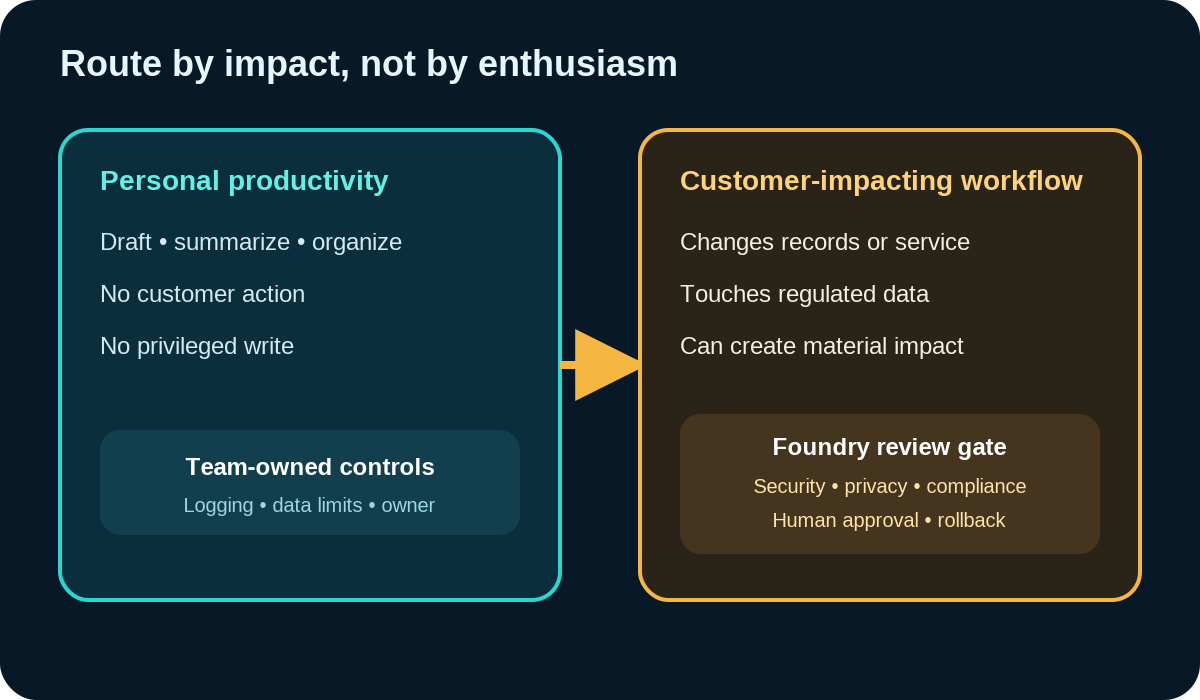
- System of record: tickets, orders, identities, service inventory and approved policy remain authoritative.
- AI role: classify, retrieve, compare, draft and recommend within a named evidence window.
- Human role: approve customer impact, exceptions, policy changes, rollout and recovery.
- Stop condition: missing owner, sensitive data outside scope, conflicting evidence or an unapproved write.
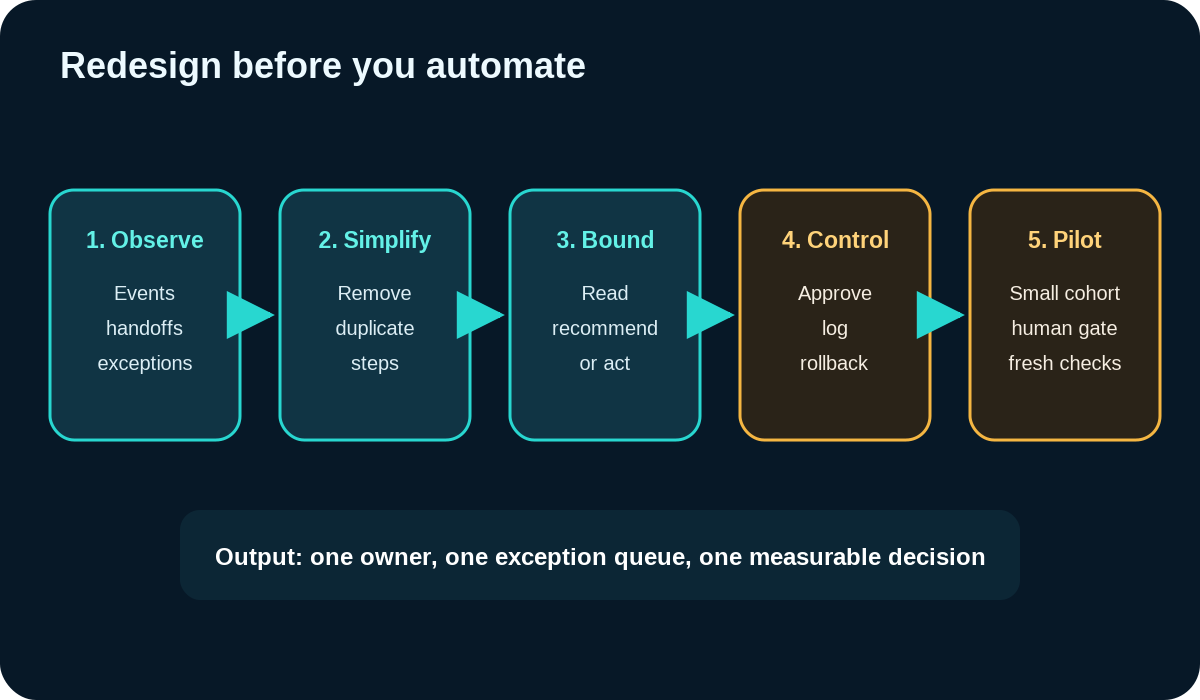
Step 1: map the current process before naming an agent
Choose one narrow outcome, such as correcting a fiber installation order or reconciling a service update. For 20 to 50 recent cases, record trigger, inputs, system touched, handoff, wait time, exception, decision owner and final evidence. Include failed and escalated cases; a happy-path diagram hides the work an agent is most likely to mishandle.
Mark each step as required control, useful judgment, mechanical transfer, duplicate entry or obsolete workaround. Remove unnecessary work first. If the process is contradictory or lacks an owner, adding an agent will make the ambiguity faster rather than make the workflow reliable.
Step 2: design one bounded agent contract
Write the contract as if a new operator must follow it without tribal knowledge. State allowed records, tools, time window, action class, fields that must never leave their source, required citations, confidence states, exception route, timeout and rollback owner. Use deterministic code for permissions, schema validation, totals, routing and policy checks; use the model for interpretation and drafting.
Example prompt: “For service-change cases SC-210 through SC-245, use only order, inventory and policy records named in the case. Return the current state, missing evidence, proposed next step, affected customer field, policy rule, risk class and reviewer. Cite a record ID and timestamp for every fact. Do not change an order, contact a customer, reveal restricted fields, approve an exception or mark the case complete.”
- Expected output: a structured review queue, not an autonomous transaction.
- Reject any recommendation without a source, owner and reversible next step.
- Send missing or contradictory evidence to an exception lane.
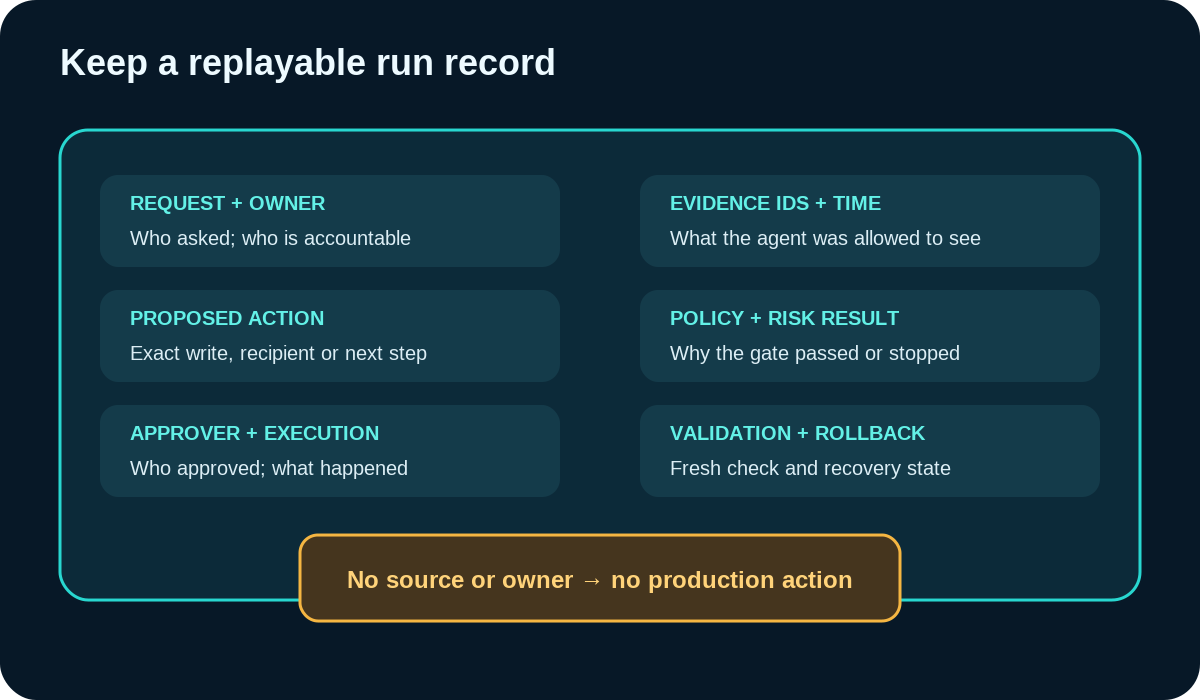
- Log the input set, prompt version, tools called, output and reviewer correction.
Step 3: put customer impact behind a real gate
Separate suggestion from execution. A reviewer should see the before state, proposed change, policy result, affected systems, customer impact, rollback and validation query in one packet. The execution service—not the model—rechecks identity, authorization and record version immediately before the write.
Start in shadow mode, then allow only low-impact reversible actions for a small cohort. A model’s self-reported confidence is not an approval signal. Use observed error classes, reviewer agreement, policy violations, rollback success and unresolved exceptions to decide whether the action class can expand.

Step 4: monitor outcomes, drift and reversibility
Measure the business outcome and the control outcome together: completed cases, exception aging, rework, policy stops, customer complaints, human corrections, unauthorized tool attempts and rollback time. Compare against the pre-agent baseline using the same case definition. Do not replace quality with a single speed or token metric.
Keep a replayable record for every run and sample both successful and failed cases. Pause when data shape, policy, system version or customer population changes. A workflow that was acceptable last month may drift after an upstream form or authorization rule changes.
Realistic limitations and why this topic was selected
An agent cannot repair a contradictory policy, know an unlogged exception, prove that a customer outcome improved, or decide what risk the business should accept. It can leak data across cases, repeat a stale rule, optimize the wrong metric, hide uncertainty behind fluent prose or create a brittle chain of agents. Process ownership, least privilege, privacy review, deterministic authorization, human approval and tested rollback remain necessary.
A focused Firecrawl search on November 16 for “AT&T agentic AI workflows production fiber installation November 2026” returned SiliconANGLE’s November 14 report first and surfaced AT&T’s official Ask AT&T Workflows material in follow-up searches. The dated independent report plus primary implementation detail established current attention and site relevance. Search placement is not proof of traffic, Google rank, adoption or DeepSecurity.io performance.
Put the insight into practice.
Deep Security helps organizations assess risk, validate controls, and build a practical plan to strengthen their defenses.
Talk with Deep Security