

A practical workflow for connecting services, deployments, alerts and incident evidence into a typed graph before asking AI to rank root-cause hypotheses.
Why ontology-driven incident triage has current attention
InfoQ published November 13 coverage of Netflix’s ontology-driven observability work, renewing attention on a detailed Netflix TechBlog post from October 16. The primary source falls inside the requested 30-day context window rather than the preferred seven days. It describes a system that connects applications, alerts, deployments, incidents, ownership and other operational facts in a standards-based graph used by specialist root-cause agents.
Netflix says its infrastructure handles more than two billion requests and more than 38 million real-time logging events per second, but the useful lesson is not its scale. It is the semantic contract: stochastic enrichers can propose facts, but identifiers, relationship types and validation rules constrain what enters the graph. Netflix also says the work is early and ranked hypotheses are sometimes wrong. Deep Security did not test Netflix’s QuipuDB, ontology or AutoRCA system.
Audience, tools and a deliberately small starting point
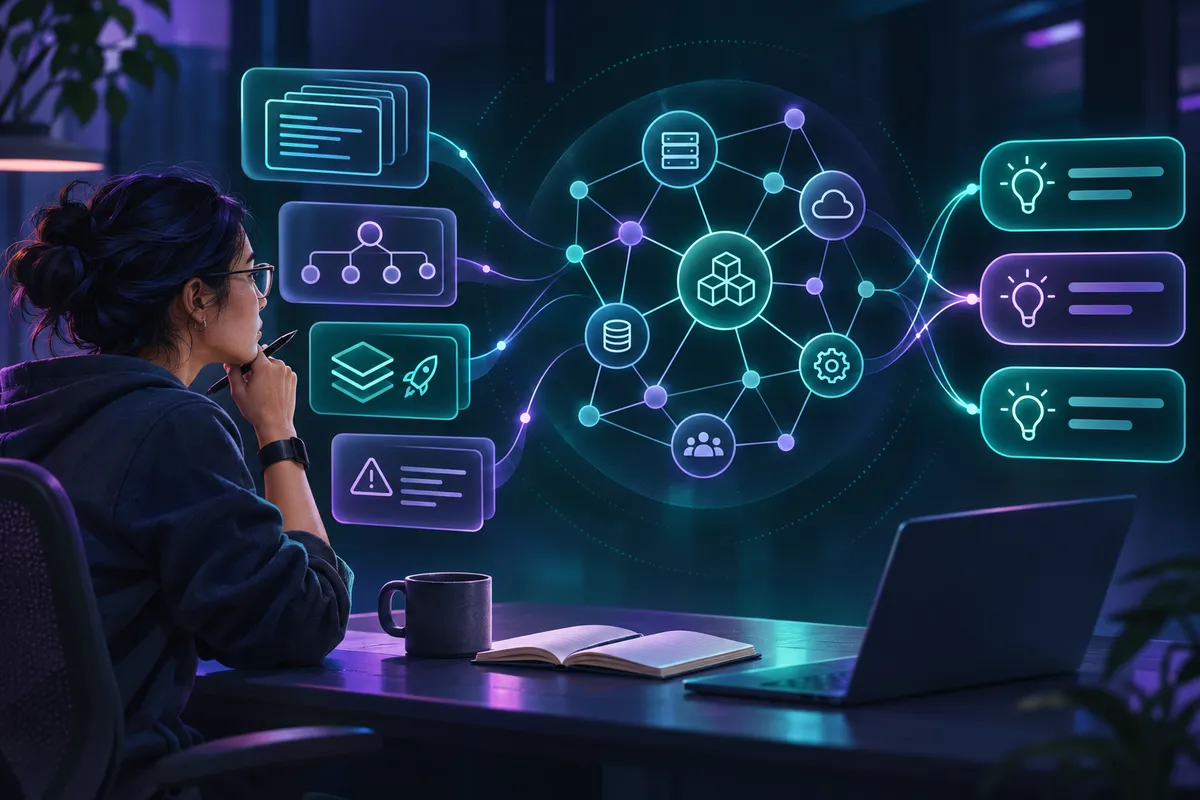
This pattern fits SRE, cloud operations, platform engineering, managed services and security operations teams whose investigations span monitoring, deployment, ticketing and ownership systems. You need a service catalog, identity and ownership directory, deployment history, alert and incident records, a graph or relational store capable of typed links, validation rules, read-only query tools and an approved model runtime.
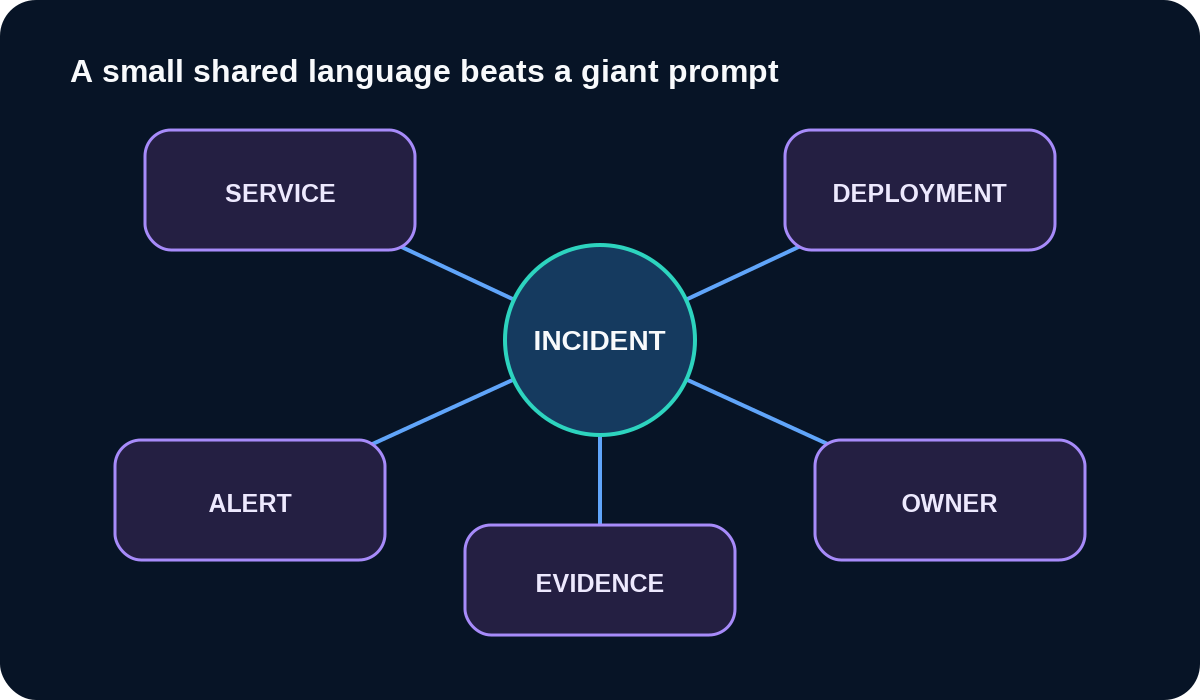
Begin with one service group and six entities: service, owner, deployment, alert, incident and evidence. Define stable IDs and relationship direction. An AI assistant may suggest links and rank evidence paths, but only validated records may become authoritative entities. It may not change production, suppress alerts, edit the service catalog or create an owner when none is known.
- System of record: service catalog, deployment platform, monitoring and incident system.
- AI role: normalize notes, propose typed links and draft ranked hypotheses with evidence paths.
- Human role: validate entities, resolve conflicts, approve remediation and update the ontology.
- Stop condition: ambiguous service identity, stale ownership, missing time window or unsupported causal link.
Step 1: establish identity and relationship contracts
Give every service, deployment and incident a stable identifier. Define allowed relationships such as deployment-affects-service, alert-observed-on-service and owner-responsible-for-service. Validate types, cardinality, time bounds and catalog membership before accepting a proposed triple. Netflix describes using RDF, OWL, SHACL and SPARQL, but a small team can implement the same discipline with relational tables and schema checks.
Keep provenance on every link: source record, collector, collection time, transform version and confidence class. Do not turn a string found in a log or chat into a service identity without validation. Cap graph expansion so a noisy dependency map cannot pull an entire estate into one incident.
Step 2: preserve human reasoning as evidence, not truth
Incident conversations contain hypotheses, rejected ideas and mitigation decisions that telemetry cannot express. Extract them into typed records with author, time, status and source span. A rejected cause should stay rejected; a tentative statement should not become an observed fact. Redact secrets and personal data before model processing and apply retention rules to derived records.
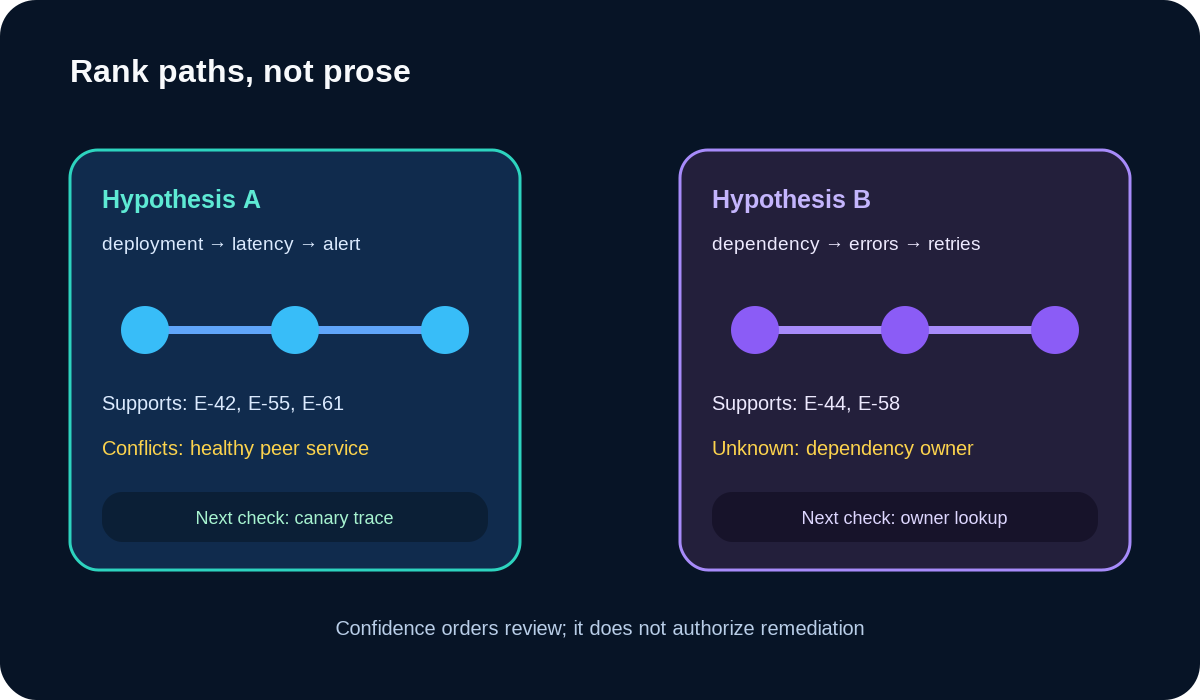
Example prompt: “For incident INC-442, use only graph records G-1000 through G-1180 and read-only tools. Return observed facts, up to three ranked causal paths, supporting and contradicting record IDs, missing relationships and the next least-invasive check. Treat chat statements as hypotheses unless a validated record confirms them. Do not change production, suppress alerts, invent an owner or claim resolution.”
Step 3: make specialist agents share one contract
Separate collectors by domain: deployment changes, metric anomalies, failed traces, security alerts and ownership. Each may propose typed records, but all must use the same IDs, validation and provenance. Netflix’s AutoRCA design uses specialist agents around a shared graph and a correlation engine that examines 13 signal types. That is a vendor implementation detail, not a minimum requirement.
Require deterministic checks for timestamps, entity existence and relationship rules. The model may summarize a path; it should not calculate the only confidence score. Preserve the contributing records so an engineer can follow the path without trusting the prose.
Step 4: pilot in shadow mode and keep remediation separate
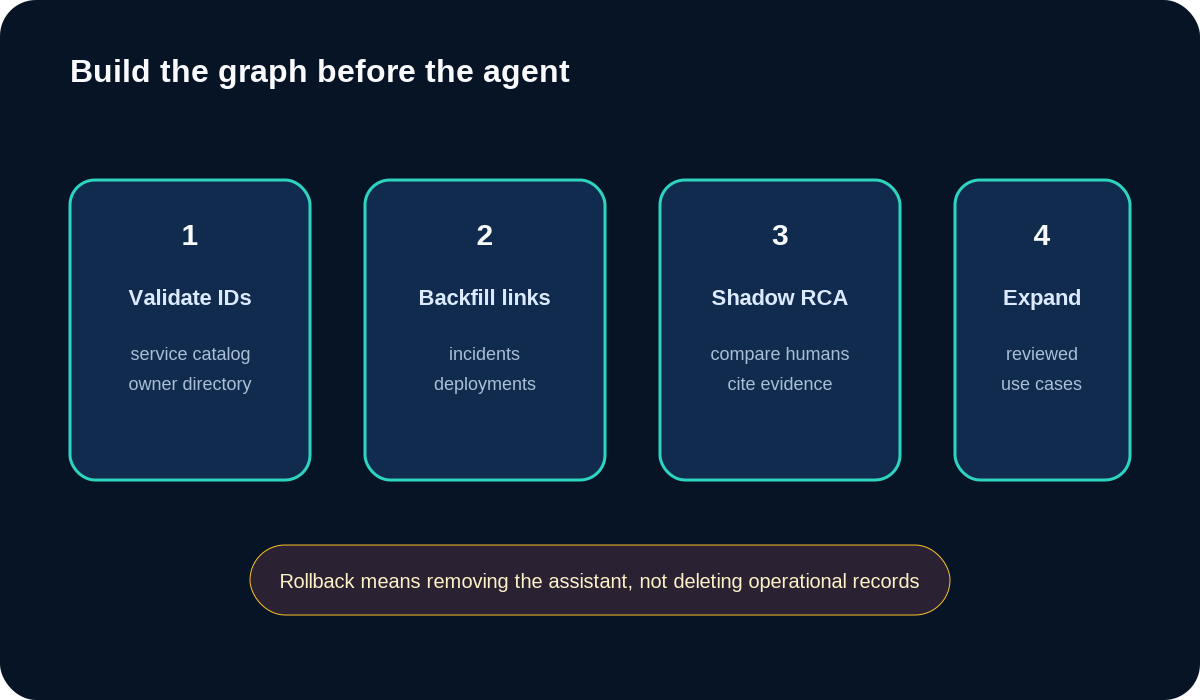
Backfill resolved incidents, compare the graph with the post-incident record and measure wrong identities, missing relationships, unsupported paths and reviewer correction time. Then run shadow investigations beside the existing on-call process. Do not use Netflix’s scale or narrative as your acceptance threshold.
The review packet should include the incident window, affected services, candidate paths, confidence basis, contradictions, unknowns, proposed verification, risk and approver. Any remediation must flow through the existing change system. Rollback means disabling the assistant while preserving authoritative operational records.
Human approval and realistic limitations
A graph can encode a wrong service identity with impressive consistency. Missing collectors, stale ownership, fuzzy matching and model summaries can all create plausible but false paths. Correlation is not causation, and a confidence threshold does not prove a root cause. The graph also concentrates sensitive topology and incident history, so its access controls and retention deserve the same scrutiny as the underlying systems.
The reviewed sources do not provide independent accuracy benchmarks, implementation cost, false-positive rates or a public Netflix product. This is an internal engineering pattern. Use it to improve evidence assembly, not to imply that autonomous remediation is available or safe.
Why this topic was selected
A focused Firecrawl search on November 13 for “Netflix ontology driven observability AI AutoRCA November 2026” returned current InfoQ coverage and the October 16 Netflix primary post. The new independent article shows renewed practitioner attention, while the older primary source supplies the necessary technical detail. Search placement is only a current-interest signal, not proof of Google rank, search volume or traffic.
Put the insight into practice.
Deep Security helps organizations assess risk, validate controls, and build a practical plan to strengthen their defenses.
Talk with Deep Security